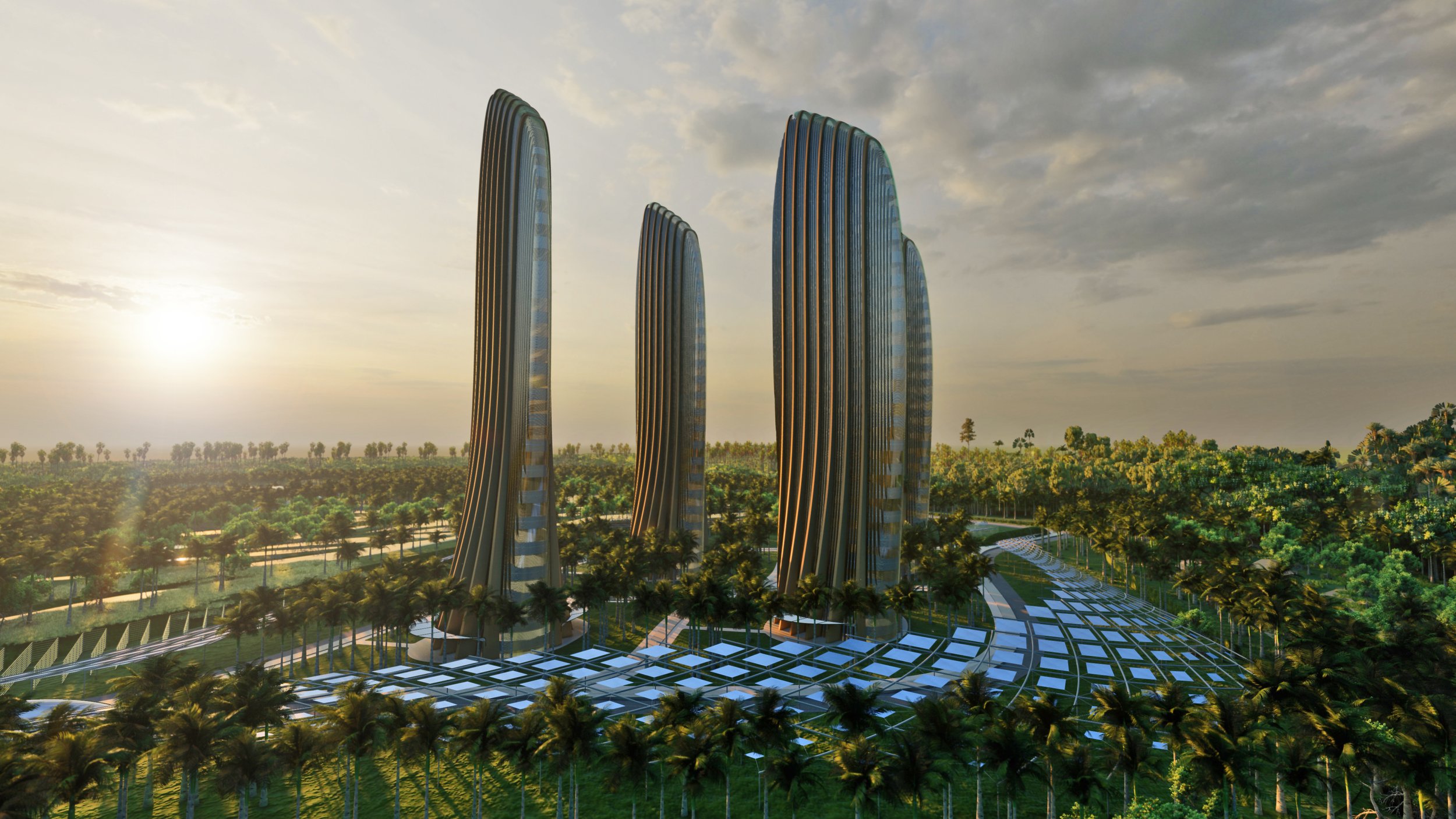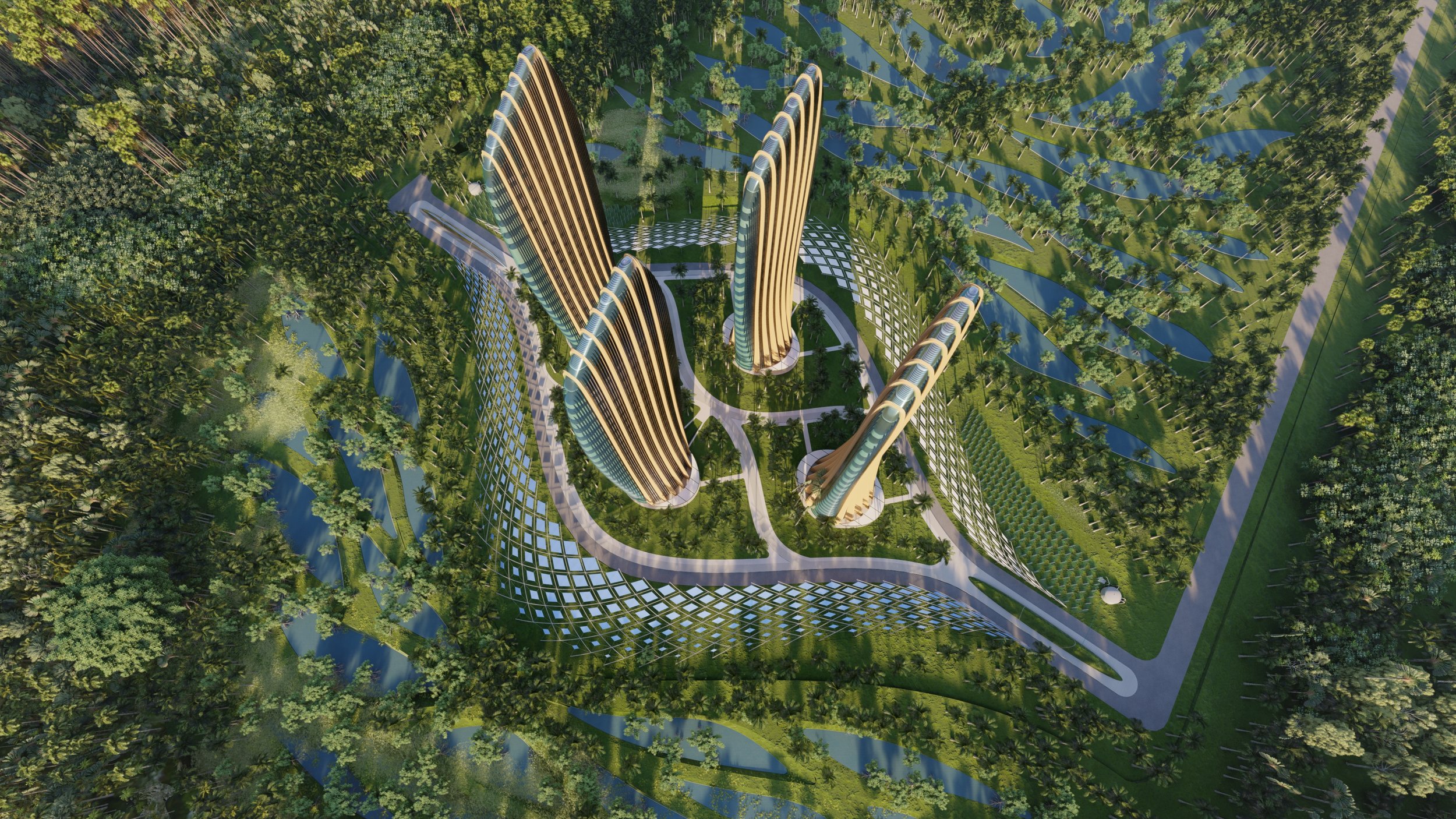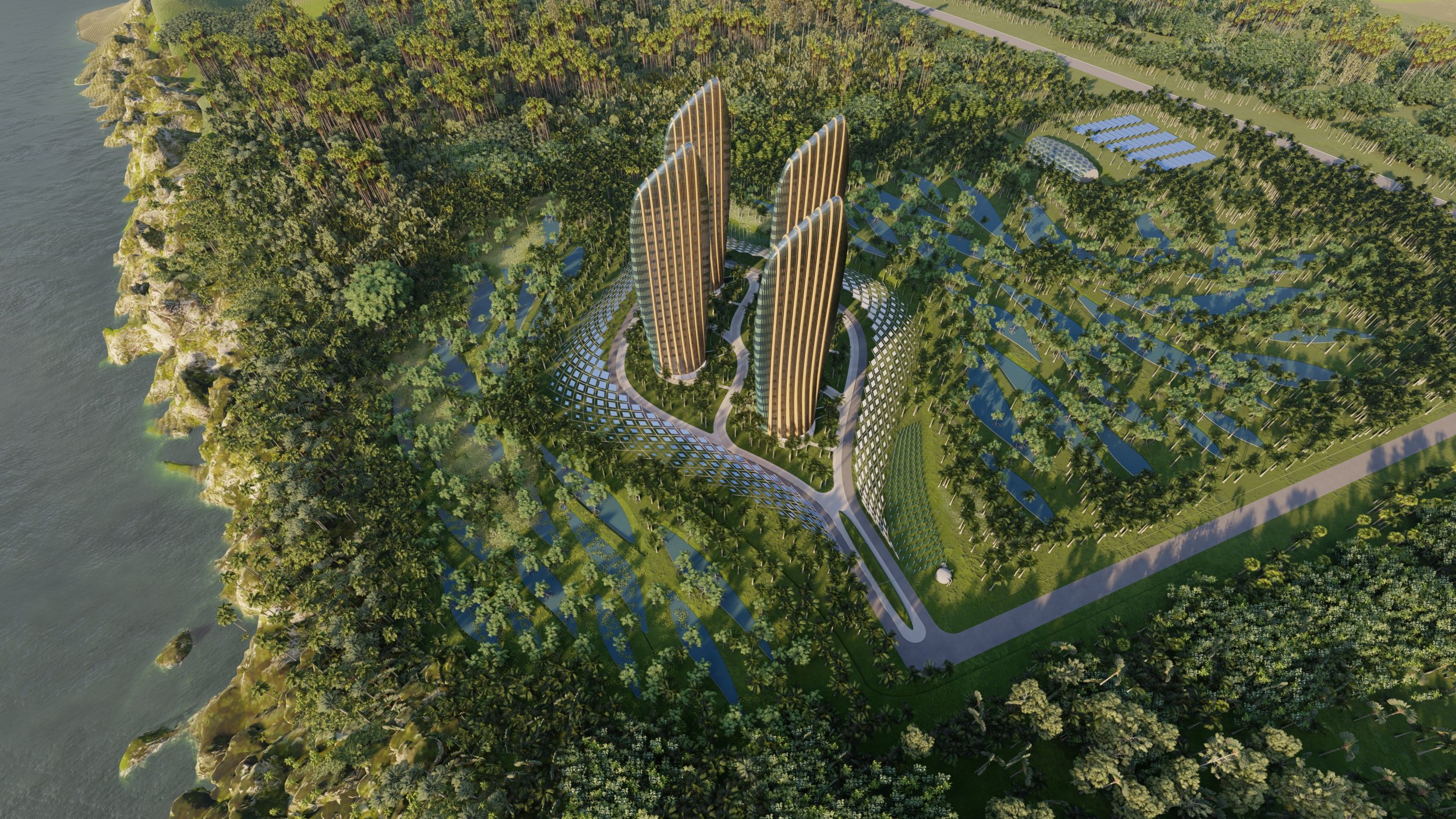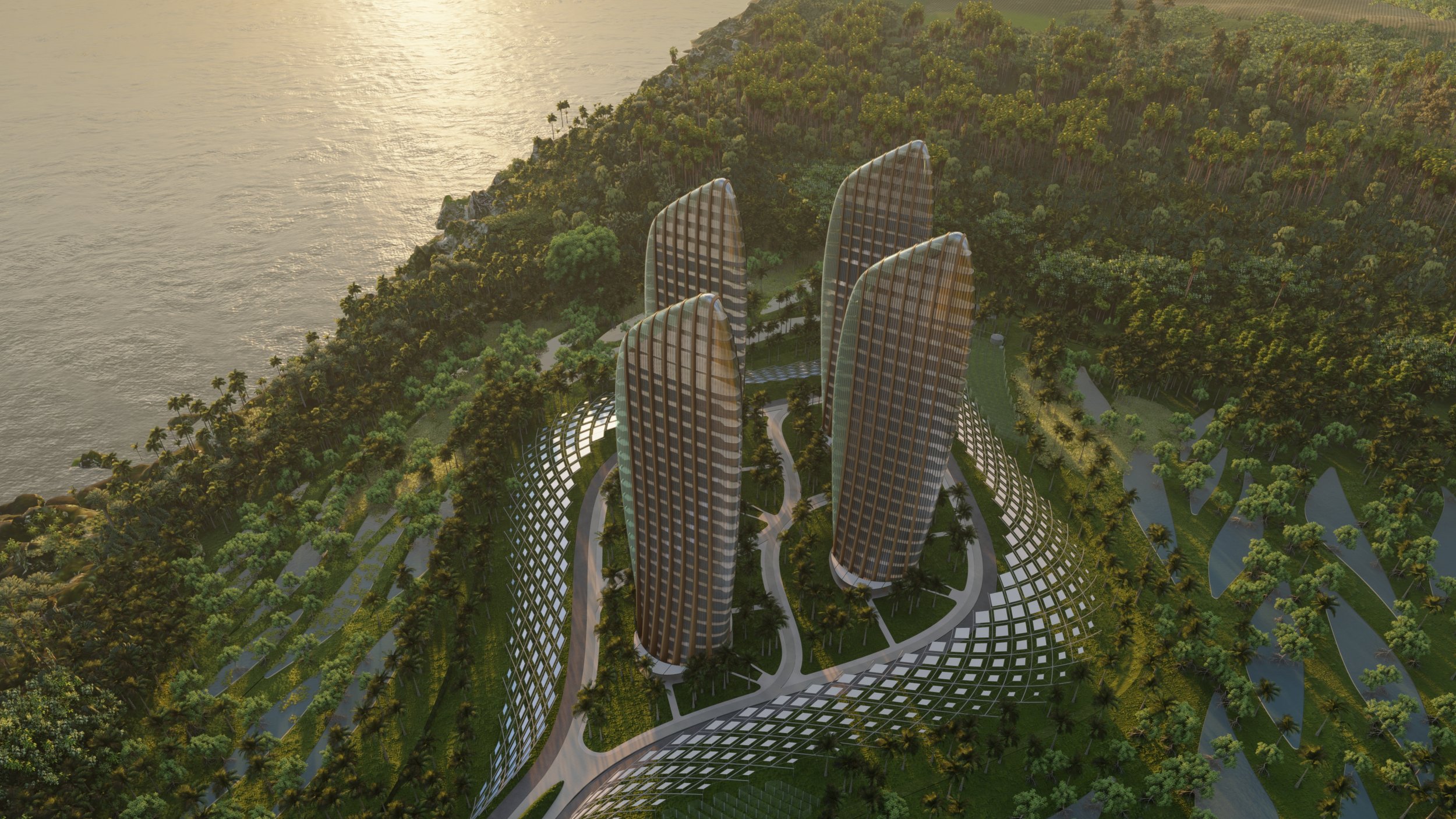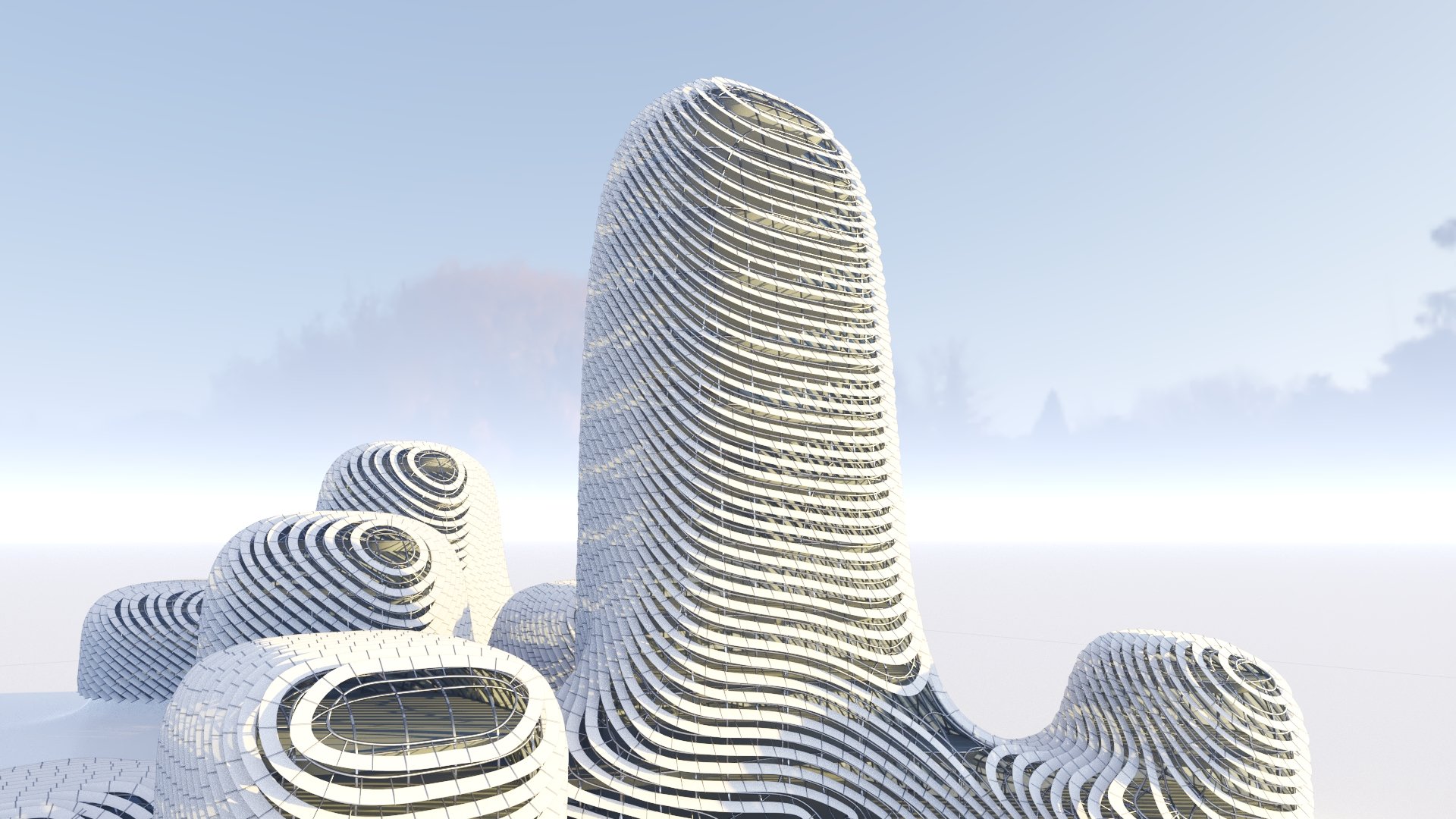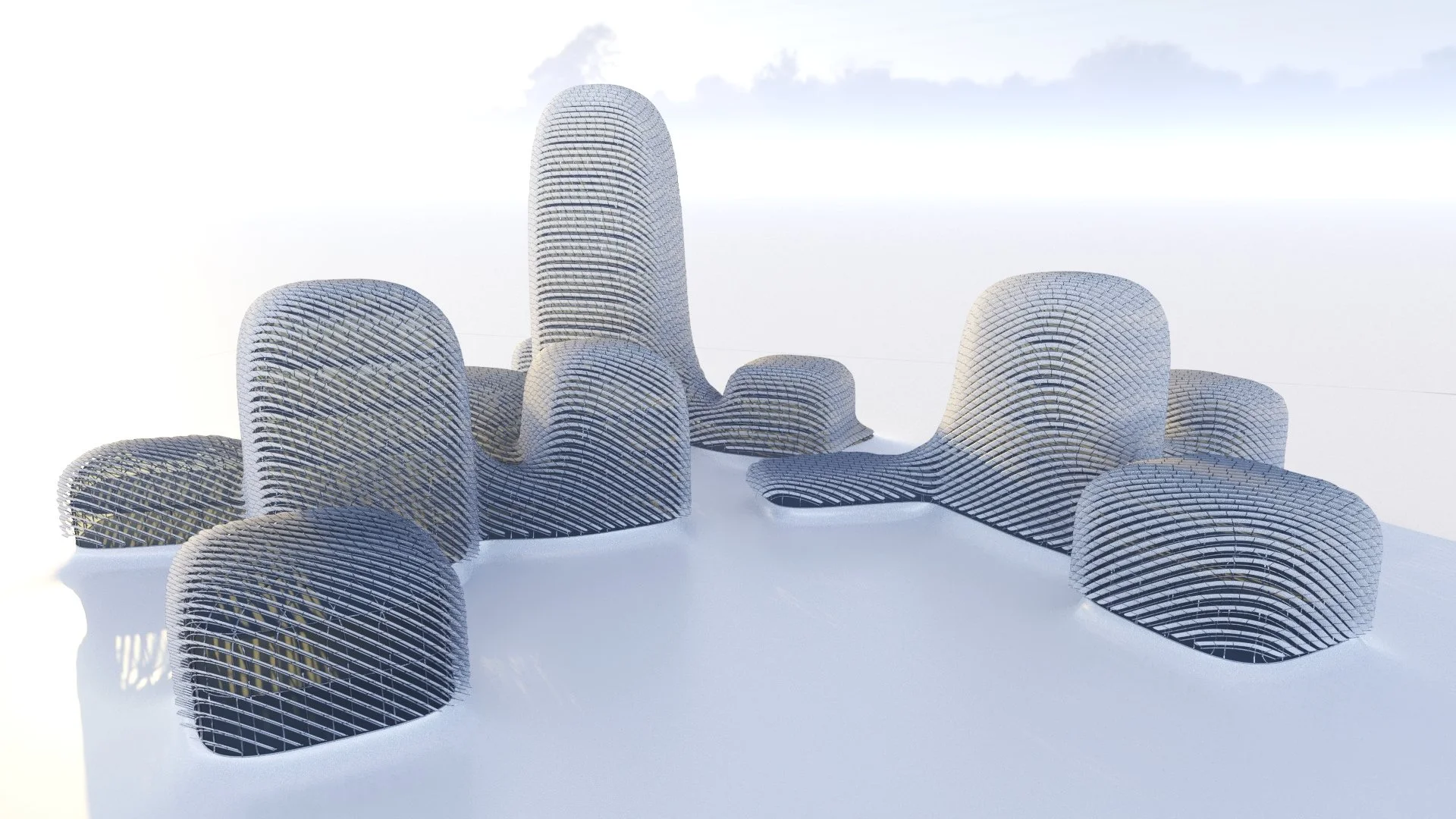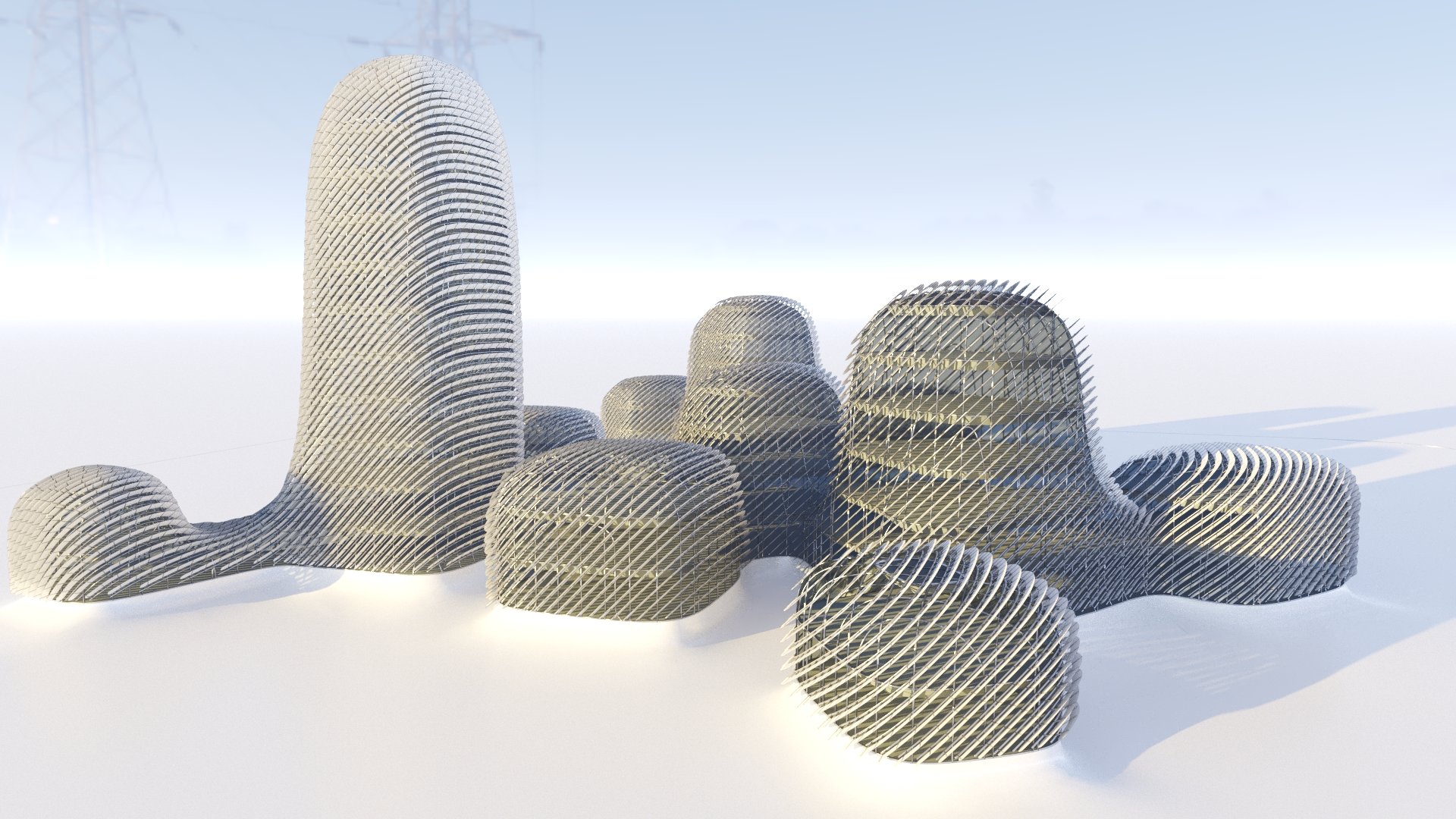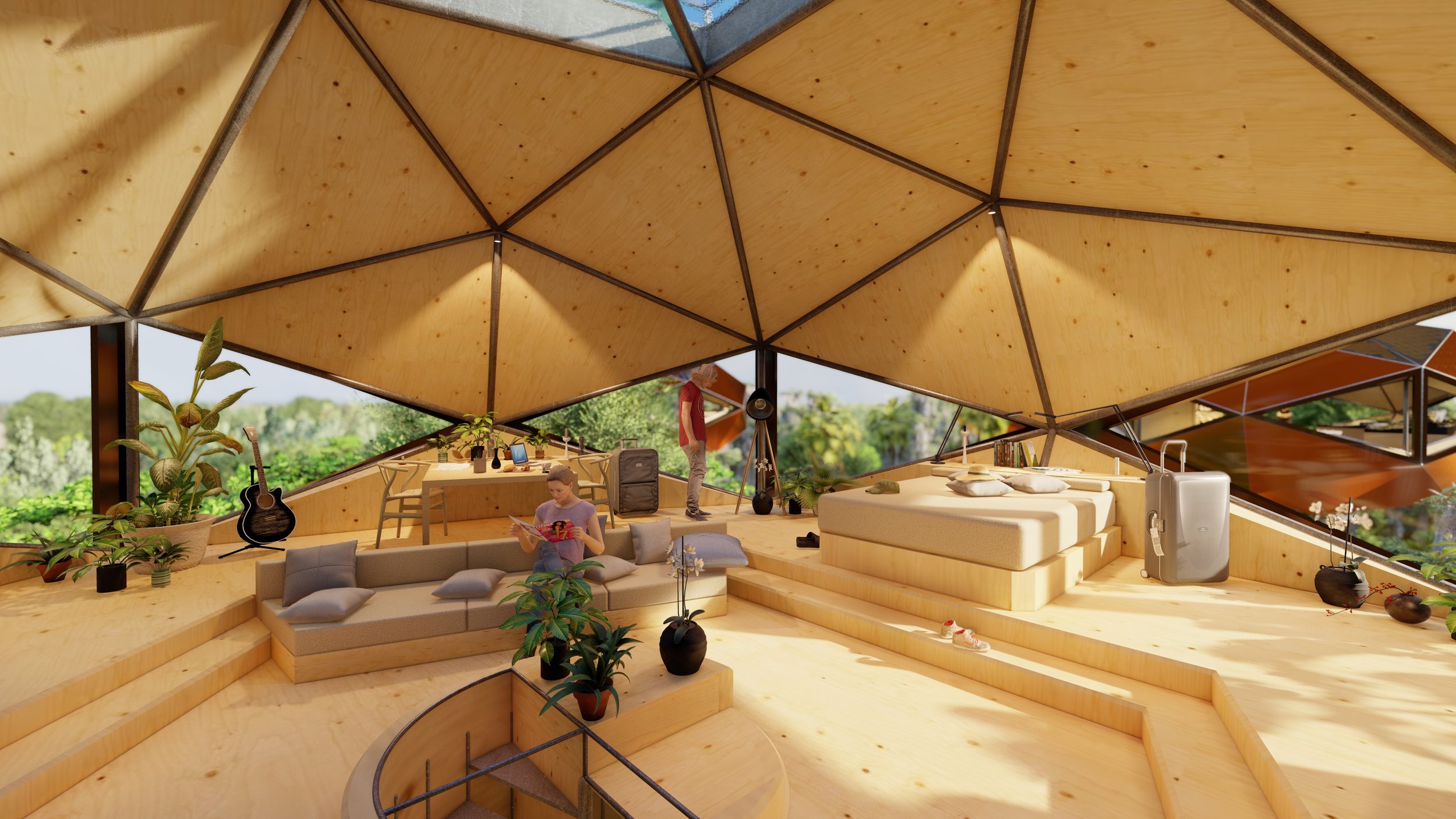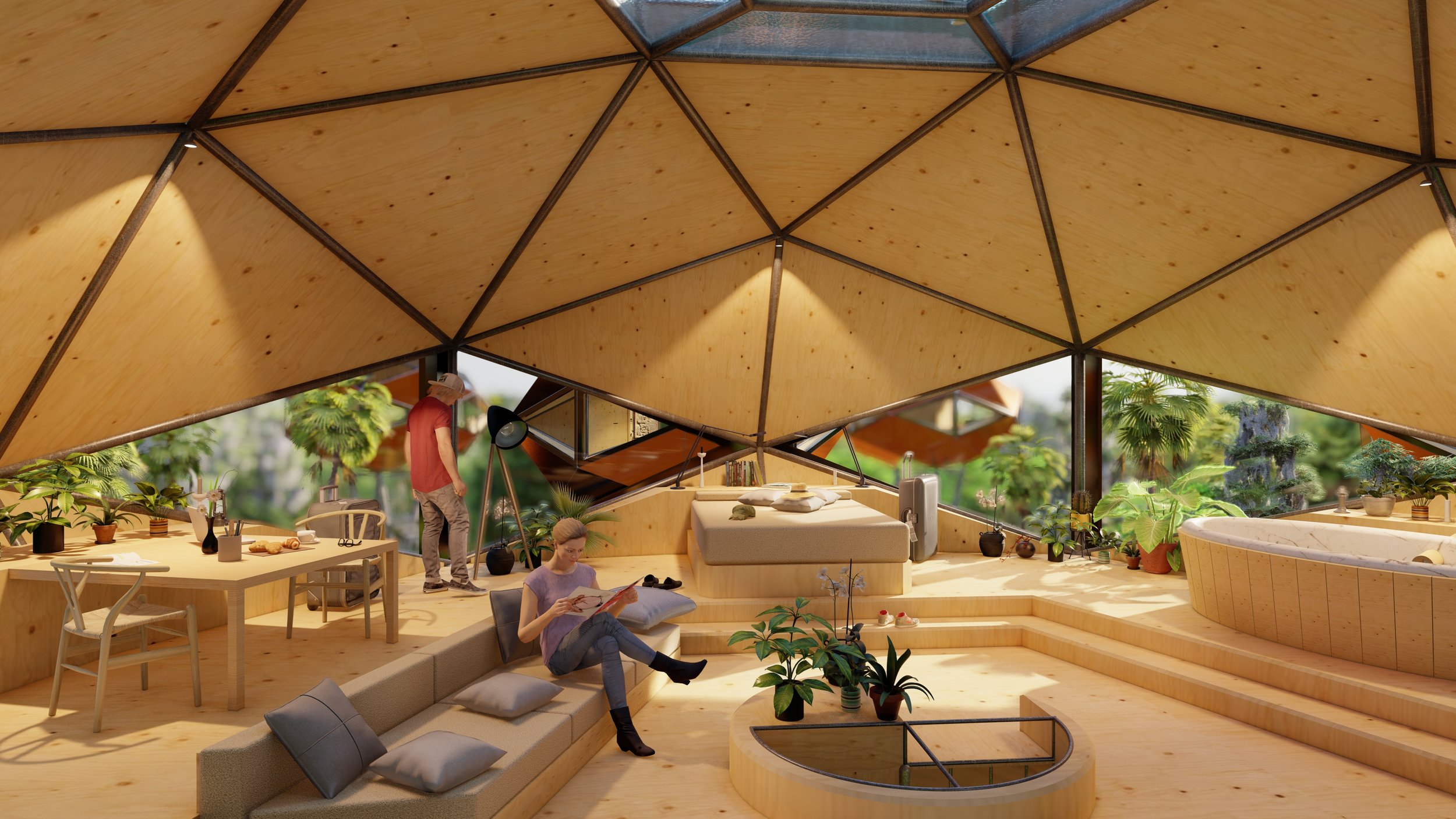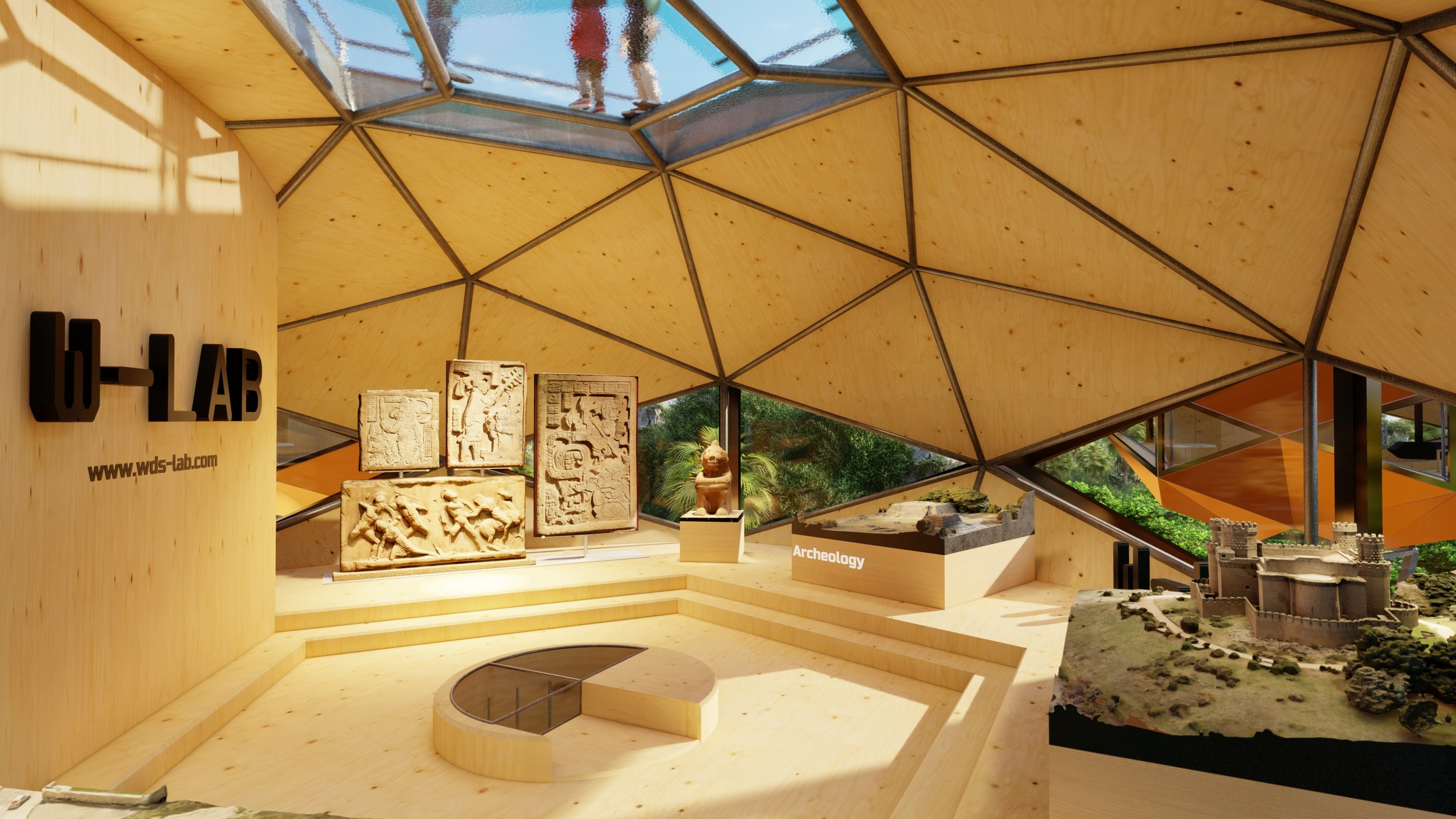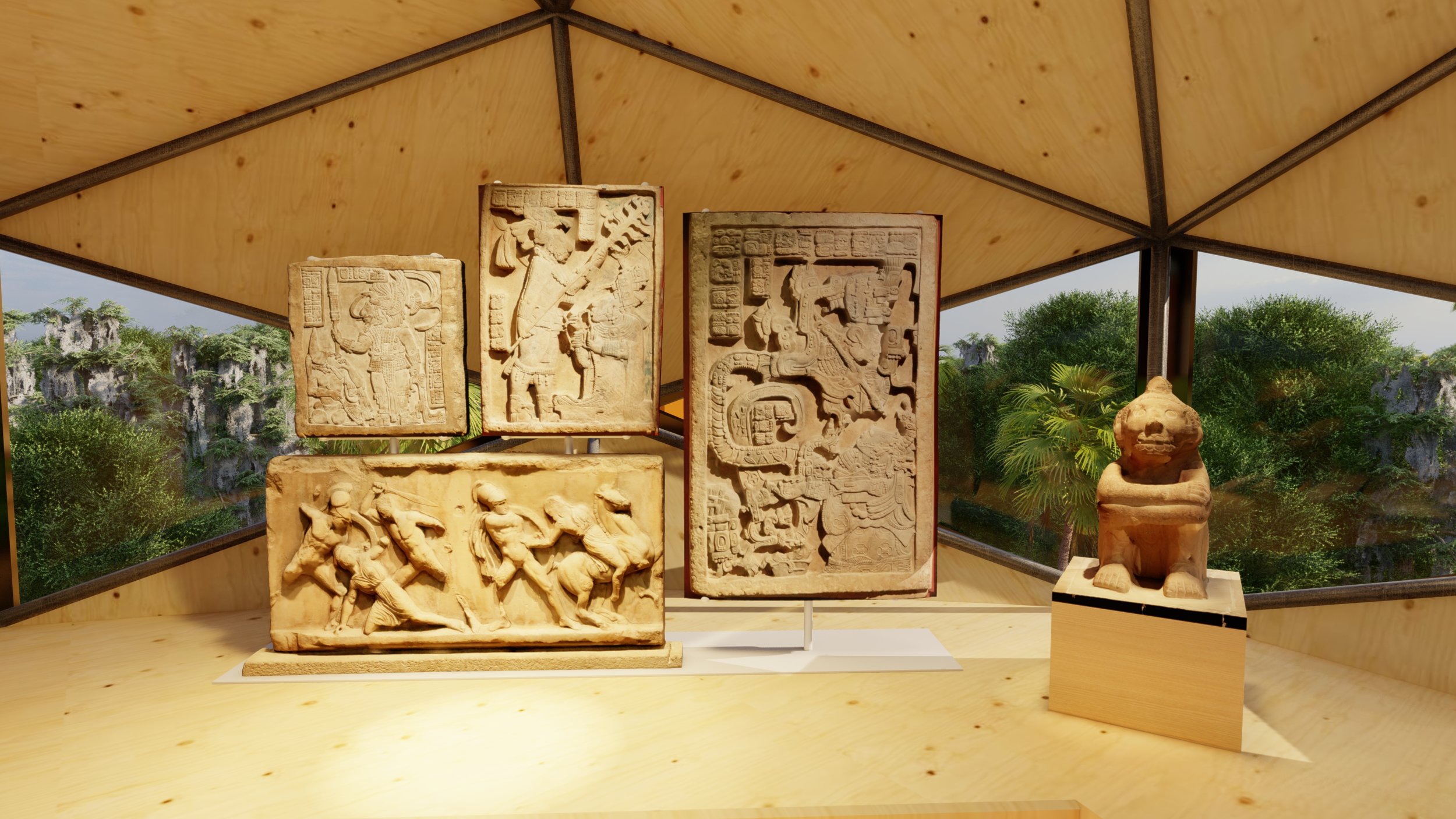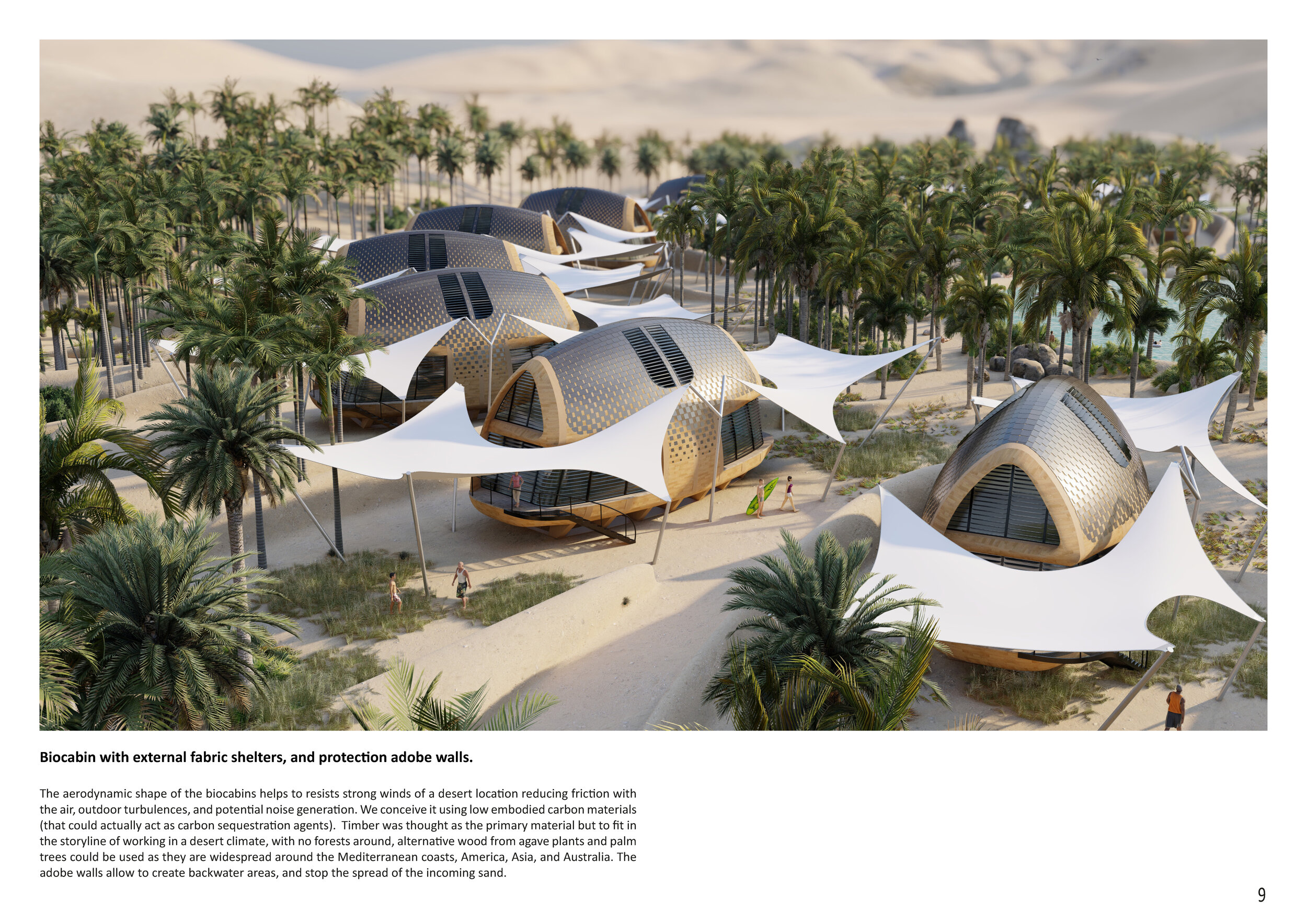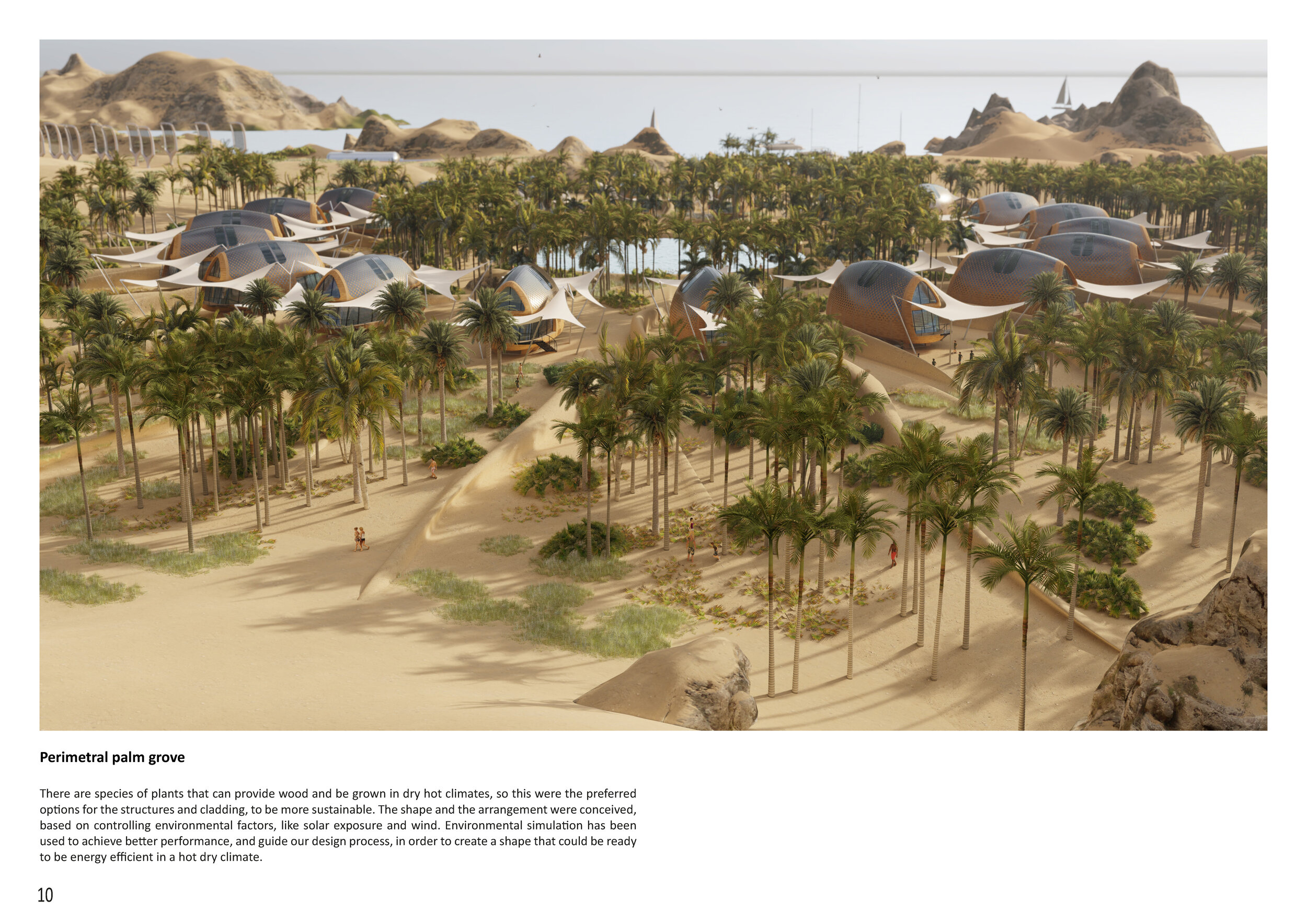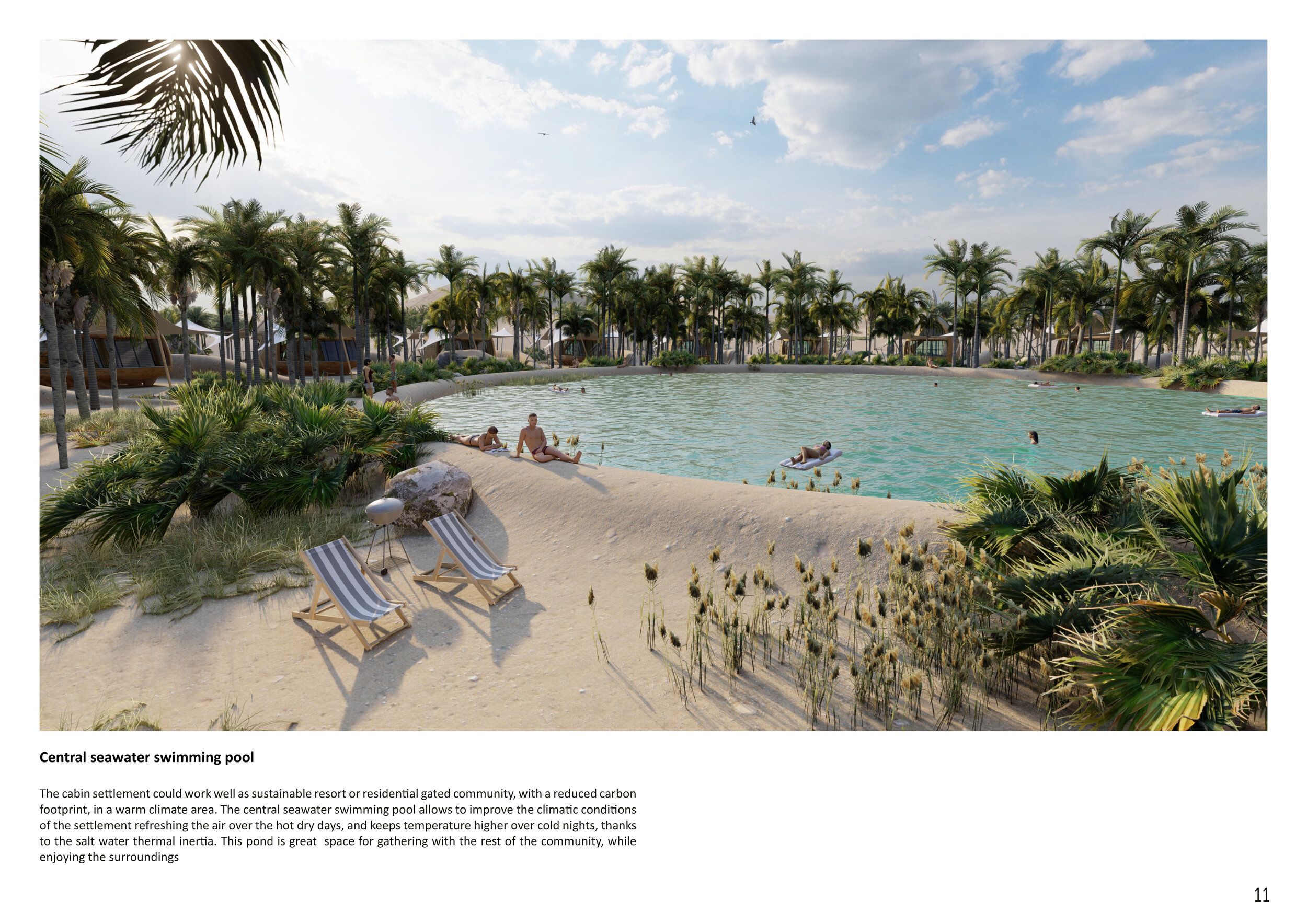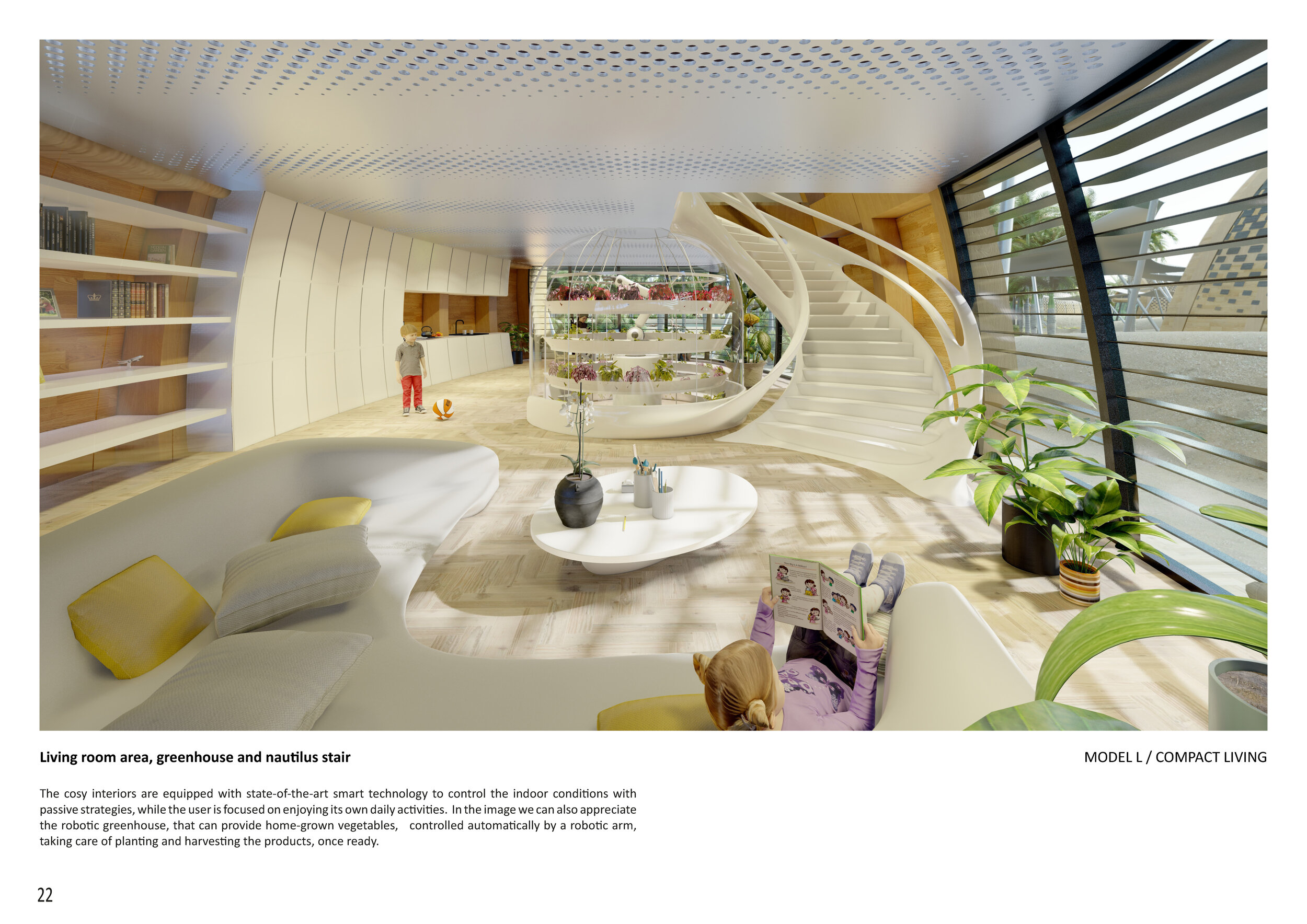
Hyperborea

Hyperborea, the New Garden City

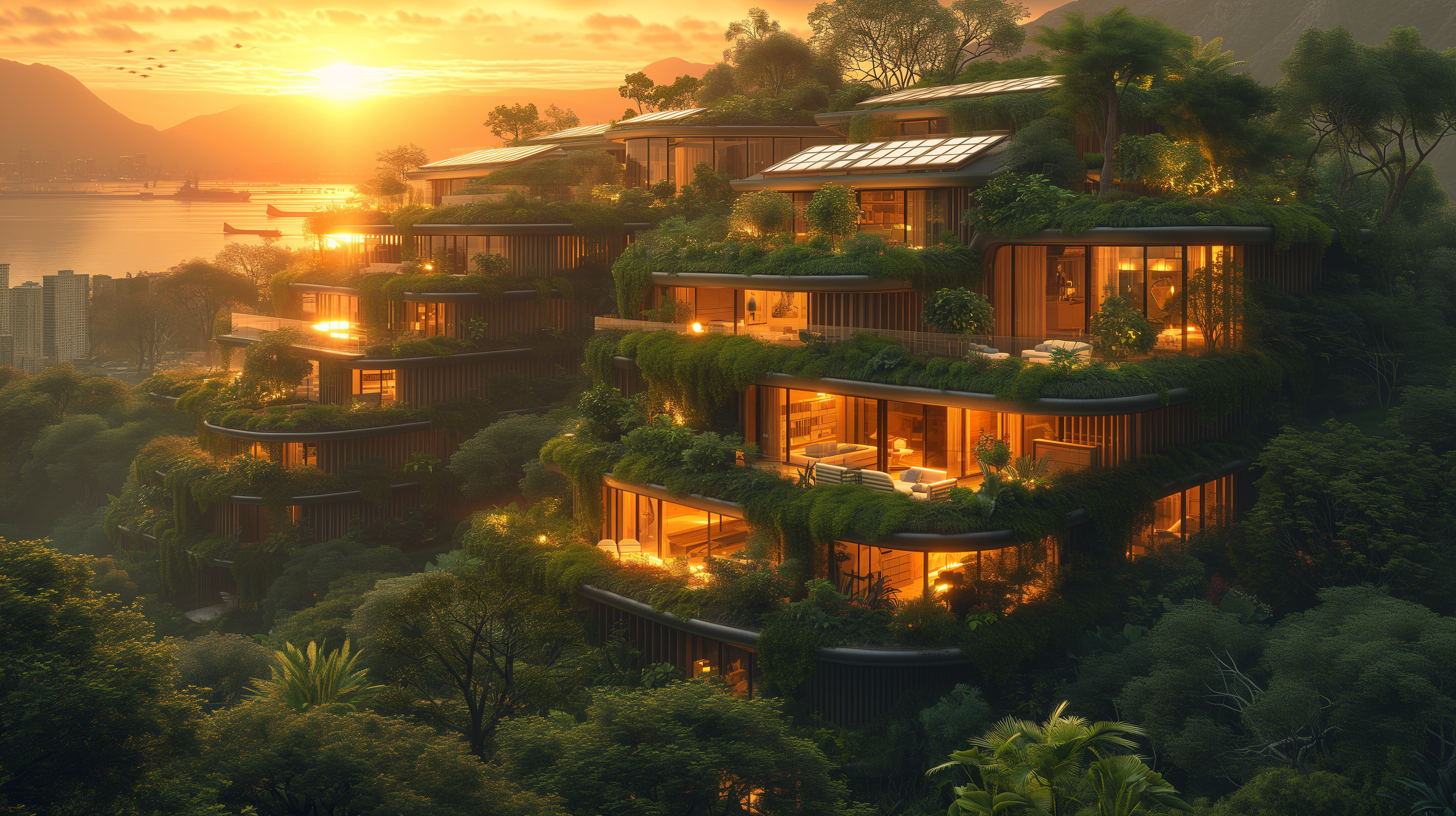
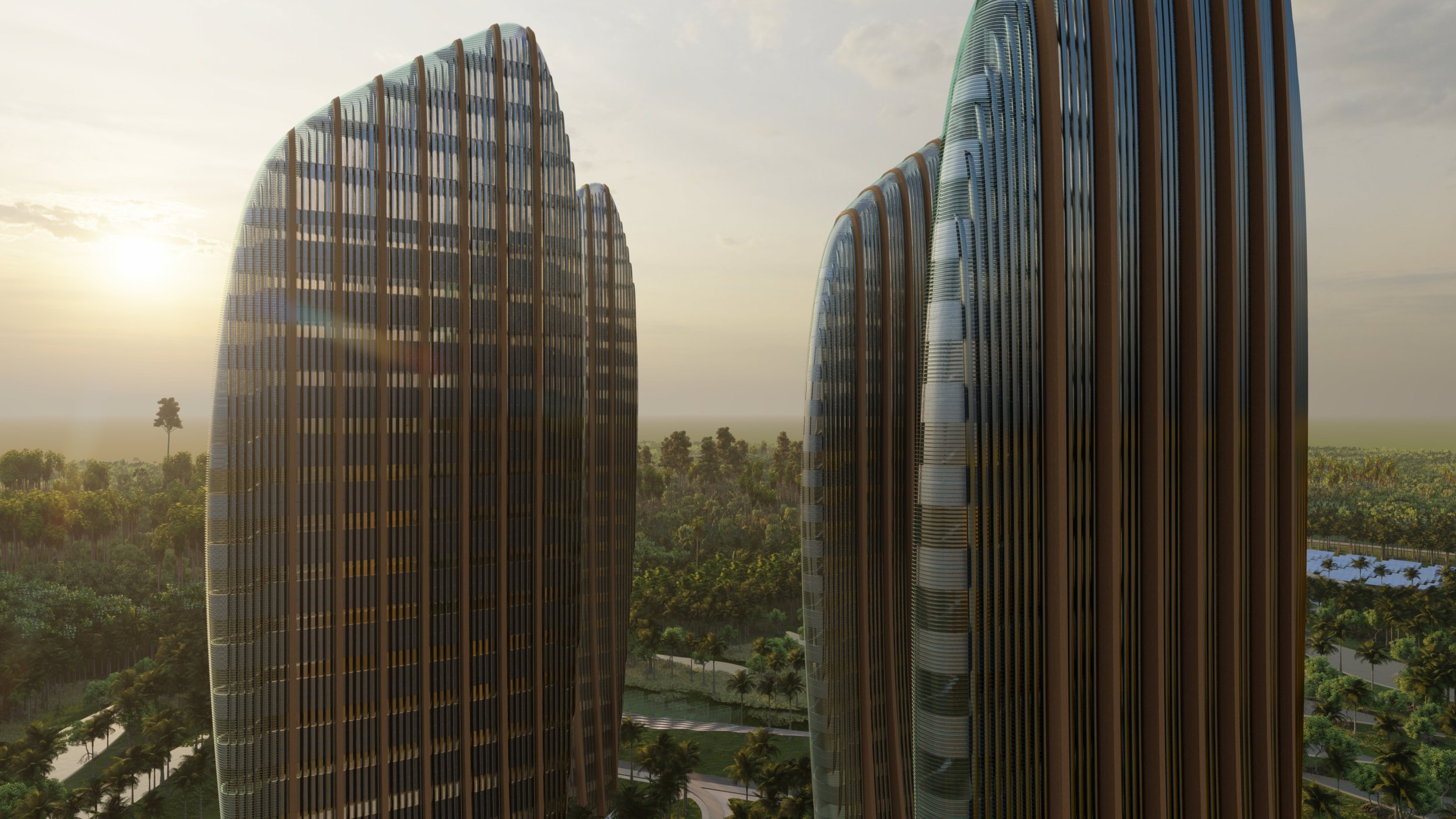
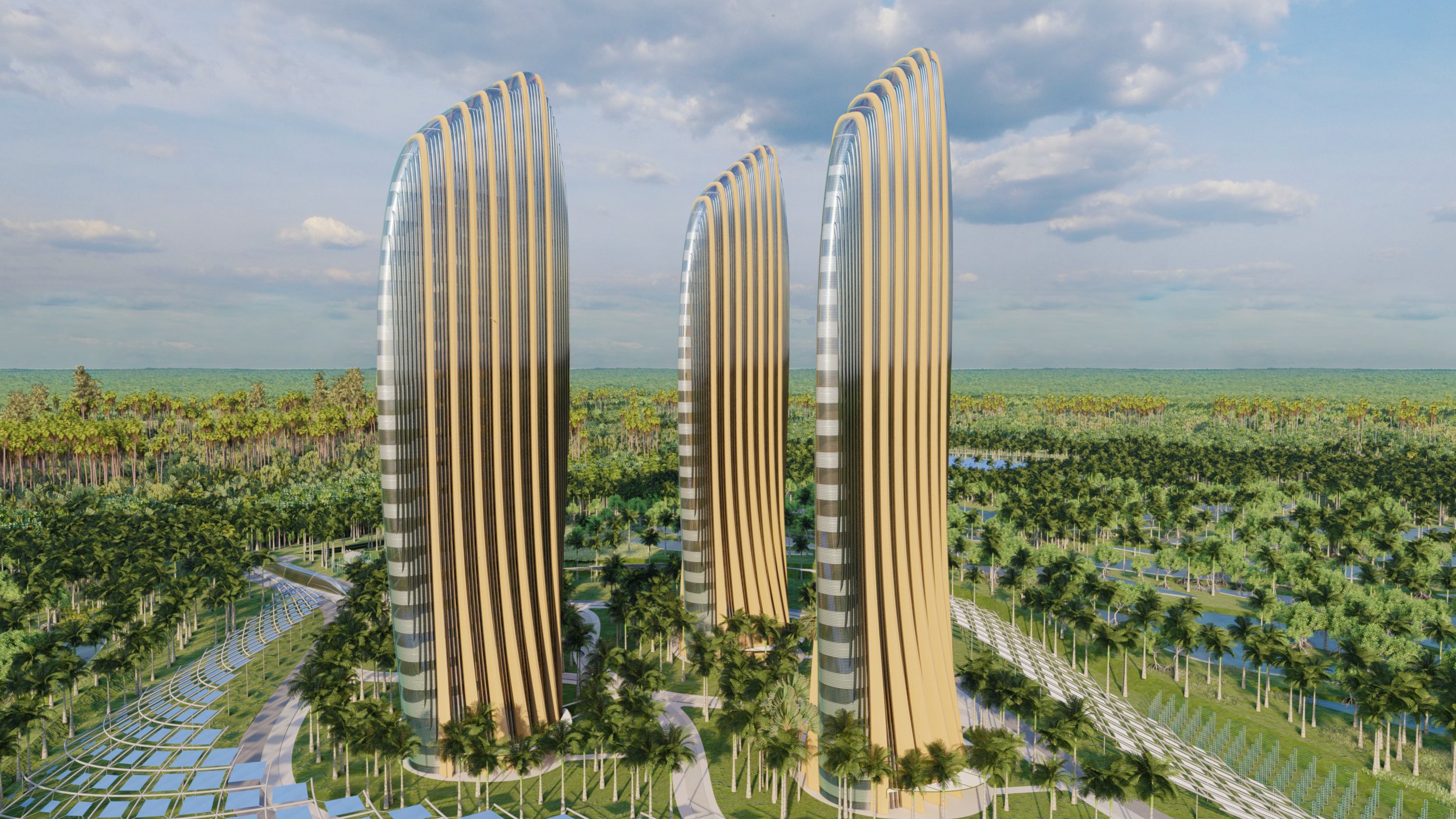
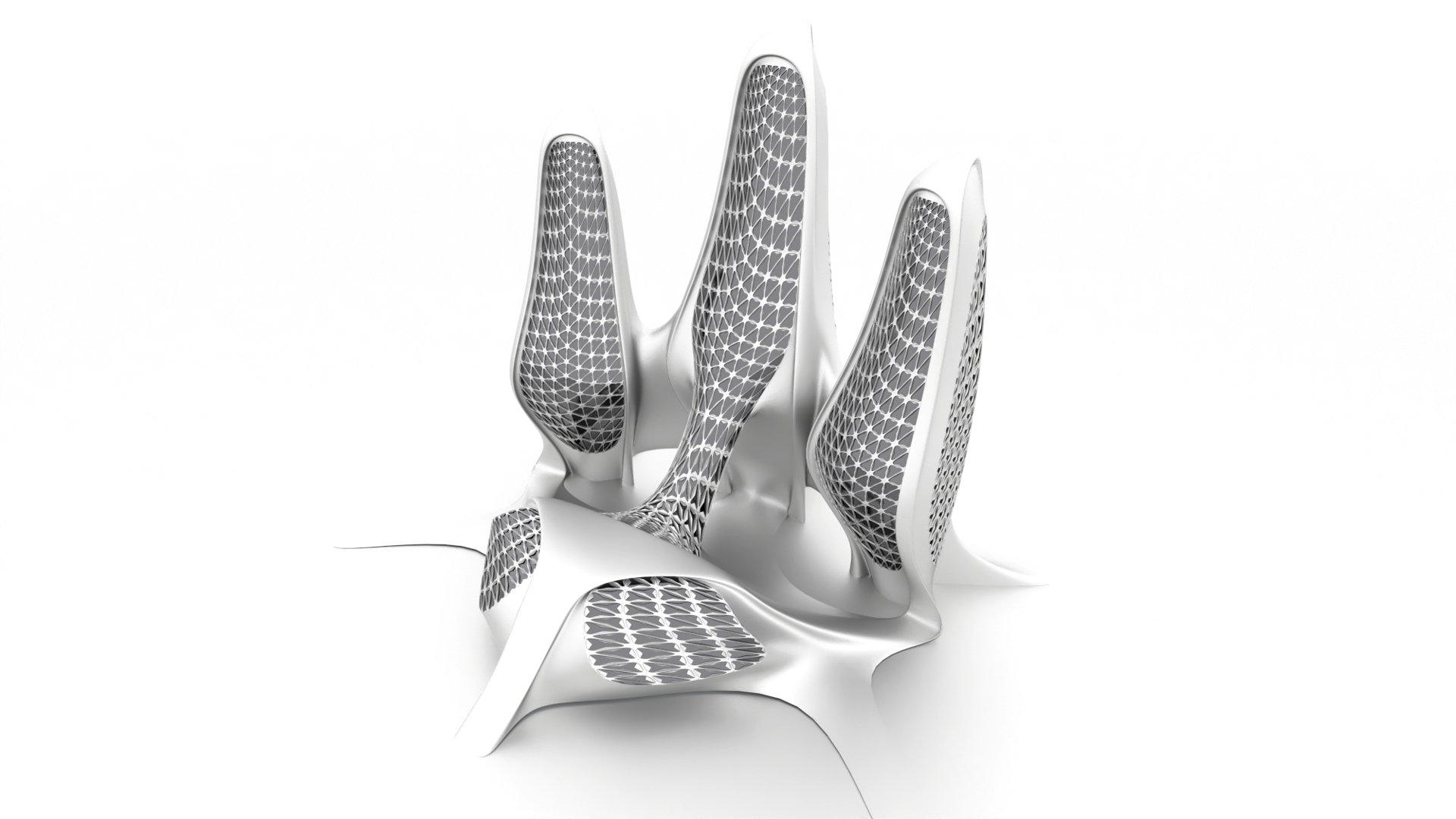
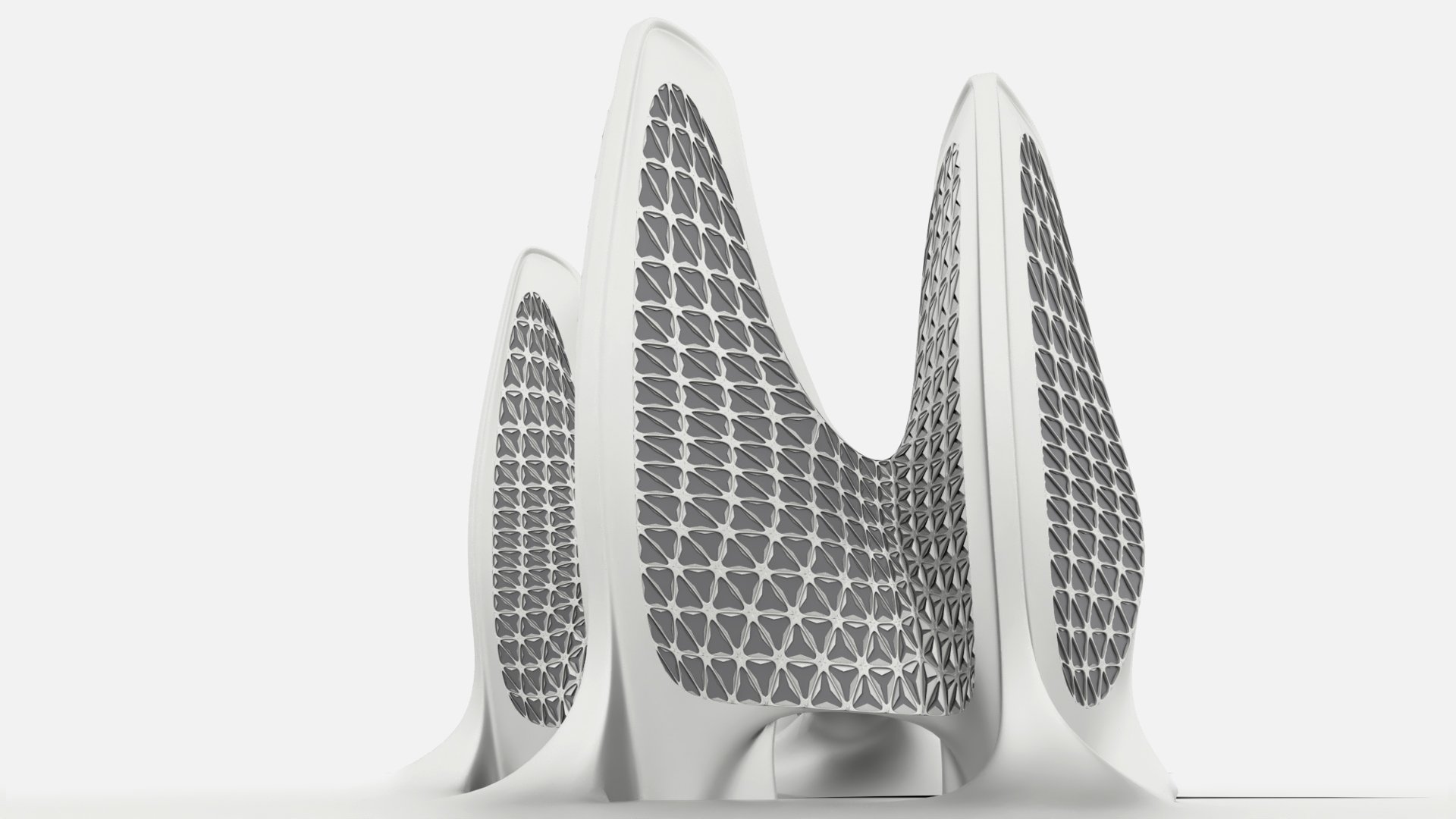
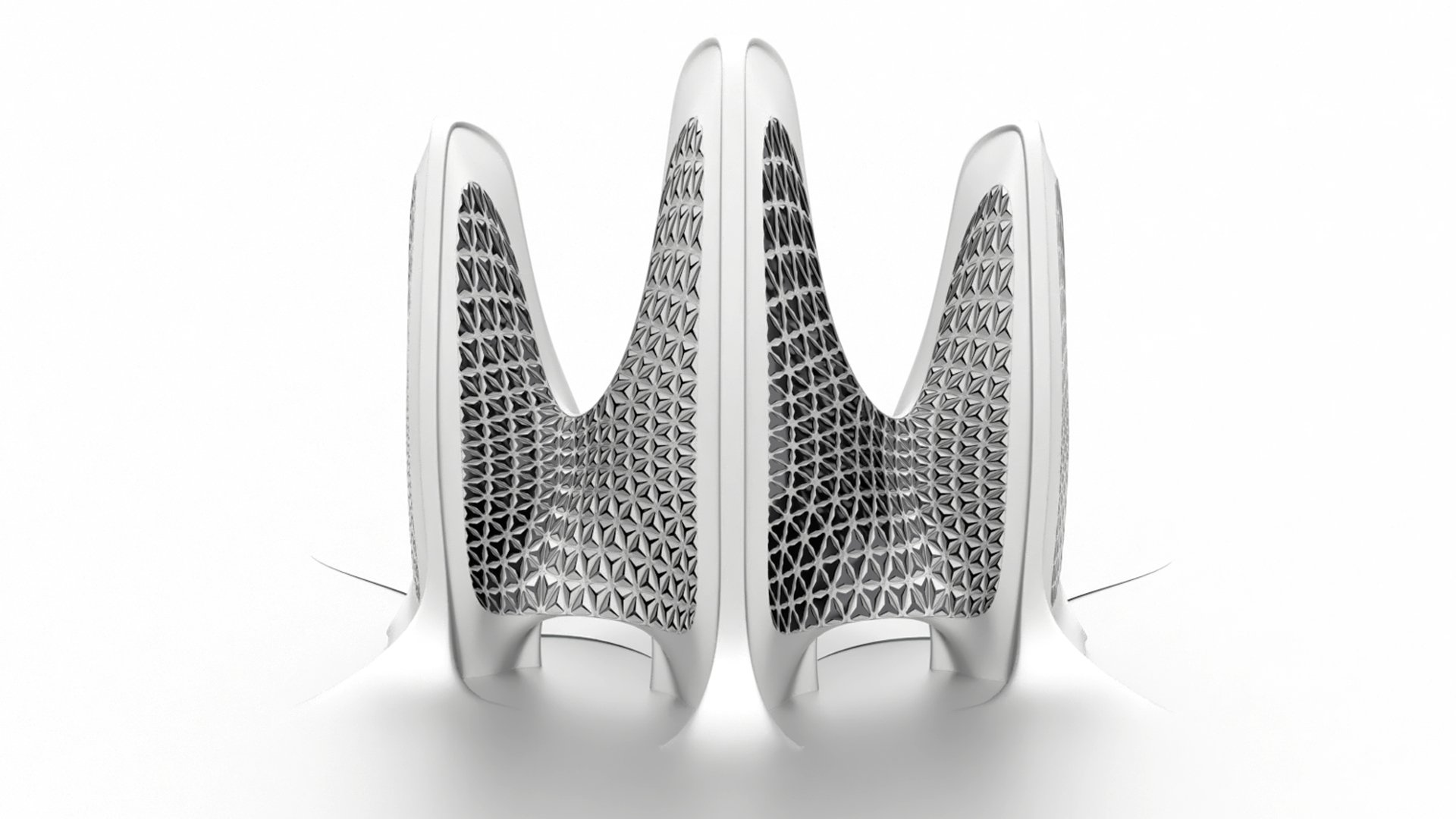
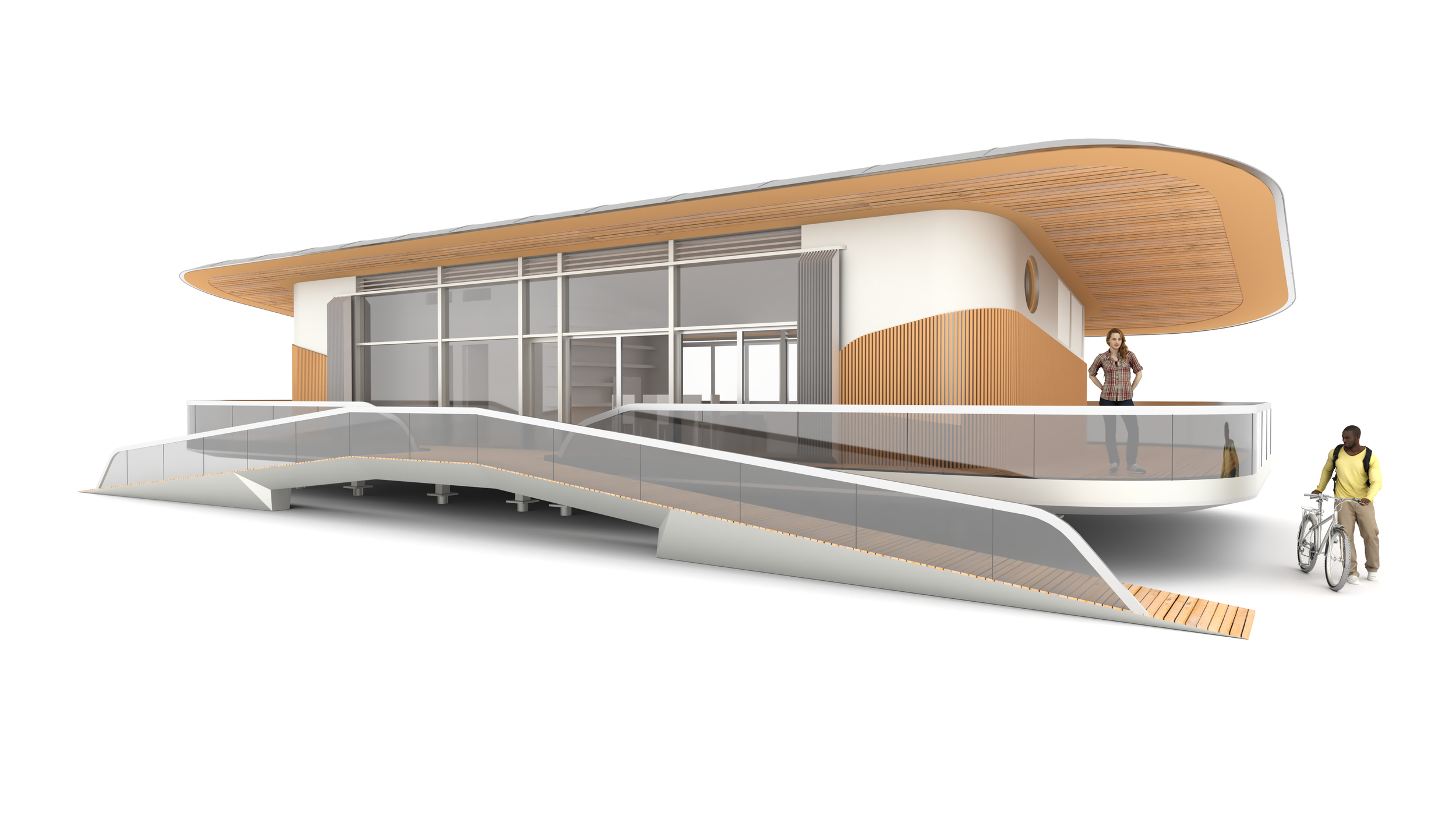
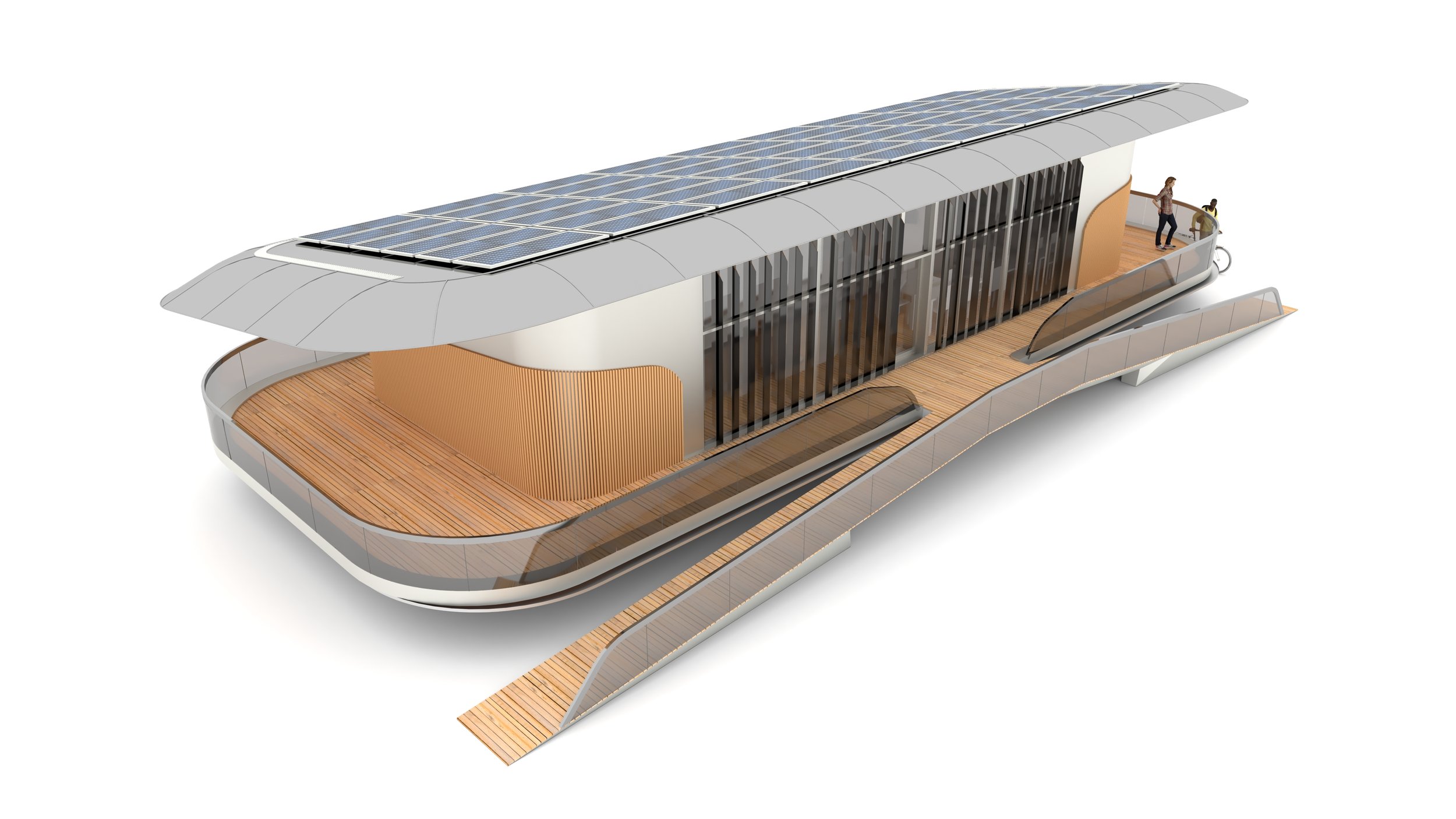
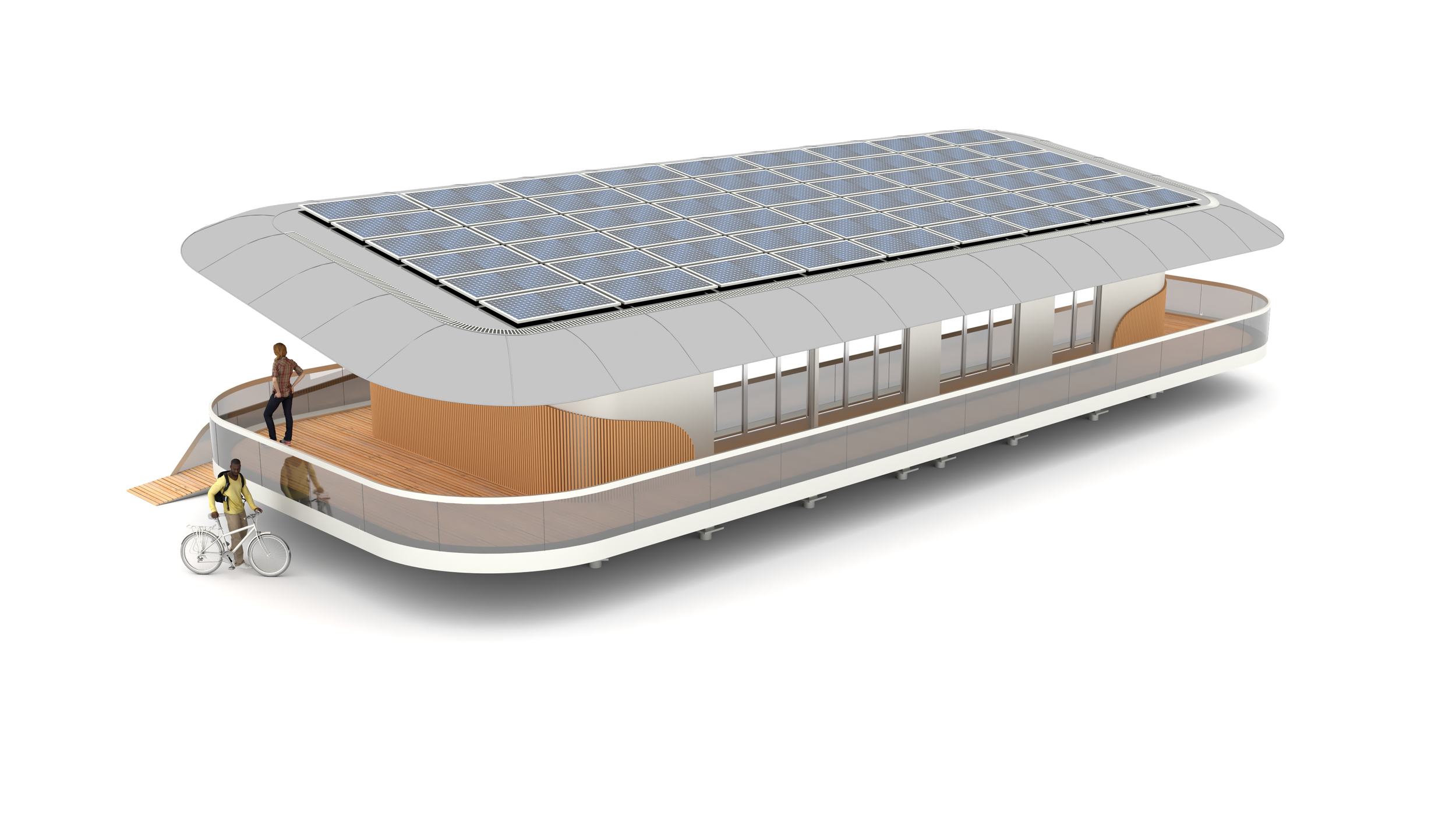
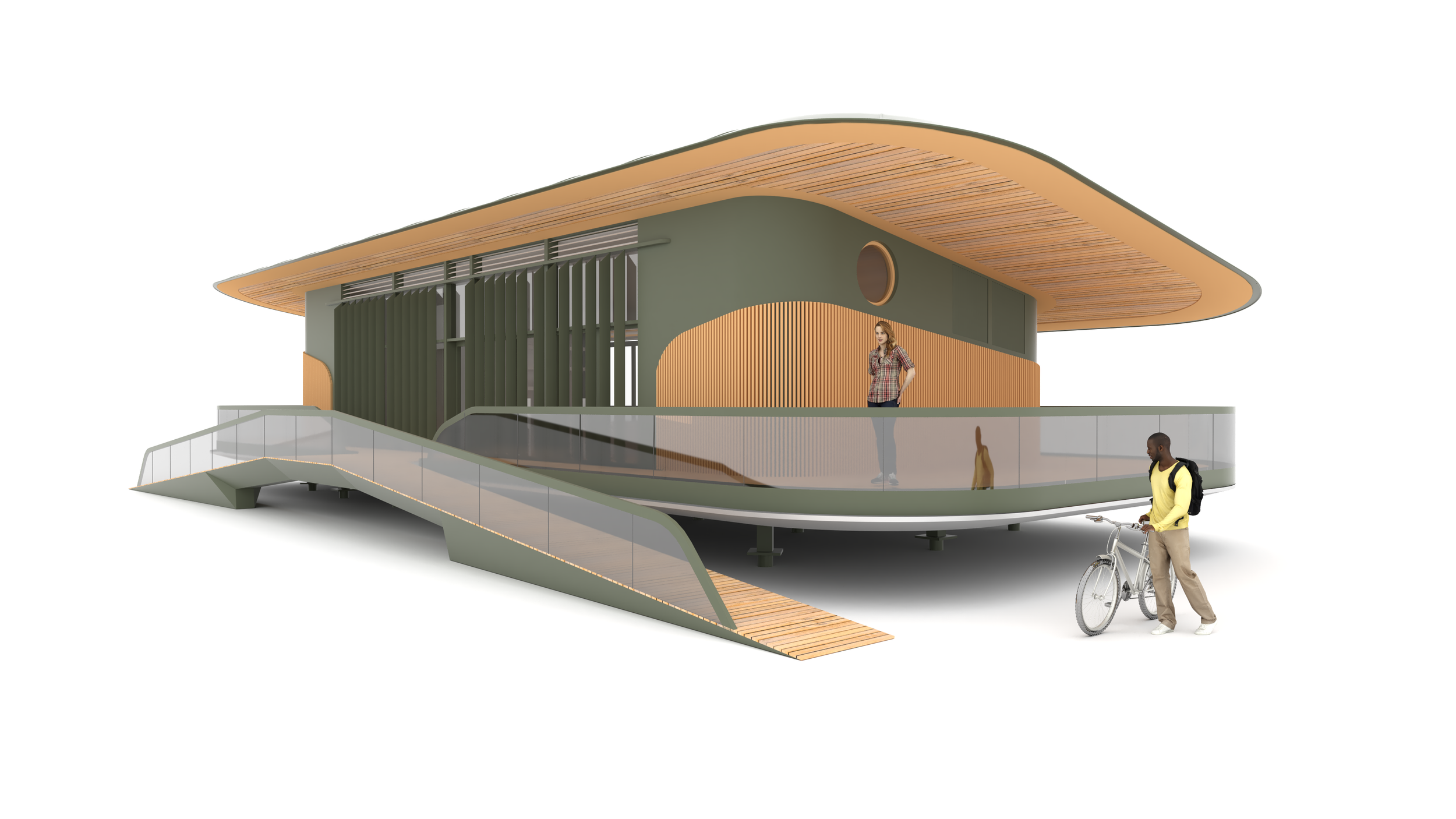
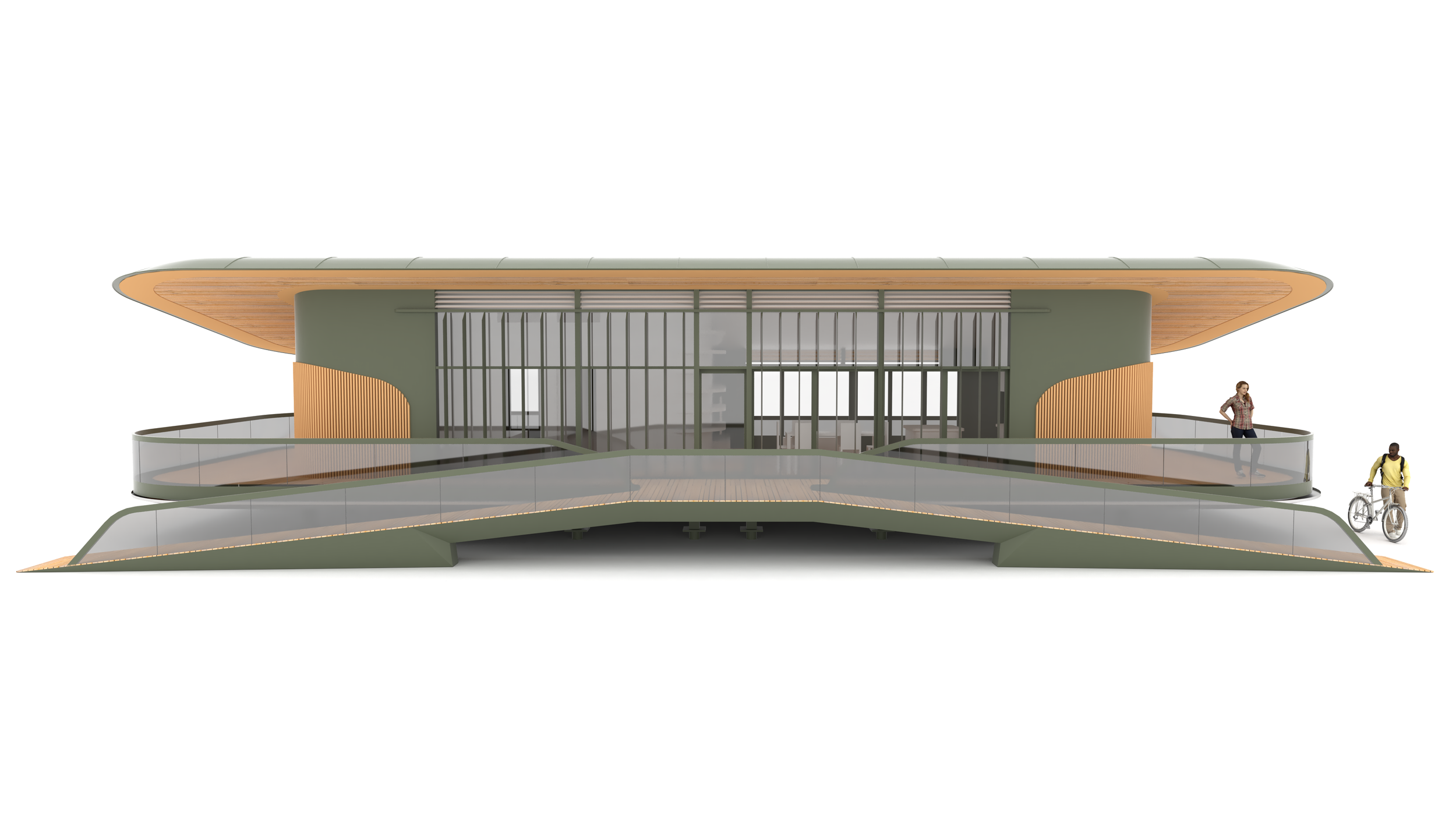
My concept of Hyperborea is based on revisiting the idea of the garden city, originally developed by Sir Ebenezer Howard (1850–1928). His sociological and urban planning ideas were presented in his 1898 book Tomorrow: A Peaceful Path to Real Reform, later revised and expanded in 1902 under the title Garden Cities of Tomorrow. He proposed replacing large industrial cities with smaller communities surrounded by agricultural land, blending urban life with the countryside.

Climate change and global overheating are largely caused by greenhouse gas emissions. Achieving balance is only possible if we significantly reduce these emissions and restore the natural habitats that have been eradicated by human activity.

I envision the city of the future as a place where advanced technology and nature coexist in harmony. A future in which societies no longer depend on fossil fuels is possible, because today we already have the tools necessary to make this change.

Facades with a Focus on Solar Control and Daylighting Performance

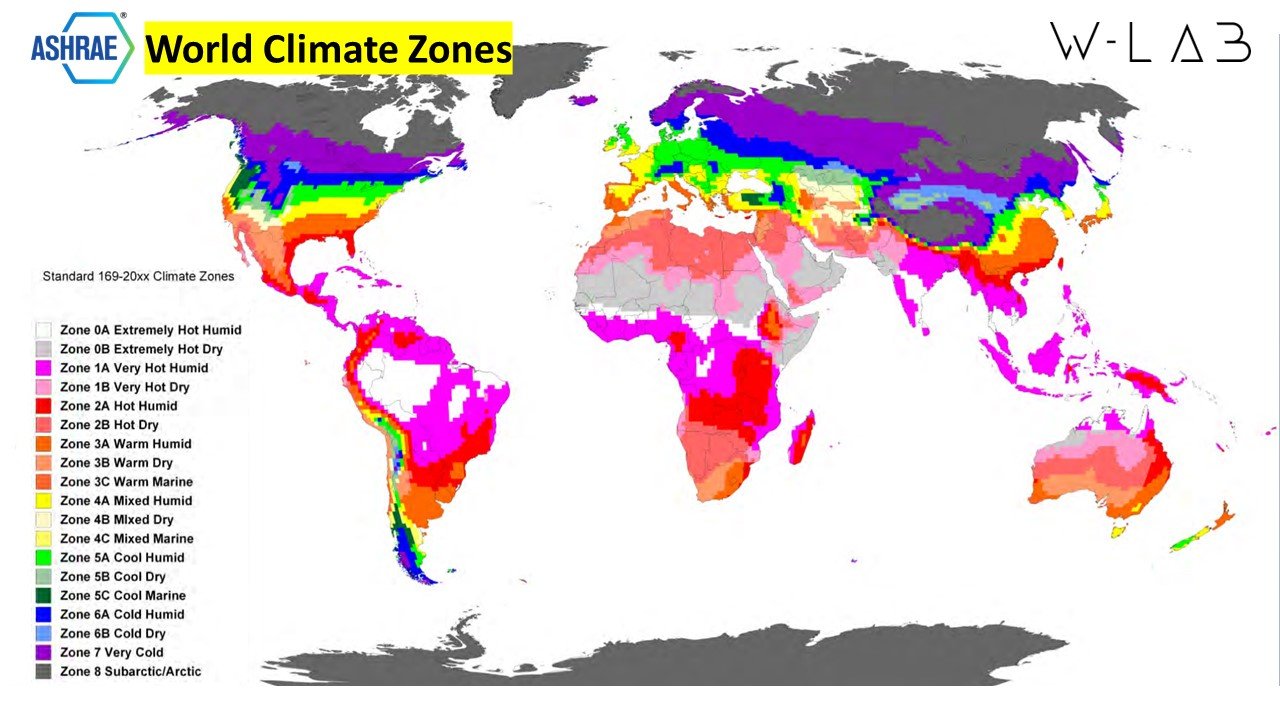
To evaluate the natural lighting conditions of interior spaces, I calculate the average daylight illuminance under overcast sky conditions, using this scenario as the baseline for minimum daylight availability. My goal is to ensure that interior spaces achieve a minimum illuminance of 300 lux across at least 55% to 75% of the occupied area, in alignment with LEED daylighting performance criteria. By optimizing facade design to control solar radiation while maximizing useful daylight, I reduce glare and overheating while improving visual comfort. This strategy significantly decreases the reliance on artificial lighting, leading to lower energy consumption and contributing to a reduction in greenhouse gas emissions, supporting LEED objectives related to energy efficiency, occupant well-being, and environmental performance.

Solar_Exposure_BCN  interiors_Page_2.jpg

Study of Direct Sunlight Access (Hours of Sun Exposure)

I conduct this study to determine whether interior spaces will receive excessive direct sunlight that could lead to increased indoor temperatures or glare issues. The calculation of direct sunlight hours can be carried out independently of the specific regulation or certification system being pursued, as each certification establishes its own required threshold values. For example, LEED recommends that regularly occupied spaces should not exceed 250 hours of direct sunlight per year in more than 10% of the floor area. If any space is found to be overexposed, facade shading systems become necessary to prevent glass overheating, along with interior shading solutions to mitigate glare during periods when the sun is at a low angle.

Solar_Exposure_BCN  interiors_Page_1.jpg

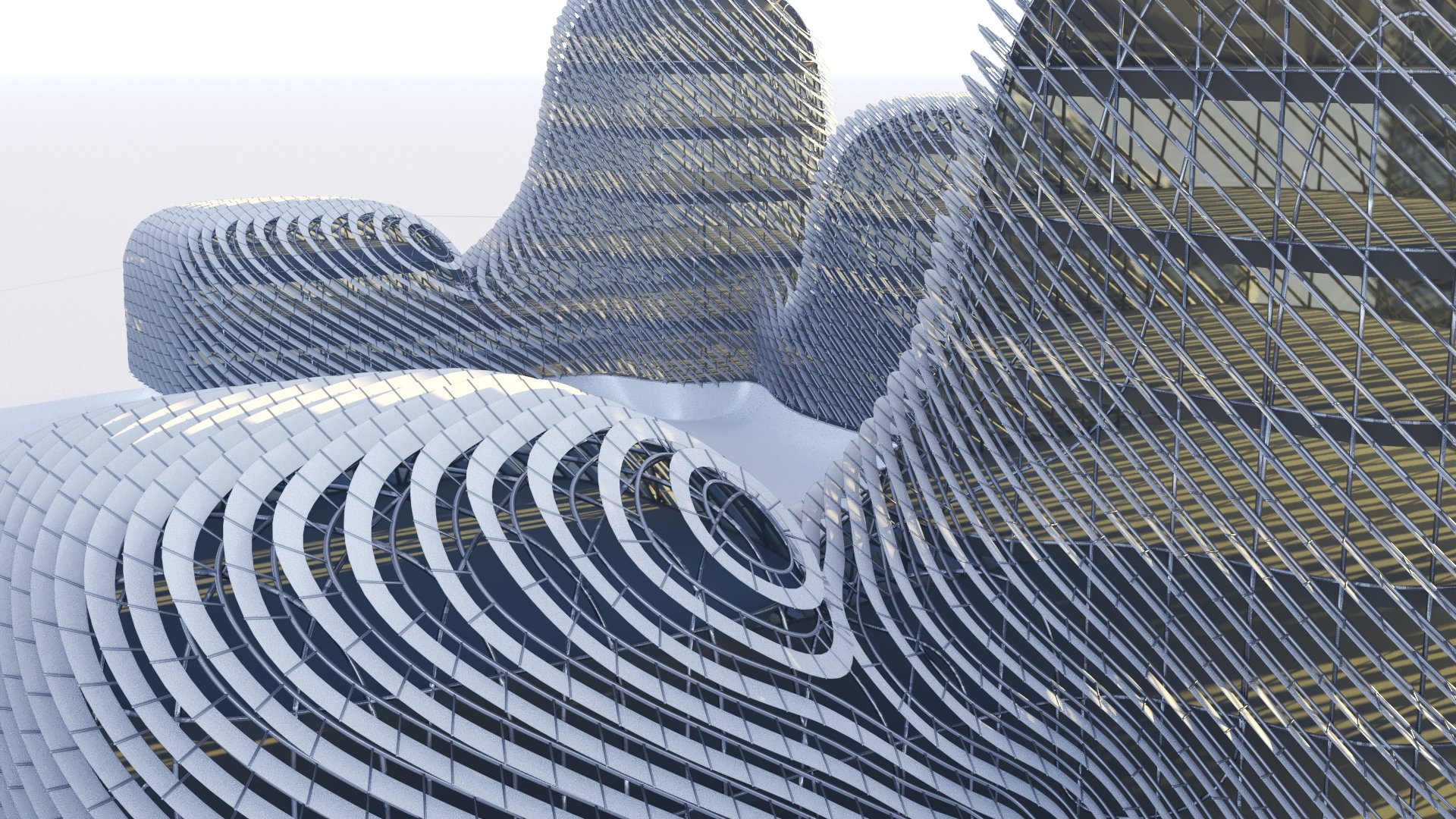
Additional note: all of the content presented on this page was produced by me. I developed the 3D models using Rhino and Grasshopper, performed environmental analysis with Ladybug and Honeybee, and created the renderings in V-Ray. Post-processing was carried out using AI-based tools to enhance realism and achieve more dramatic lighting effects.

How to consider sustainability standards in a design project

Creación del programa y marco teórico sostenible para un proyecto arquitectónico urbano

A la hora de comenzar en un proyecto para un intervención urbana, es necesario desarrollar una serie de capítulos que esbocen las áreas en las que nos vamos enfocar para tratar el tema de la sostenibilidad. Aquí incluiremos texto y diagramas que muestren cómo trataremos el entorno y los recursos en función de nuestro tipo de proyecto y climatología del lugar. La lista de temas a desarollar, sería la siguiente:

  • 1) Salud y bienestar

  • 2) Consumo energético

  • 3) Uso del Agua

  • 4) Transporte y conexiones

  • 5) Materiales

  • 6) Tratamiento de residuos

  • 7) Uso del Terreno y recuros ecológicos

  • 8) Polución

  • 9) Aspecto social

  • 10) Iniciativas de innovación

  • 11) Estrategias Compensación de emisiones de CO2

Dependiendo del país en que estemos trabajando, cada uno tendrá su visión sobre la sostenibilidad, y una serie de estándares oficiales (Certificación Verde LEED, BREEAM, MOSTADAM, Estandar Chino para la Sotenibildad… etc… ), que nos sugerirán cómo guiar el proceso constructivo y de diseno, para cumplir sus objetivos. ) si quereis saber más sobre el espectro de certificaciones verdes que existen a nivel global, aquí encontraréis toda la información: Whole building Design Guide.

Cuando nuestros clientes nos preguntan que hacer para conseguir un edificio sostenible, siempre recomendamos usar el estandard oficial de cada país como guía, dado que éstos nos darán las herramientas necesarias para trabajar mejor con el clima en que tengamos en la zona, y los puntos serán muy similares a los descrtios anteriormente.

Cómo comenzar a modelar nuestro proyecto sostenible:

Todos los puntos mencionados antes son el marco teórico sostenible para nuestro proyecto. Los argumentos y elementos que integremos en ellos serán el “Check list” de todo lo que se debe integrar para considerarolo sostenible. A la hora de concebir y modelar una propuesta es cuando debemos utilizar flujos de trabajao de ingenieria medioambiental con y herramientas de simulacion y modelado 3D que nos ayuden a comprobar que podemos cumplir con los estándares mínimos requeridos. Esta es nuestra receta de para estructurar el proceso de modelado:

1) Crear un “massing” con bajo impacto mediambiental para un uso residencial.

A la hora de emepzar a pensar en cómo insertar el programa dado por un concuros o nuestro cliente. tenemos que modelar una serie de volúmenes dónde podamos integrar las actividades y metros cuadrados que se exigen. Si queremos minimizar su impacto ambiental y asegurar niveles mínimos de comfort nuestra sugerencias iniciales son :

  • Estudiar las horas minimas de sol necesarias en fachada según los estandares locales, en Invierno para ventanas en habitaciones y salas de estar.

  • Optimizar la orientación y distancia mínima entre edificios, para mejorar los niveles de luz natural en interiores.

  • Estudios de comfort exterior de viento alrededor de los edificios (Para entender cómo el viento se canalizará entre edificios).

  • Estudios de exposición solar y sombreamiento a nivel de calle.

2) Optimizar el diseño de las fachadas para controlar el exceso de sol.

Una vez tengamos el “massing” desarrollado podemos empezar a pensar en cómo sera la estética de nuestro edificio y sus fachadas:

  • Desarrollo de un sitema de sombreamietno por plano de fachada para evitar sobre-exposicion del vidrio y los interiores.

  • Integración de elementos control de deslumbraminto y reflejos.

  • Estudios para la orientación de ventanas y posicionamiento de balcones.

3) Estudios de los niveles de comfort en espacios interiores.

Tras haber diseñado nuestra fachada y esbozado lo inteiores, es de gran utilidad estudiar el impacto del entorno en ellos, para optimizar lo siguiente:

  • Estudio de los niveles de luz natural en interiores, y mejoras de la distribución para incrementarlos.

  • Estudio de ventilación cruzada en interiores y mejoras de la distribución para potenciarla.

4) Estimación del consumo energético.

Con todo lo anterior ya definido es cuando podemos estimar los consumos energéticos que nuestras decisiones de proyecto tendrán en el futuro, y de ésta manera conocer cual será la cantidad de CO2 que se puede emitir una vez que el edificio esté en uso.

5) Estudios de comfort en el espacio Exterior

Con nuestros edificios definidos debemos estudiar el impacto en el entorno exterior para los usuarios del espacio publico:

  • Estudios de incidencia solar a nivel de calle.

  • Detección de reflejos y puntos de concnetración solar (fachadas de cristal).

  • Comfort exterior y velocidad del viento.

  • Creación de soluciones de protección solar y de viento para mitigar exposición excesiva.

Siguendo éstos pasos aquí mencionados, tendremos una propuesta más robusta que no sólo logre nuestros objetivos a nivel estético sinó que además esté blindada ante cuestiones que un jurado o comité de expertos pueda hacernos, cuando estemos presentando el proyecto. Si nuesrta estrutura teórica y diagramas de se usan para sustentar nuestro disño, y las simulaciones lo respaldan con datos numéricos, habremos logrado una argumentación sólida para definir un arqutiectura sostenible y atractiva a nivel estetico, con un impacto reducido en el medio ambiente.

Para mas información y asesoramiento no dudéis en contactar:

W-LAB TEAM

Generative AI tools to envision Sustainable Architecture

We have seen the internet flooded with AI-generated images after the appearance of generative artificial intelligence tools like Midjourney, DALL·E 3 Stable Diffusion, and others. helping designers visualize and create millions of ideas to envision the architecture of the future. But can we use AI also to help us provide realistic high-end sustainable architecture solutions, which could be built with today's technologies? Carlos Bausa Martinez, a Spanish architect, Senior Associate, and Head of Sustainability at Zaha Hadid Architects, explores the use of AI tools as a blender to throw at it everything we know from sustainability to propose radically different solutions for green architecture that could help create new formal languages adapted to cope with the current climate crisis we are living in. Sustainable materials, like negative carbon concretes, stone, or passive design solutions, can be described in text format and introduced in AI consoles as “prompts” that can produce unexpected and aesthetically interesting results, defying the current sustainable architecture solutions we see in the market, very often considered boring or not useful for high-end commercial and residential architecture.

AI-01 houses series. Climate zone selection.

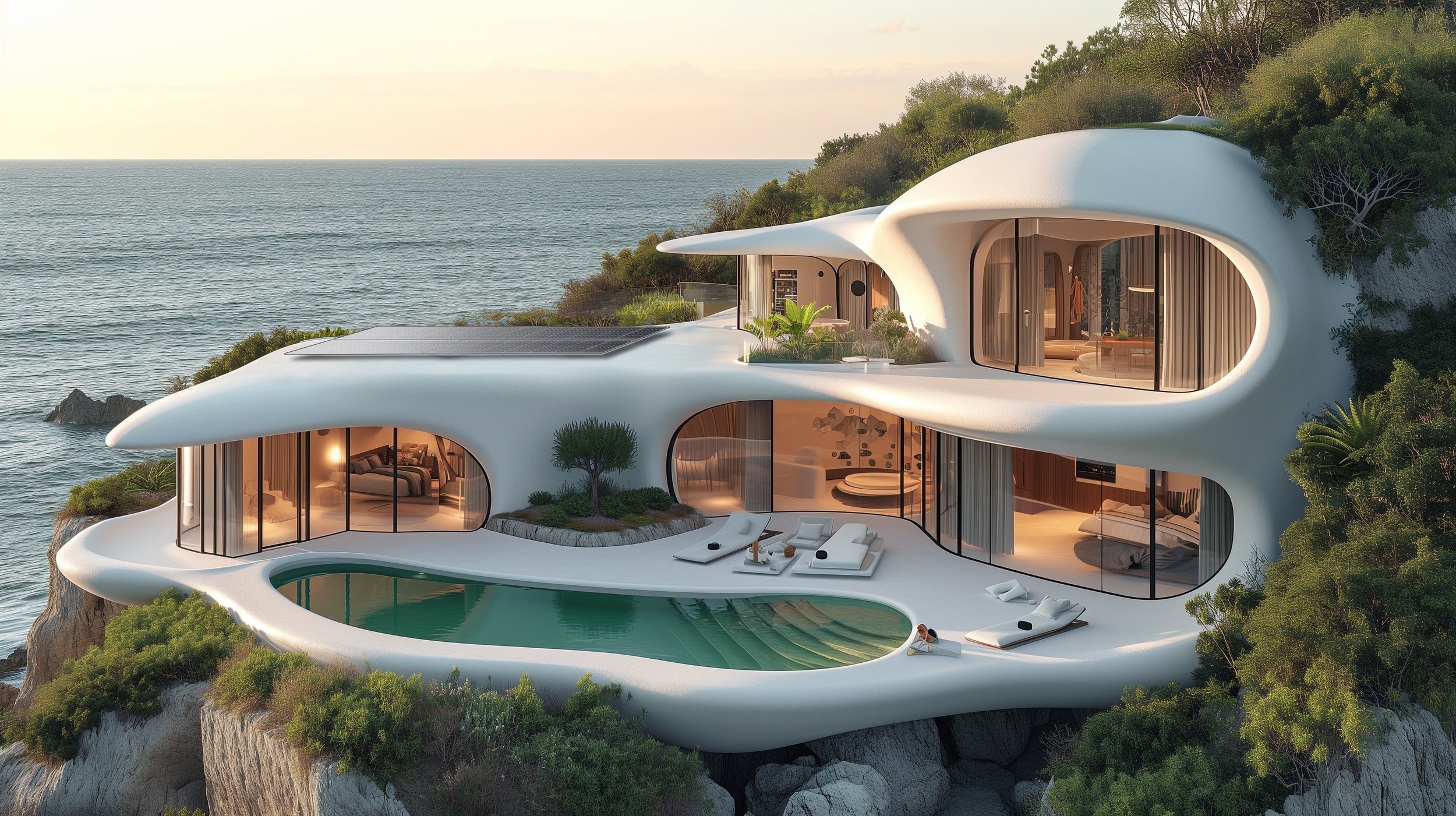
Very often, international firms of architects have the chance to select and participate in competitions from different regions around the world. Multiple locations in the world benefit from mild climates, with average temperatures falling in the comfort range between 16 and 25 degrees. Selecting competitions in these areas could be a strategic decision to produce new buildings and reduce the need for centralized HVAC systems. Using passive systems such as natural ventilation, underground spaces, or deep overhangs for shading the buildings can reduce the overall carbon footprint associated with the operational life of the building. The AI-01 house series explores the possibility of developing houses integrated into natural-looking spaces, taking advantage of the thermal inertia of stone or "green concrete" solutions. It aims to be built in a climate zone that does not require enclosed spaces, windows, or complex facades, allowing natural ventilation and passive shading.

AI-02 Series. Vegetation integration

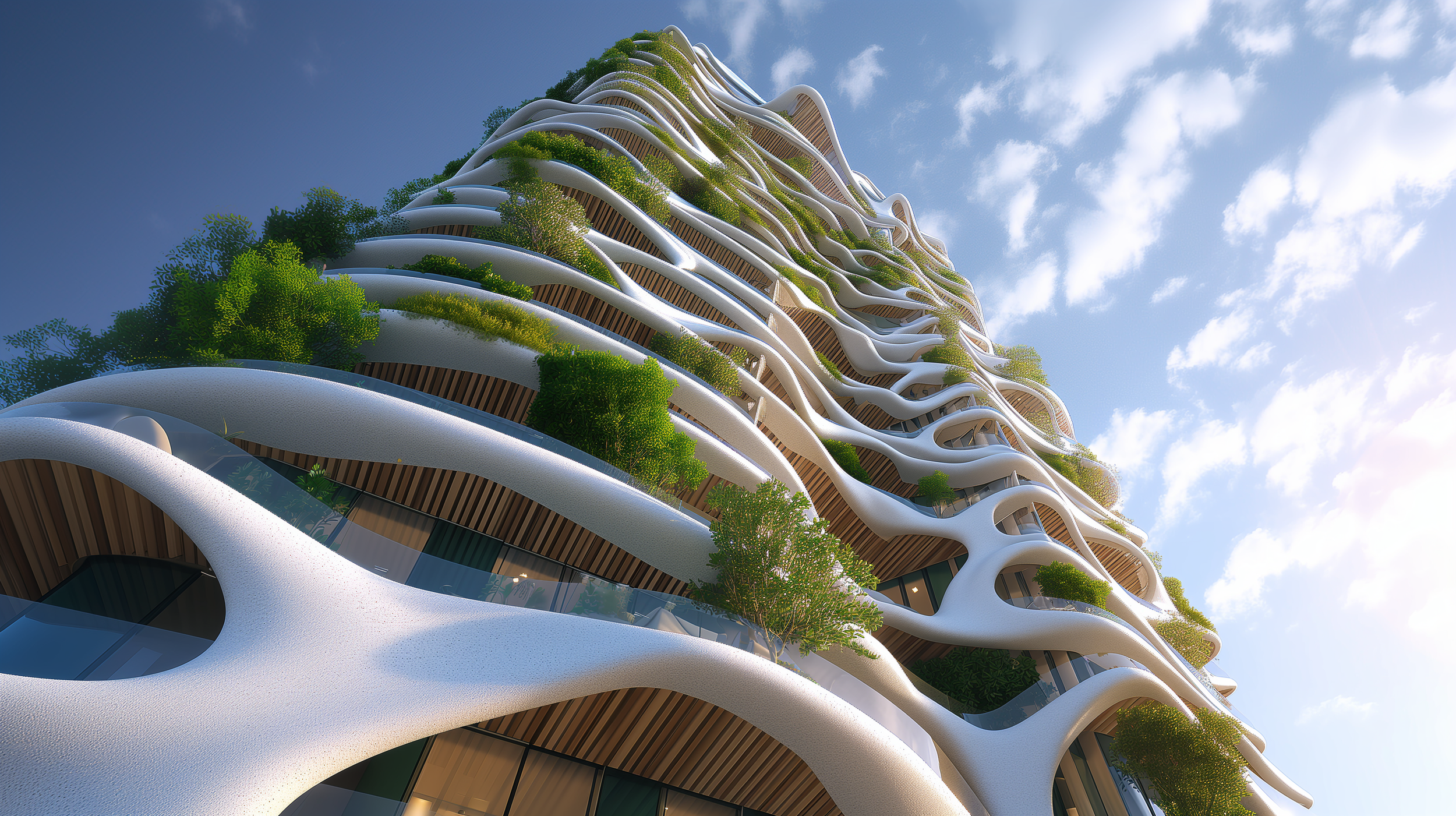
Vegetated facades and roofs that use xeriscaping solutions in dry climates or just local autochthonous plants in locations with frequent rains could drastically benefit the bioclimatic behaviour of a building with minimal maintenance. The AI-02 luxury house series exploits this logic and is conceived as an organic style of architecture that could integrate natural elements on every surface. This would help regulate the temperature passively, provide better insulation, and mitigate the heat island effect by reducing temperatures through the evaporative cooling effect of the plants. On the other hand, this regenerative architectural solution could reinforce the missing link with nature, restoring biodiversity.

AI-03 houses series. Solar control

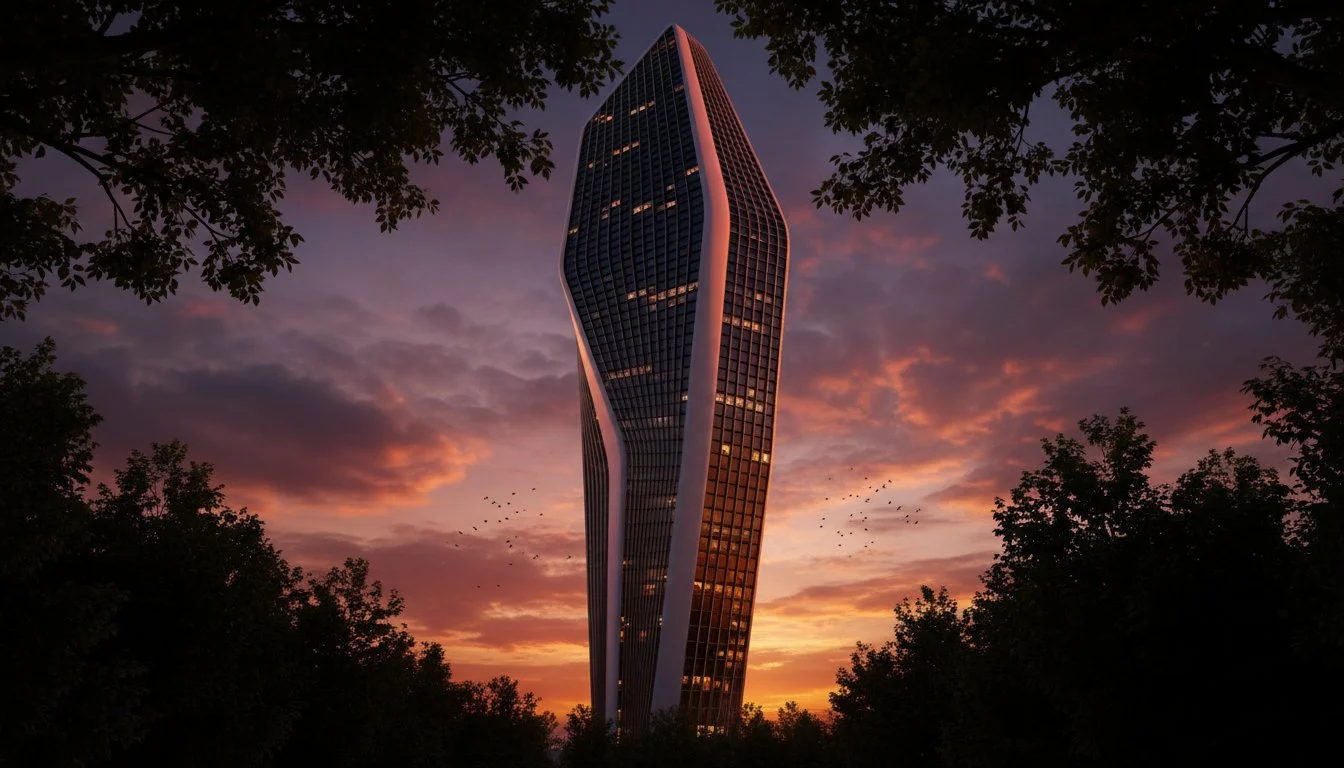
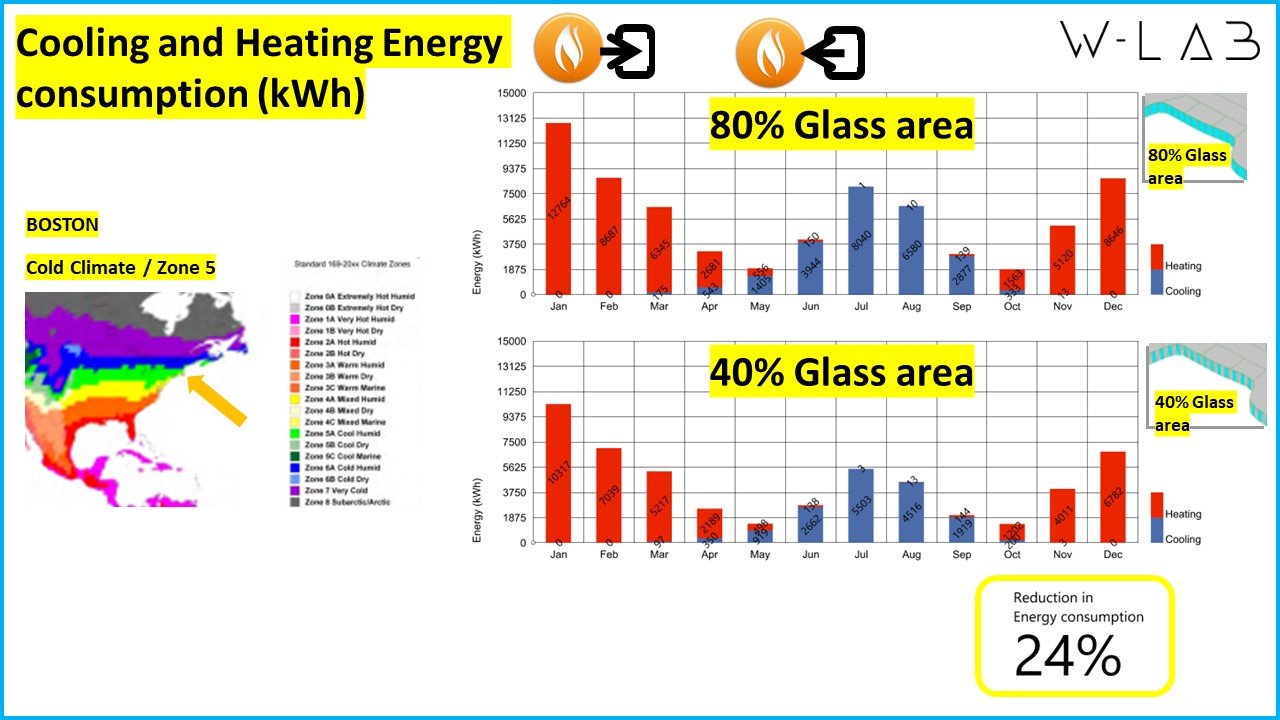
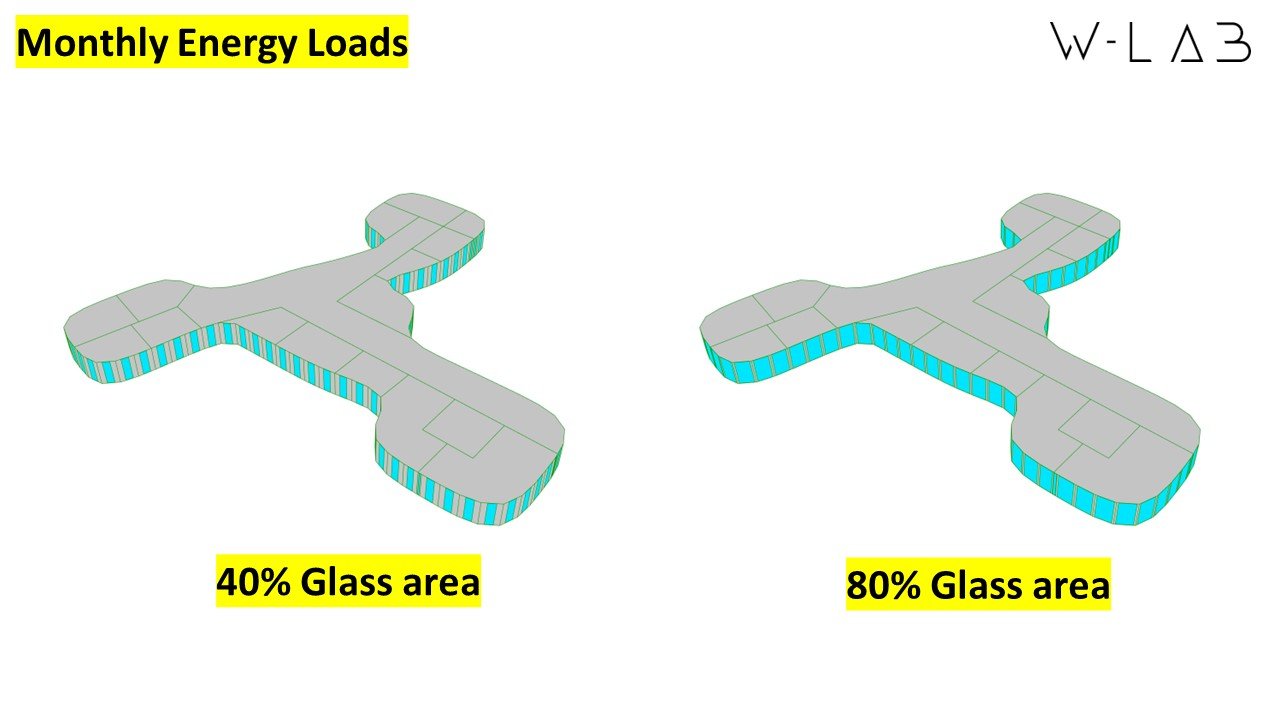
The current market for high-rise buildings is worldwide dominated by fully glazed towers. We often overlook the fact that fully glazed buildings are incredibly energy-inefficient due to the thermal loses over winter and solar heat gains in summer. Therefore, the AI-03 explores a design language that considers overhangs and low window-to-wall ratios to mitigate solar gains, controling the amount of sun that can overheat a building. Reducing thermal exchange allows buildings to become more energy-efficient, losing less heat in winter and reducing solar gains in summer. Additionally, the combination of shading elements, light-colored materials, and vegetation on facades and roofs helps reducing the heat island effect. This leads to passively cooling the city environments where the buildings could be inserted.

AI-04  house series. Negative carbon concrete

Concrete seems to be the most common and widely used material for structural solutions. Therefore, shifting to green concrete options with a negative carbon footprint could be the solution in the future of construction. Currently, timber and magnesium oxide cement are the best options for low-carbon architecture when it comes to structure and cladding elements. The AI-04 series was developed, targeting the use of wood and green concrete to define new design languages with a certain nostalgia for brutalist architecture. These structures could benefit from the high thermal mass of concrete to create better insulation and fresher buildings in locations that could be affected by warm climates. The integration of vegetation would help to reduce heat and its effects while restoring biodiversity, which could be further enhanced by greywater recycling and rainwater capture, utilizing the surfaces of the building to guide water to underground water tanks. The reduced amount of glazing in these typologies would help minimize the need for air conditioning and heating, making them even more energy-efficient.

AI-05 house series. Renewables integration and heat island effect mitigation.

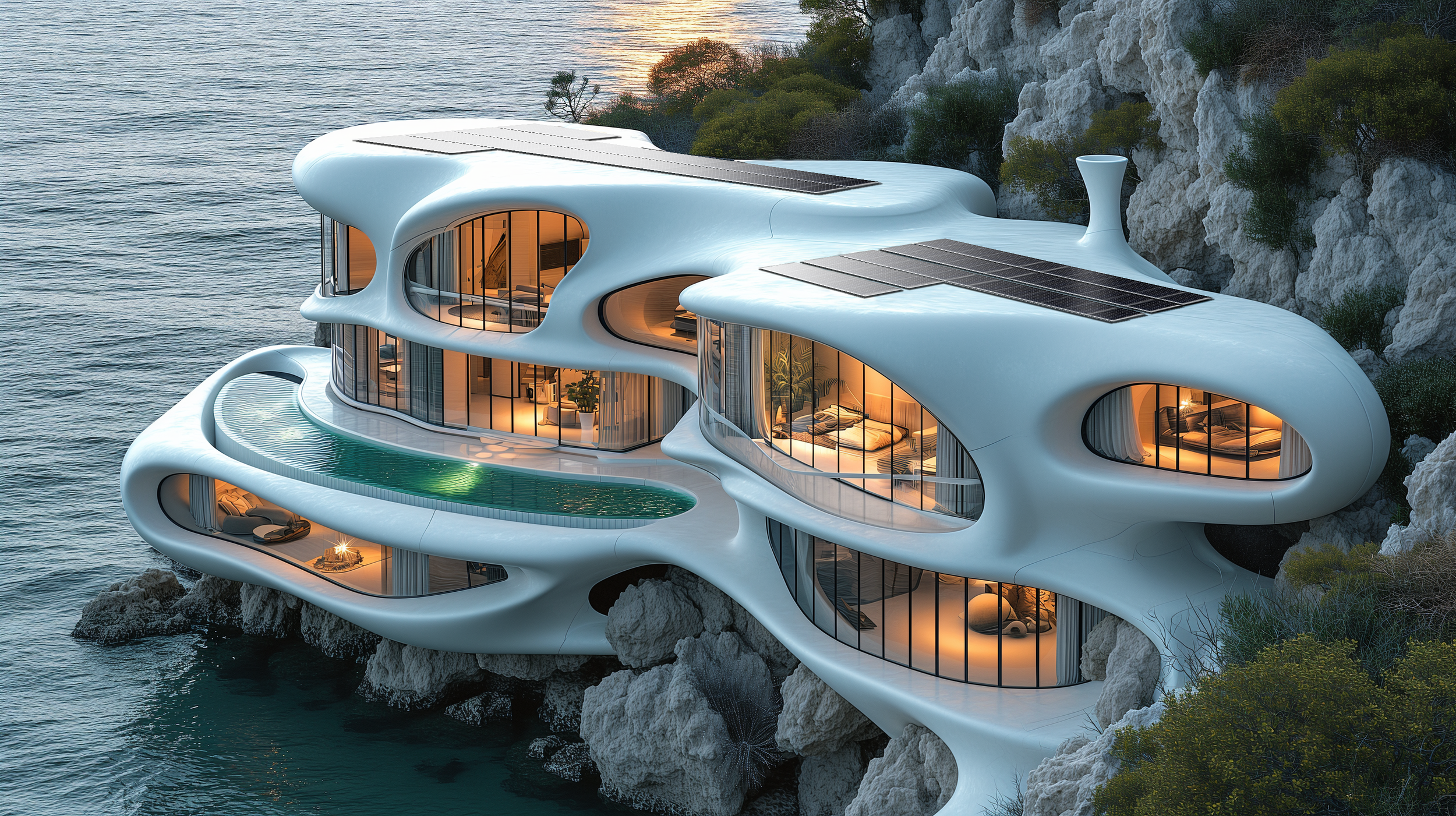
This proposal for high-end luxury houses was developed taking into consideration multiple sustainable strategies, including the integration of solar panels and materials that could help reduce the heat island effect. Light-colored stone cladding or white-coated materials with an organic look would reflect heat during the hottest periods of the year, thereby reducing the overall temperature of the surroundings. This, in turn, would have a direct impact on cooling load reductions. On the other hand, recessed windows would mitigate solar exposure on the facades, helping to reduce solar heat gains. An interesting observation is that AI engines often exhibit a bias for high levels of glazing, especially when the terms "high-end" or "luxury house" are introduced. This bias can be mitigated by specifying clearer percentages for the glass-to-wall ratio. This phenomenon reflects the current trend in the luxury homes market, which tends to prioritize maximizing views over creating energy-efficient facades. However, achieving the same level of views can be possible with lower glass-to-wall ratios..

Conclusions of this study

The use of AI tools can significantly contribute to generating and envisioning new solutions that blend various sustainable design strategies. This enables architects to think outside the box when proposing new formal languages that integrate all the requirements from sustainability certificates such as LEED or other standards. This could lead to new, original solutions to propose more iconic architectures worthy of preservation. While each architect has their style and preferences, AI generative art tools are definitively a great aid for architects to visualize new ideas that can be reverse-engineered and used as a source of inspiration for all sorts of projects.
The Biotowers

Restoring the connection in between Modern Living and Nature, with lower carbon footprints.

This architectural research project wants to propose an ideal scenario where nature, passive architectural design and climate, work together with technology to create a residential tower complex with a low carbon footprint that is able to host natural life and manage its own resources passively.

Designing for temperate climates will lower building energy demand

Since this is a free theoretical design exercise, we assumed the plot would be located in a subtropical climate where comfort conditions are good overall the year, allowing the towers to require less energy for cooling and heating which will lower their operational carbon footprint. The surrounding plot takes the space that would be destined for a gated community and concentrates all the residential units in 4 towers allowing extra space for nature within the property.

Restoring Nature to lower carbon footprint

We conceived the space as a plot surrounded by wetlands, which could be integrated as a landscape feature, to work as a shelter and attractor of natural life and even migratory birds that could be passing by the area. Carbon sequestration will happen in the soils of the wetlands and the trees and vegetation included in this plot helping to reduce even more the carbon footprint of the complex associated to construction process and materials transportation.

Timber Structure to lower carbon footprint

The tower structure represents around 60% of the material used to build the tower. Because of that we prefer to conceive it as a Laminated Glulam structure, which can reduce the embodied carbon footprint to around 60% just by making the decision of having this material.

External Shading for Passive Solar control

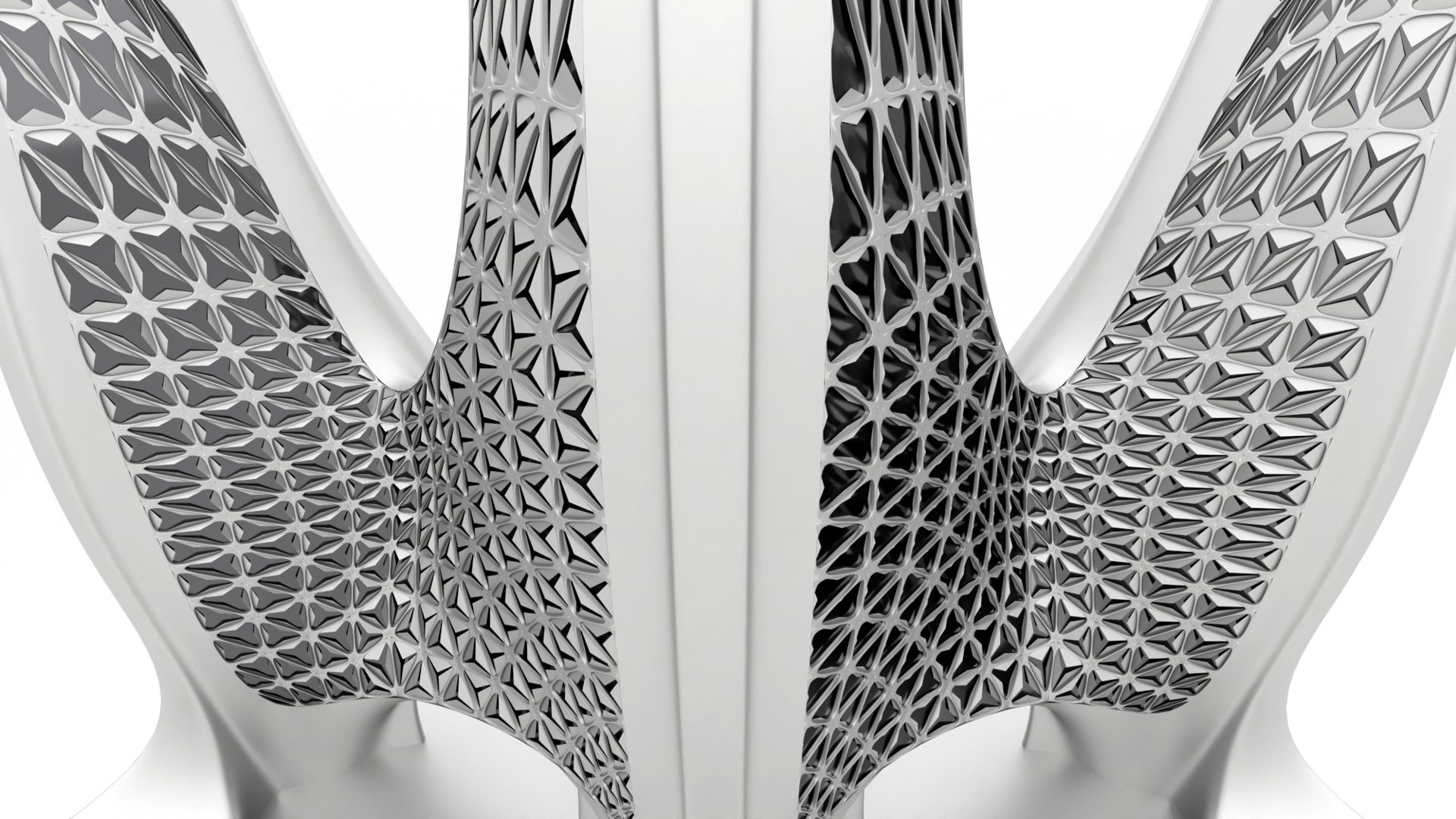
Even in mild climates, solar exposure can rise temperatures of the interior of our residential spaces, over hot sunny days. This would produce an increase in Energy Demand for Air conditioning, so we included a shading design in the facade, as a second skin to reduce the solar heat gain. with vertical elements looking towards East and West, and horizontal elements looking south.

Slim towers to reduce Energy demand and increase Natural light

The shape of the tower is not arbitrary. The thought behind these slim tower profiles is to increase the amount of natural daylight indoors. Deep slabs will require more Artificial lighting, to keep good lighting conditions, so the thinker the better it will be to allow more access to natural light, in all rooms. At the same time, its orientation allows less solar heat gain, reducing the size of the south facades including translucent horizontal shading on them, to eliminate potential solar excess. East and West are more prone to low sun angles, and for what we included a translucent vertical shading design able to cut down solar access and glare from low sun angles.

Onsite water capture and desalination

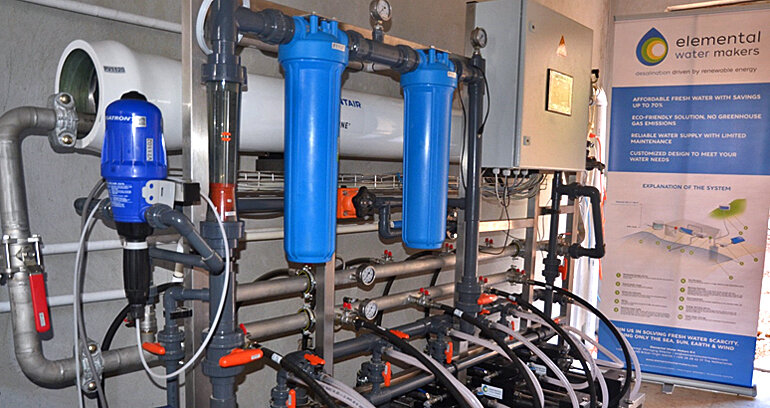
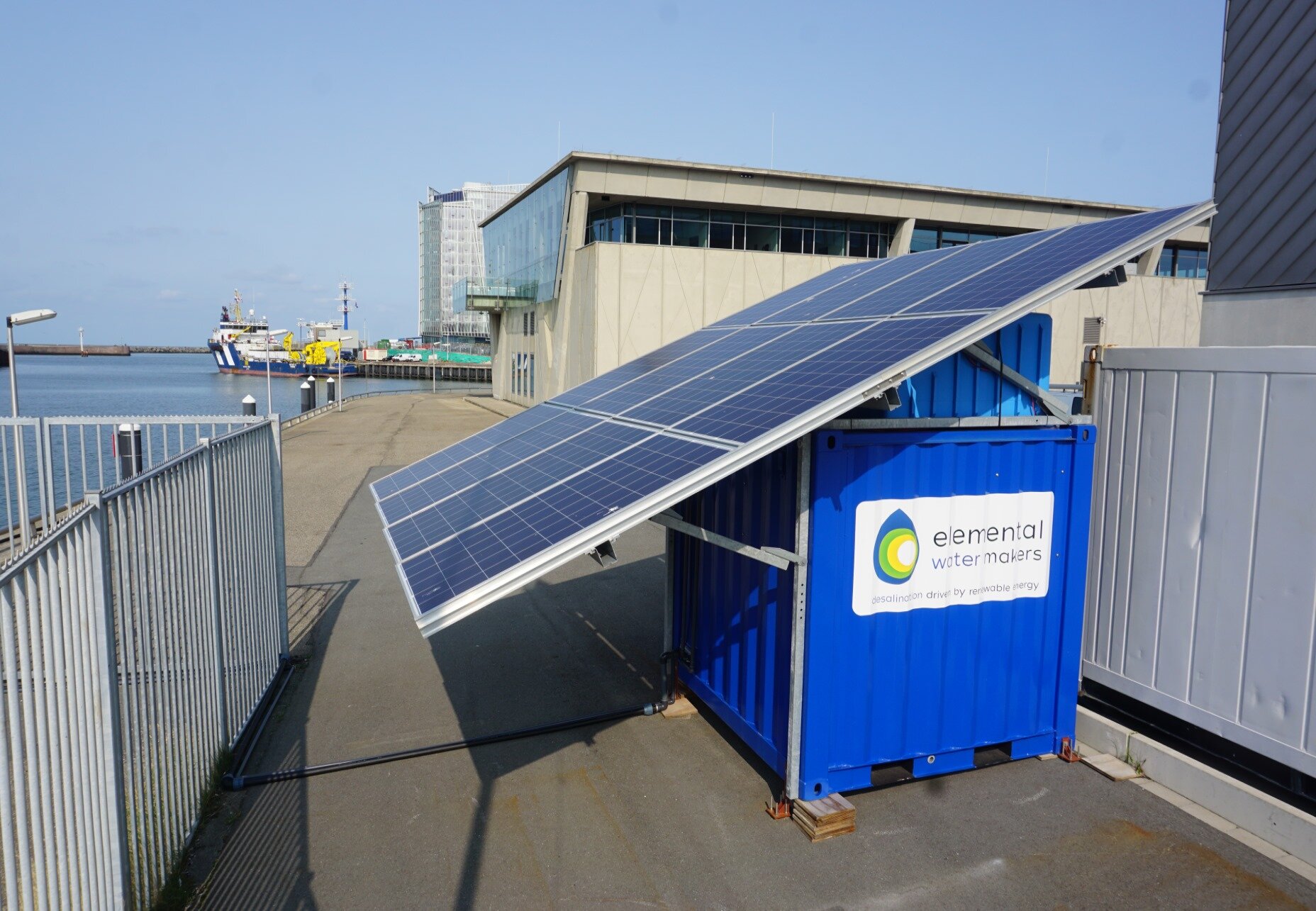
To be self-sufficient we would need Solar energy gathering onsite from different areas and water capture technologies. This complex would count with water desalination facilities, powered by solar energy like the one you can see in the image below. Rainwater collection will happen in the plot surrounding the towers and the premises. After being treated and filtered with the appropriate system this could be used for flushing or irrigation purposes. Fresh water will be obtained through an osmosis system with will take water from the sea and transform it into fresh water for human consumption.

Water Recycling and Sewage treatment

The ultimate goal of the project is to close the water cycle, recycling all the sewage water coming from all the residential units. For this purpose, a bioreactor can be installed on-site ( A system that already exists ). It uses algae to digest the organic materials in the sewage water allowing this to be filtered and reused for other purposes like flushing, irrigation, ponds and lakes, or for outdoor cleaning operations. The system requires a long translucent pipe circuit, exposed to the sunlight for the algae to do photosynthesis. These eat the organic compounds, and remove them from the water. A separation filter removes the algae from the treated water at the end of the circuit. The water can be used at this point and the separated remaining algae is brought back to the circuit to start the process again.

Isla Plana, La Azohia

The Island of “Isla Plana” is located nearby the fishing village of La Azohía, belonging to the municipality municipal district of Cartagena ( Region of Murcia, Spain ), located at the Gulf of Mazarrón. It surroundings are considered Protected Naural Area. The interactive 3D model below will show you the geography of the island. Explore its interest points by clicking on the numbers

Explore the Underwater Posidonia Meadow

The underwater landscape It is surrounded by an important Posidonia meadow which is the habitat for a wide variety of fish and other sea creatures. Below you can see images of our underwater expedition. We took 360 photos to observe the current state of the water and its life as you can see in the virtual images below. Drag and slide to move the camera and explore the seabed. Common species that can be found in this location are grouper, haddock, shi drum, seabream, slipper lobster, and marine phanerogams (“Sea Grass” and Posidonia) among other species. Isla Plana is a small Island but due to the species that inhabit it on its surface and beneath it, the island it’s considered an area of special natural interest and it belongs to the Natura 2000 conservation program. This is a network of core breeding and resting sites for rare and threatened species and some rare natural habitat types which are protected in their own right. It stretches across all 27 EU countries, both on land and at sea. The aim of the network is to ensure the long-term survival of Europe's most valuable and threatened species and habitats, listed under both the Birds Directive and the Habitats Directive.

Isla Plana Top view

The image below shows the shape of the island from top view. The crystal clear water allows us to even see the algae and sea plants location and density. Unfortunaltey due to boats anchoring many places surrounding the area, where cleared out from posidonia meadow. At the moment the boats are not allowed to anchor anymore, so the are forced to secured themseleves to different mooring points.

Geology and the Mineral Waters

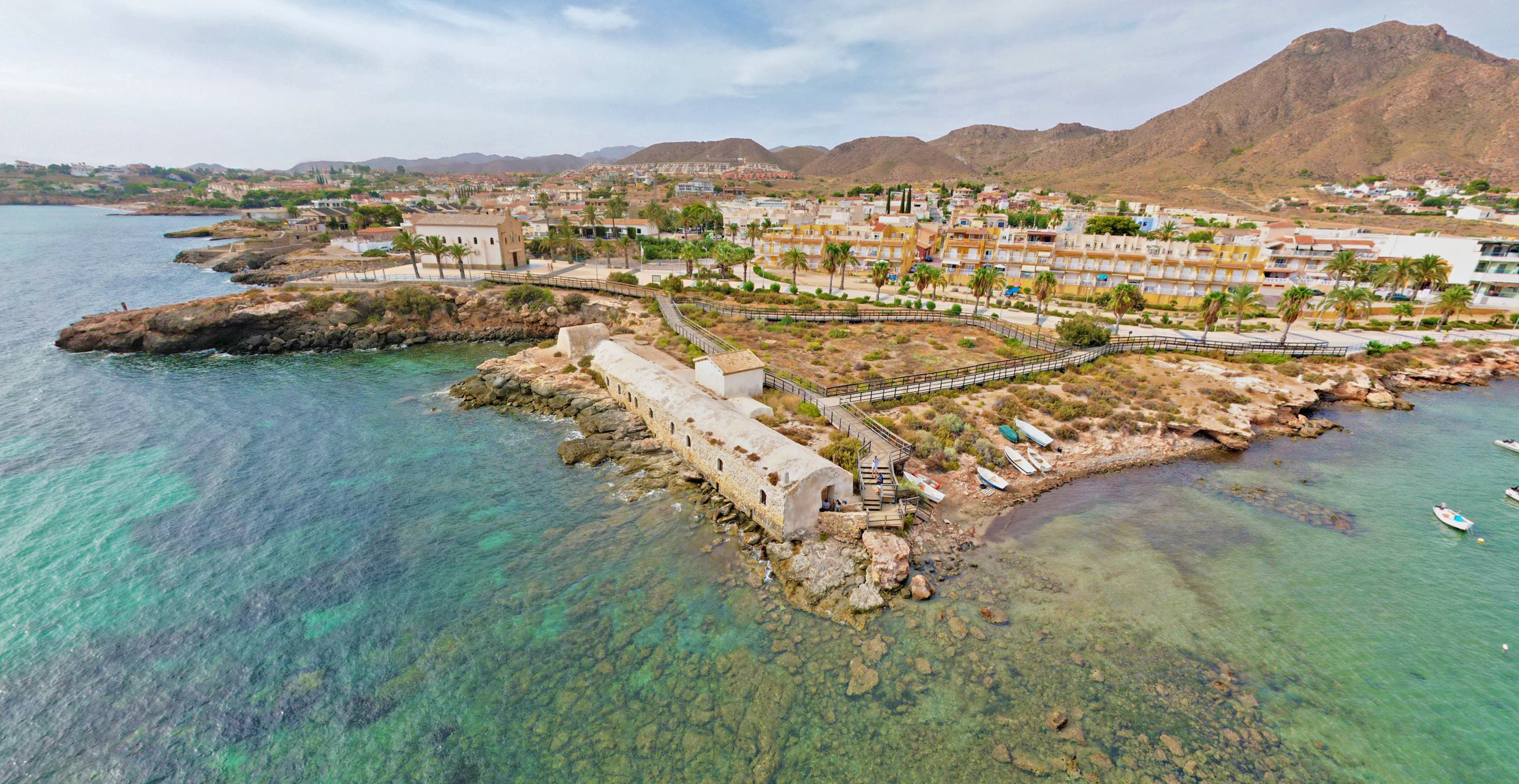
The rocks composing the island are mainly Triassic Calcites. Due to the rock porosity and composition of the area, mineral water was carried from the mountains all the way down to this location. Medicinal spring waters emanated at this point, which gave this location special importance. For almost a century ( between 1876 and 1976) the waters could be enjoyed in a public bathhouse which it´s remains are well preserved on the coast of Isla Plana. The aerial images we took show the public bathhouse on the edge of the coast of Isla Plana town.

Isla Plana Bathhouse plans:

  1. Exterior Main entrance to the vaults

  2. Windows facing the sea

  3. Entrance to the cold general baths with gender separation

  4. Seashore Entrance to the cold general bathroom without gender distinction

  5. General cold baths, separated by gender

  6. General cold baths unisex

  7. Private bathrooms with bathtubs supplied with hot water

  8. Water inlet from a well located 100 meters away

  9. Water tank, below the boilers

  10. Water lifting mechanism

  11. Excess water outlet

  12. Ticket Office

  13. Dining room with marble tables

Below you can see the map of Isla Plana and its Location


Photogrammetry, 3D model and photography its all original from WDS-LAB studio
Information sources and bath house plans:
http://www.cuevashipogenicasdemurcia.es/BIBLI/015-aguas%20mineromedicinales%20isla%20plana.pdf
https://www.regmurcia.com/servlet/s.Sl?sit=a,55,c,365,m,1753&r=ReP-22011-DETALLE_REPORTAJES

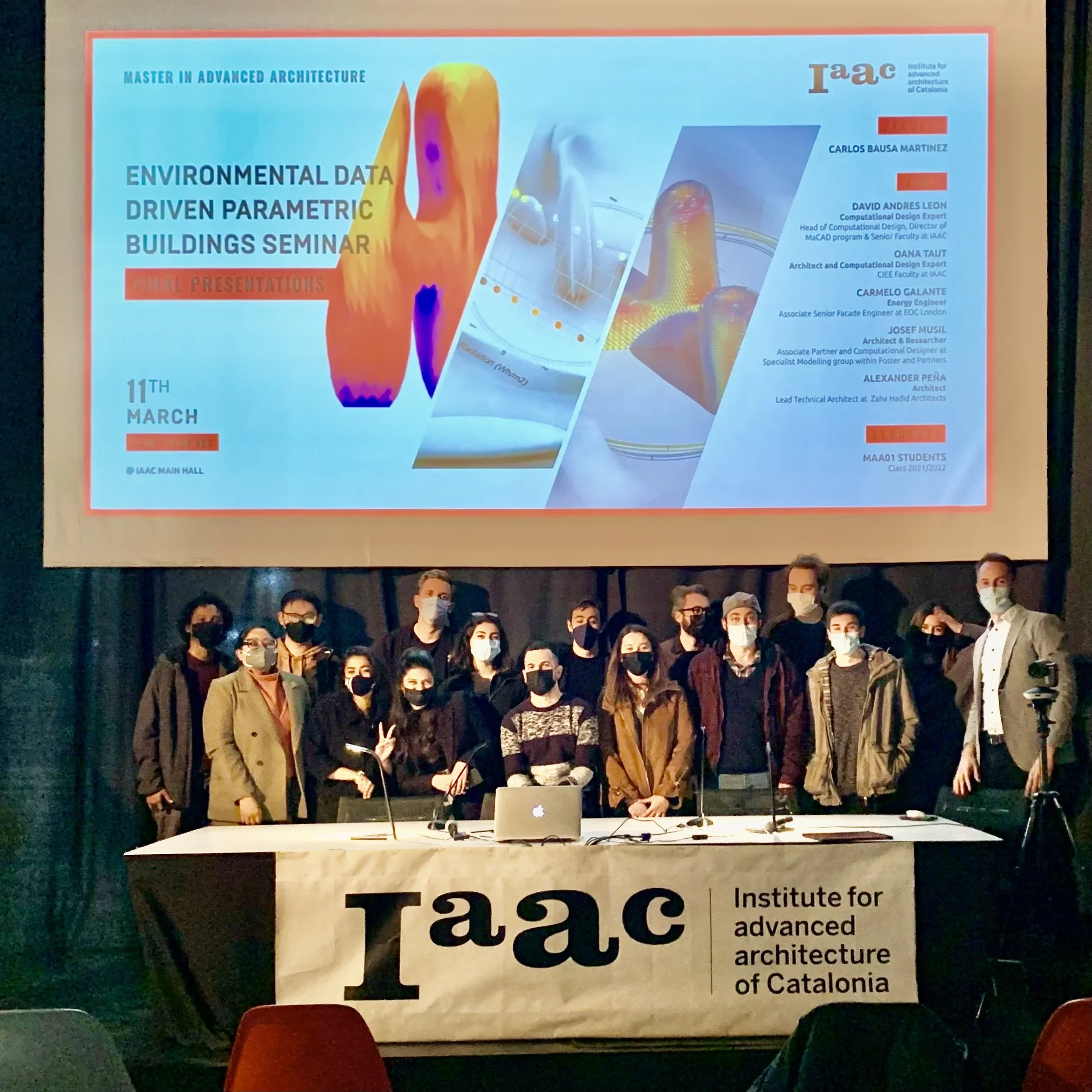
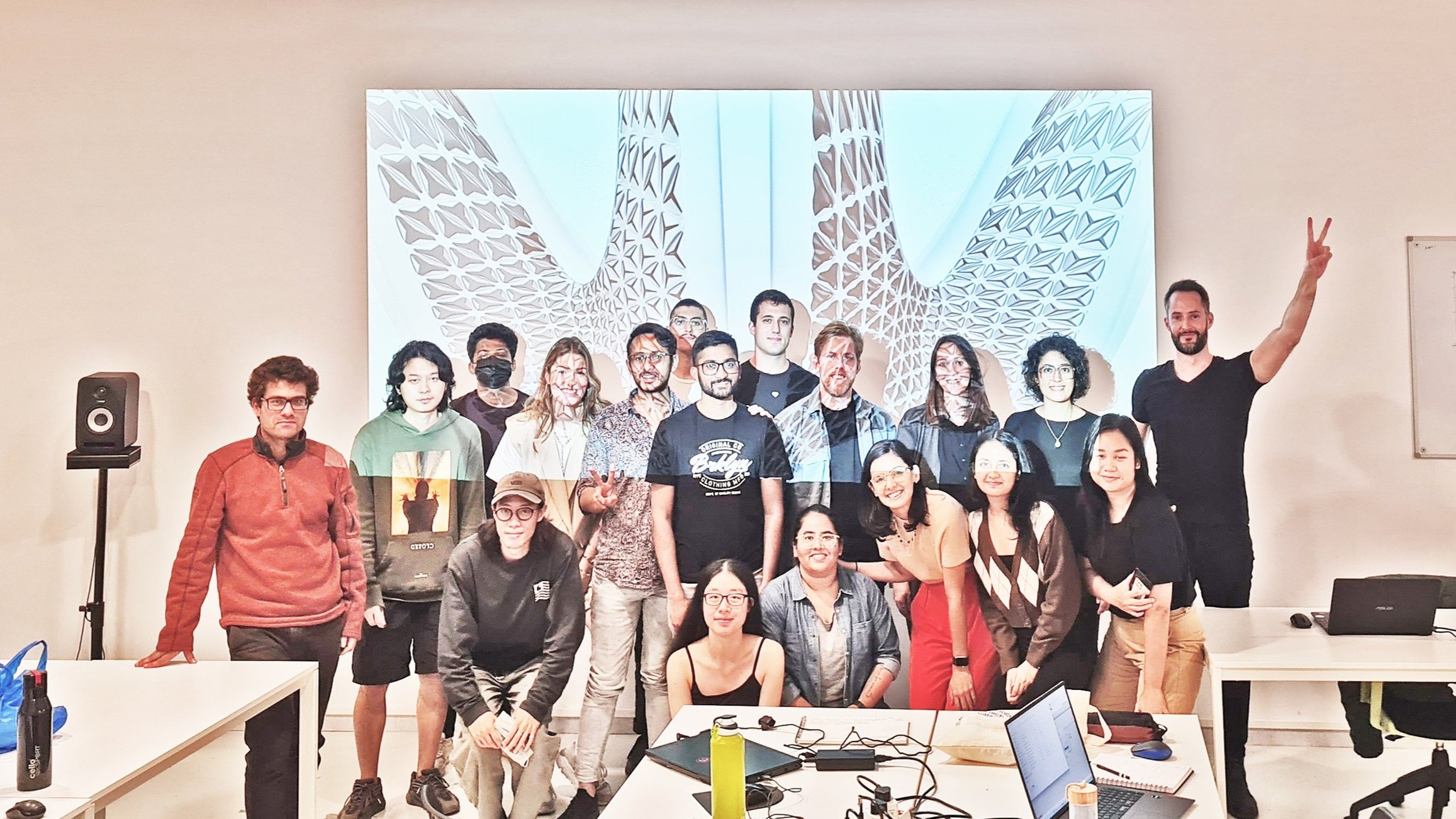
Designing Net Zero Architectures with enviromental simulation / Iaac Workshop

(February and March 2022)

This workshop focused on workflows used to create passive architectures to target Net Zero and Low Carbon solutions. After COP26, According to the latest UN climate reports, Architecture, and the construction process alone, are responsible for almost 40% of all the CO2 emissions humans are responsible for, having a greater impact than Transportation or other industrial processes like food production and agriculture on their own. Architectural Envelopes design is what has a major impact on defining cooling and heating loads accounting for an average of 75% of the operational energy total consumption, over its life cycle. If we want to create efficient buildings to reduce the impact on Climate Change, we´ll need to focus on studying how to create more efficient building envelopes that could have passive behaviour, and at the same time integrate the use of renewables on site, to help on the detachment of buildings from fossil fuels.

Over the evolution of this workshop with the Iaac Students, we looked at how to create parametric passive buildings, targeting the achievement of Operational Net Zero buildings, to define the next generation of carbon-neutral architectures.

We used algorithms based on Ladybug an honeybee tools within grasshopper for rhino, to understand how to inform design decisions with environmental Analysis. Parametners like Solar exposure, indoor Daylight distribution and Energy Balance, help us to understand the impact that our facades will have in the operational energy demand. With them, we can define new facade envelopes able to cope with different climatic conditions.

Shape Shifting Buildings

Adaptive building facade design

(October 2022)

The atmospheric conditions around buildings change during the day and over the seasons since we are surrounded by a dynamic atmosphere. The sun moves from sunrise to sunset, and over the year too, while atmospheric conditions change seasonally. On top of that climate change patterns are being modified due to human activity which will alter the livability of the places we inhabit around the world. So why still we should conceive buildings as static entities, unable to cope with these climatic alterations?

During the development of a three-hour workshop, I taught the students the basics of how computational design could be used to produce buildings able to change their solar access behaviour to introduce parameters that will help them to mitigate excessive solar exposure. This workflow will allow building design to be more energy efficient lowering Energy demands relative to Air conditioning with can represent almost 50% of the general energy demand of a building when located in warm climates.

Over the workshop session, we went through the following concepts:

●        Understanding the basics climate data-driven geometries, and Net Zero architectures

●        Optimization and benchmark of bioclimatic designs to reduce operational carbon footprint.

●        Steps to create a kinetic facade project at conceptual level, using environmental analysis to inform the design decision-making.

JOMA HOME

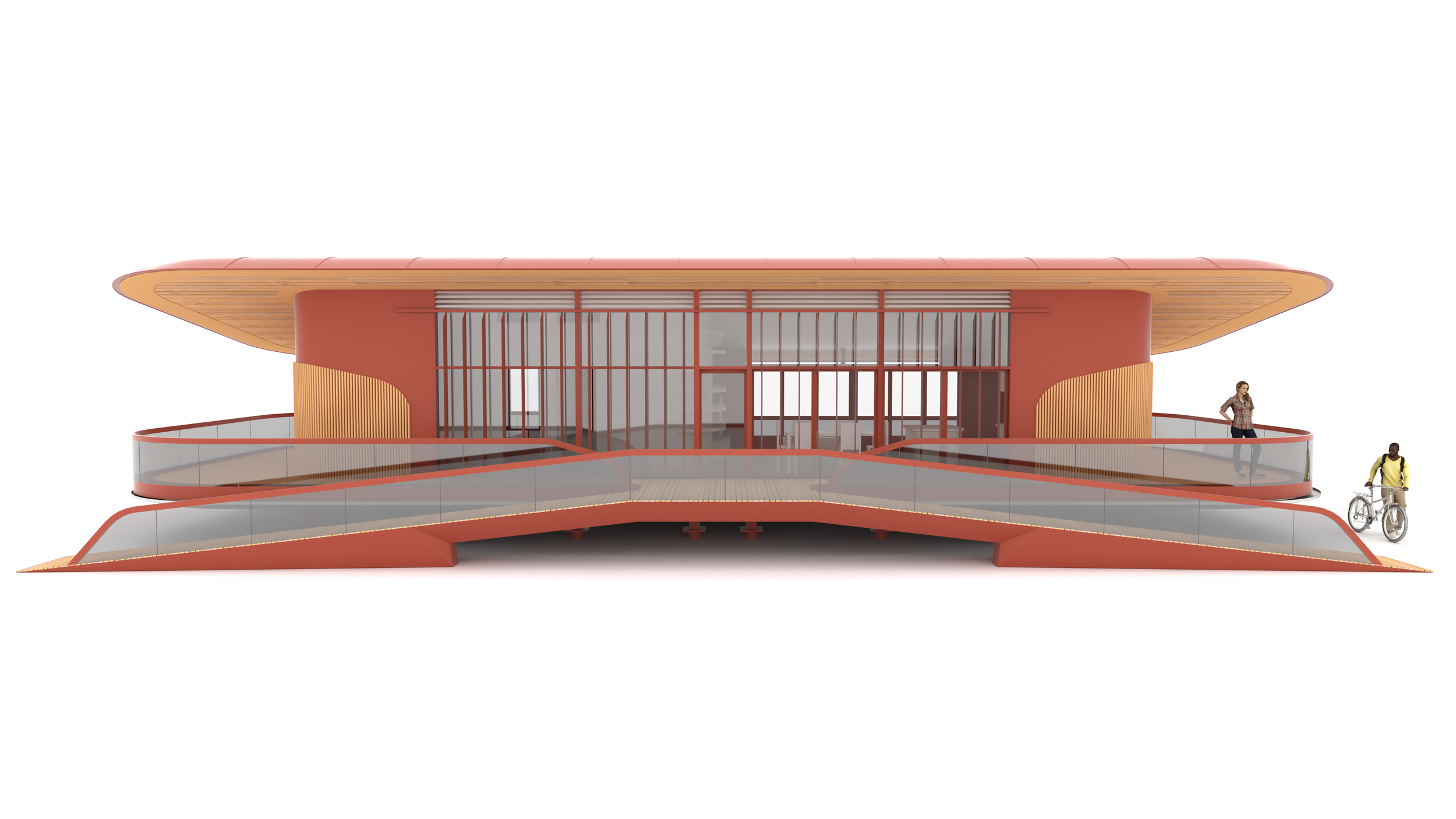
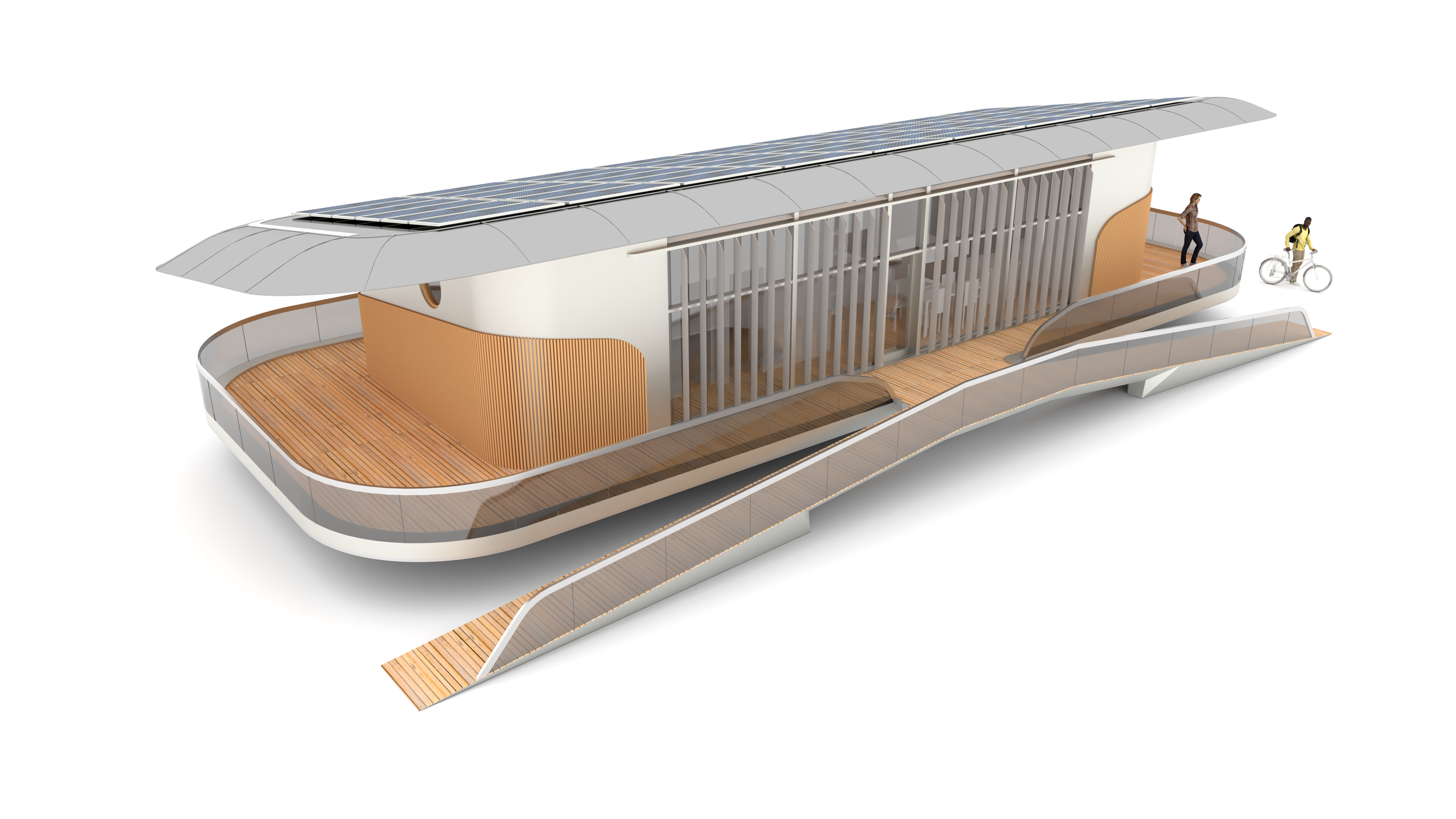
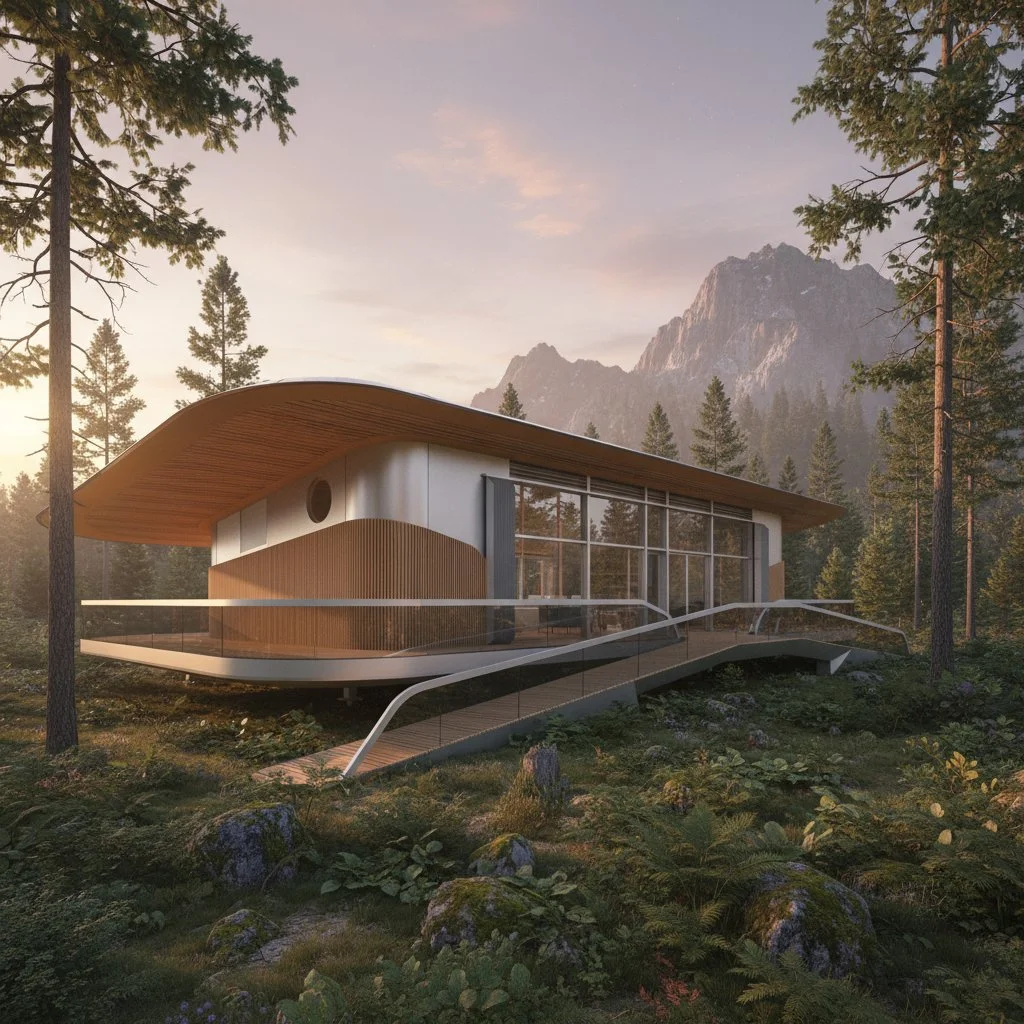
WALB helps its clients shape their vision and create projects that can meet the highest living standards while providing all their technical expertise to achieve carbon-neutral projects. JOMA HOME represents the vision of a very special client, Jon Robert Bonderer, who started his quest to make sustainable living possible before the pandemic. WALB helped Jon conceive his first prototype off-grid cabin that could allow people to live completely detached and independent from fossil fuels, running 100% on renewable energies. This house is meant to be prefabricated and assembled in parts at its final destination.
Combinations and personalization.

JOMA HONE has been conceived in a way for each cabin owner. can apply their personal touch allowing different finishes and colours. Below we can show some of the potential colour combinations so you can see the house's look and feel from multiple angles.

House interior design and distribution

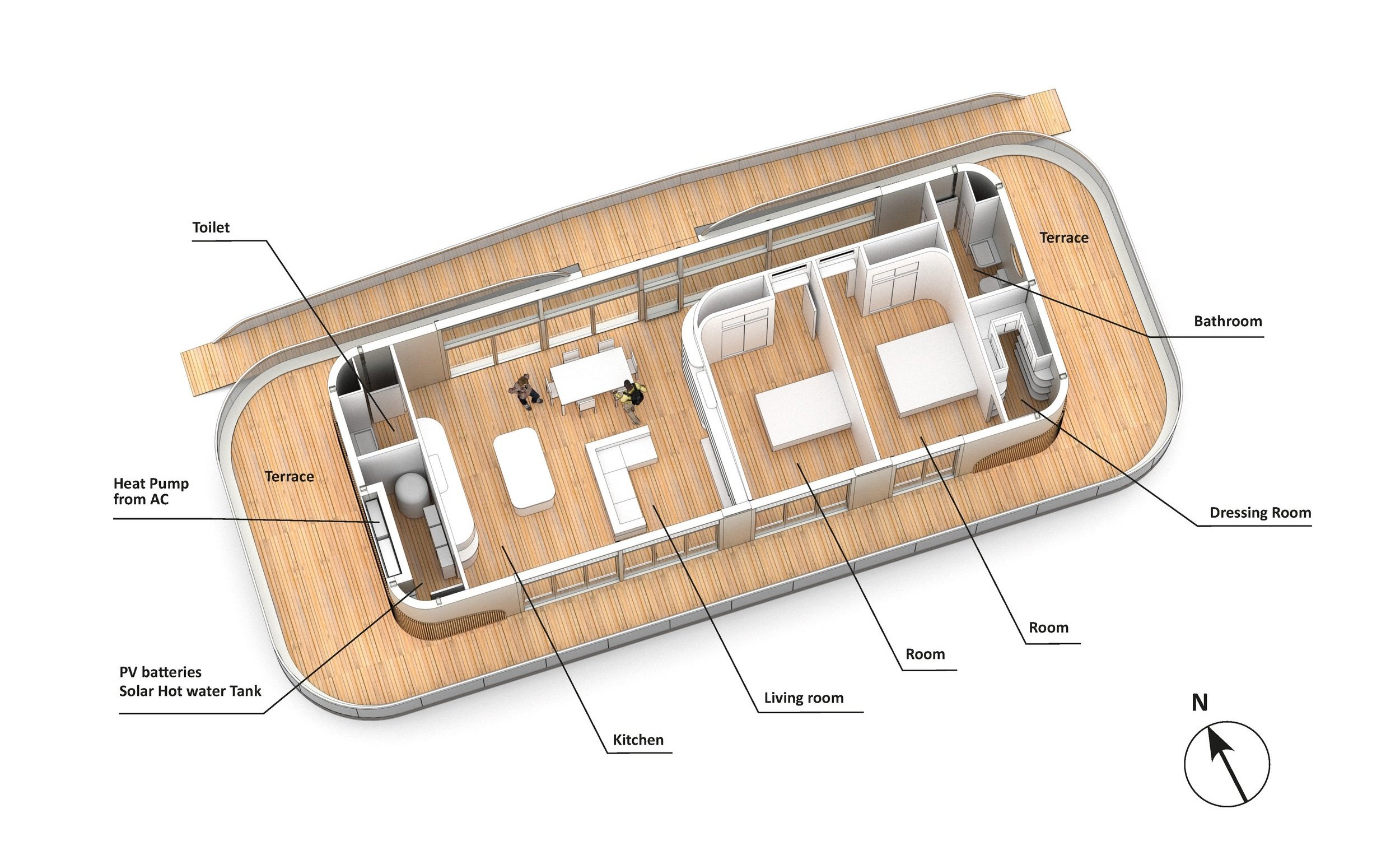
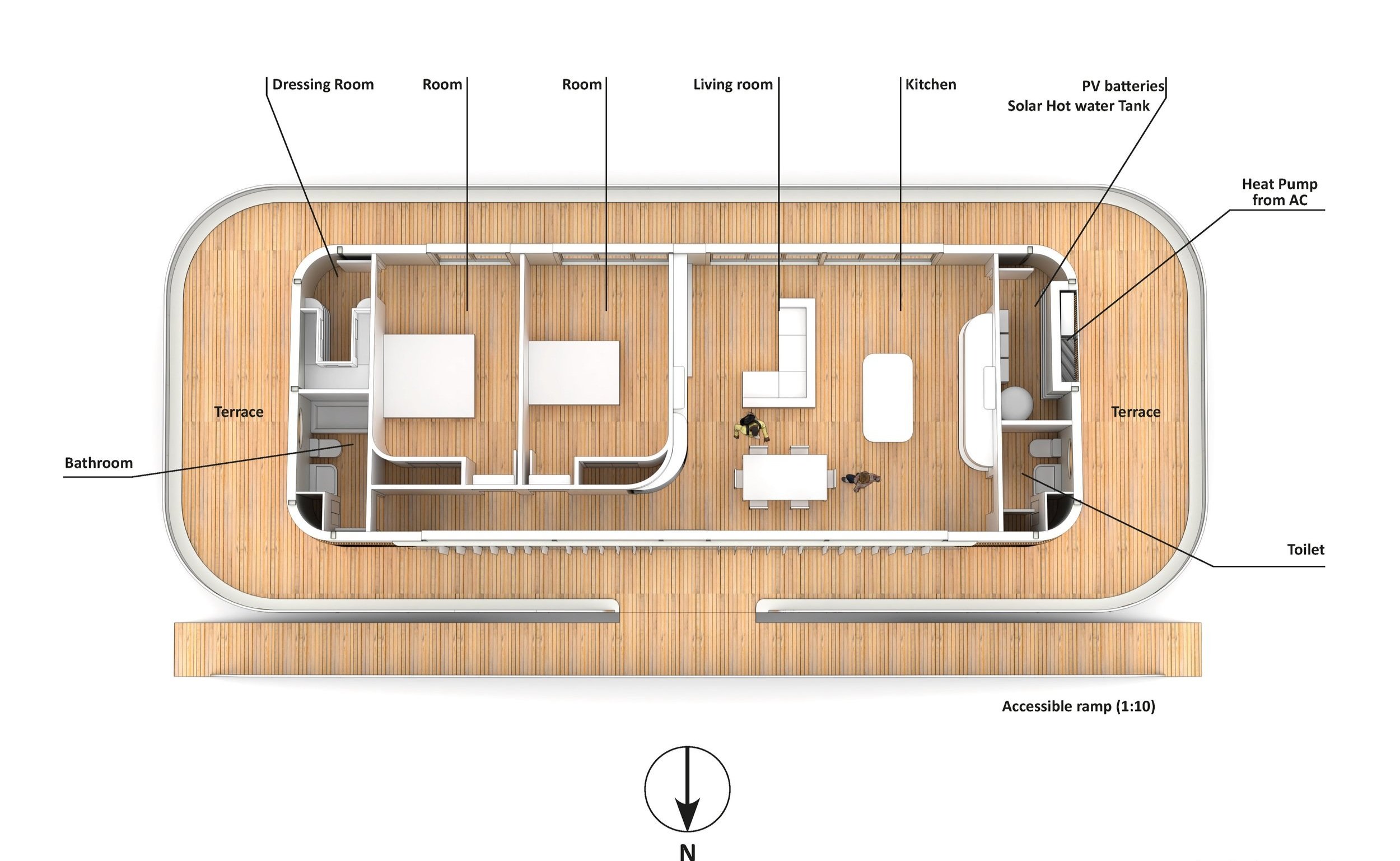
TheJOMA HOME counts with a useful indoor area of 80m2. It comes with two rooms that can fit a king-size bed, which includes its wardrove and storage spaces. One of them has access to its own fitting room. We can also find a cozy Living room with a dining space and integrated kitchen, perfect for all sorts of social interactions. The house has one bathroom and a Toilet. It also counts with a large storage space, for equipment, like the electric boiler, solar batteries, washing machine, cleaning materials, and hot water storage tank. Solar-powered individual Air conditioning units can be installed in the rooms and the living space.

Passive solar control solutions

WLAB designed the JOMA HOME to transmit Jon´s idea of considering comfort first, following a human-centric approach. For that, we wanted the house to be efficient and able to protect it’s inhabitants from exterior conditions, but with a responsible use of the energy, through passive design solutions.

A Self-Sufficient Building.

Energy from Renewables: The JOMA HOME demand has been calculated with Energy Modeling software, taking into consideration all the passive solutions applied as well as the material specifications of all the house planes. We can predict that if this house were installed in a country with similar weather and sun patterns as the south of Spain, it would even be able to sell energy to the grid. This would allow not only savings in energy bills but also some earnings.

Water use reductions: The roof is designed to capture and store Rainwater. That water can be used for operations like flush toilets, irrigation, or even for taps and showers if treated with the right equipment. We had in mind that wastewater can also be treated with water recycling systems that can reuse part of it or dispose of it locally with an underground filtration system.

Natural Ventilation: The inclination of the roof and its ceilings and opposite vents location allows the house to be ventilated passively. The inclination allows hot air escaping through the higher vents, avoiding stagnation, improving comfort in summer, and reducing Air Conditioning needs. At the same time, the house is elevated to allow ventilation under the floor reducing the chances of moisture travelling from the ground to the house floors or walls.

More information

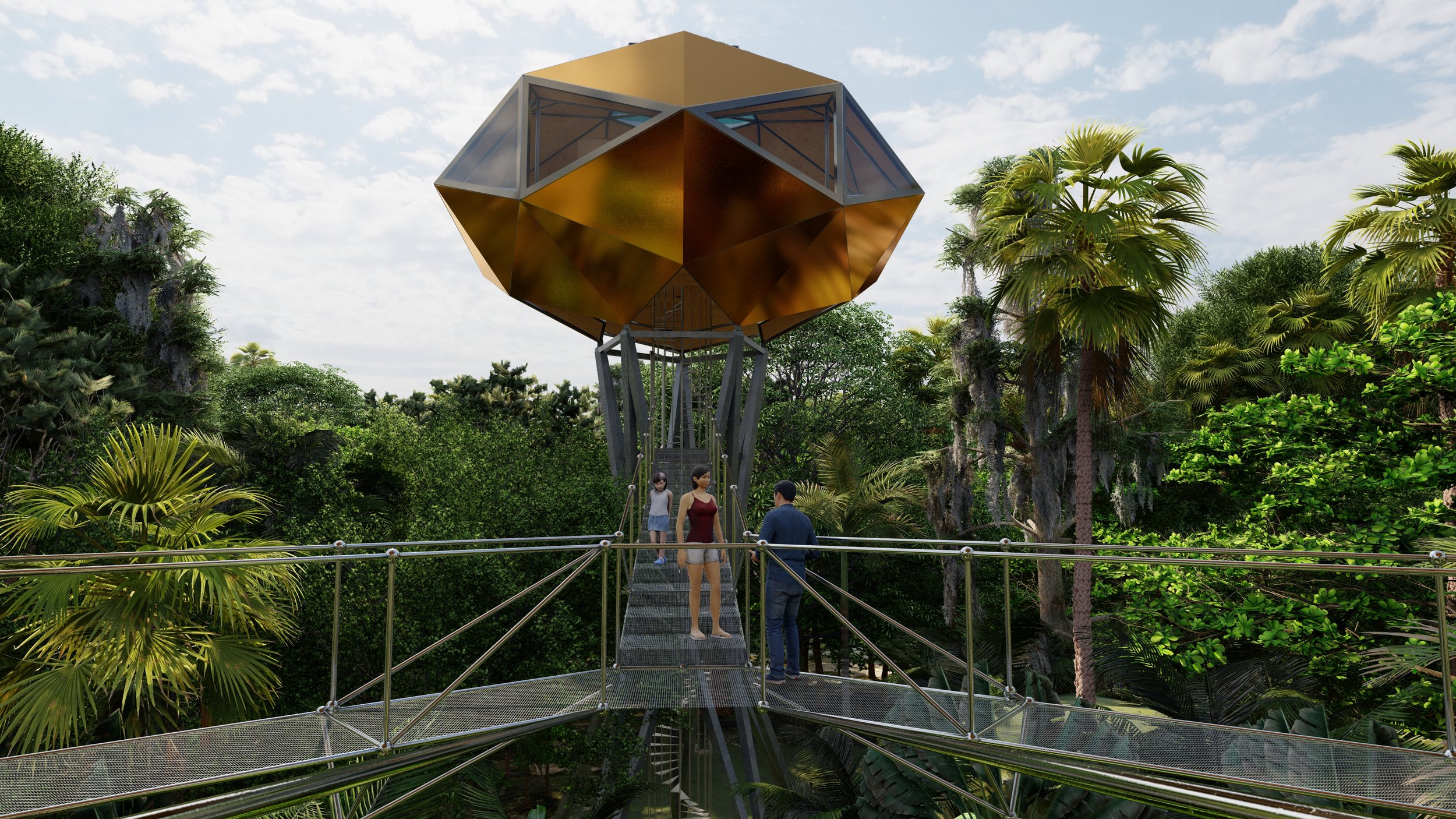
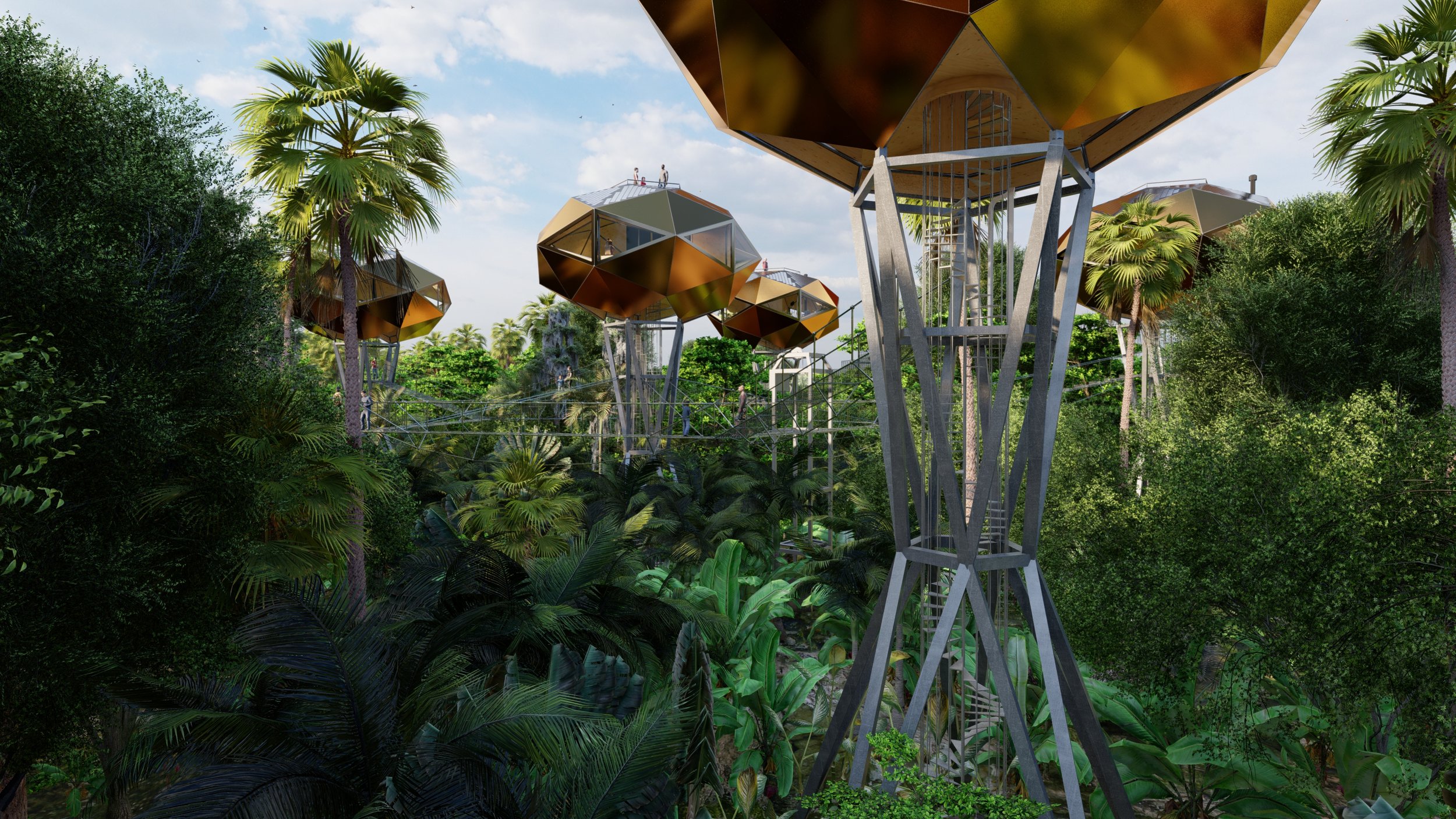
The Tree Canopy Ecovillage

Los seres humanos siempre hemos estados íntimamente ligados a la naturaleza manteniendo una estrecha relación con los recursos naturales y su entorno. Con la vida moderna y nuestras nuevas necesidades, nos hemos desvinculado de los espacios naturales, congregándonos en grandes urbes artificiales de alta densidad. En ellas encontramos todo aquello que necesitamos para nuestra subsistencia. Nuestra conexión con la naturaleza se ha debilitado y es por ello por lo que debemos trabajar en crear propuestas que ayudan a recuperar ese vínculo y restablecer el equilibrio perdido.

Un espacio para reconectar con la Naturaleza

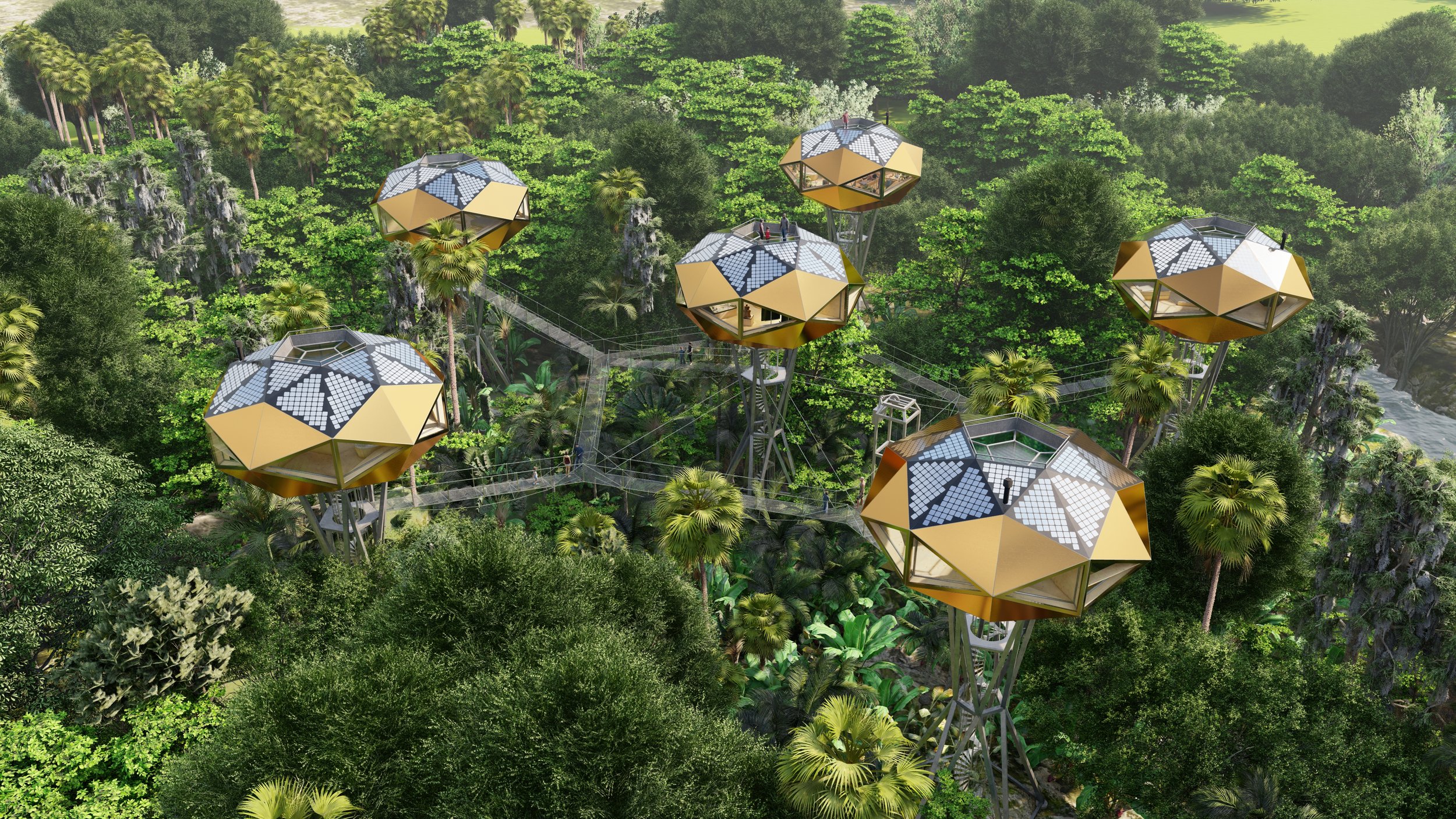
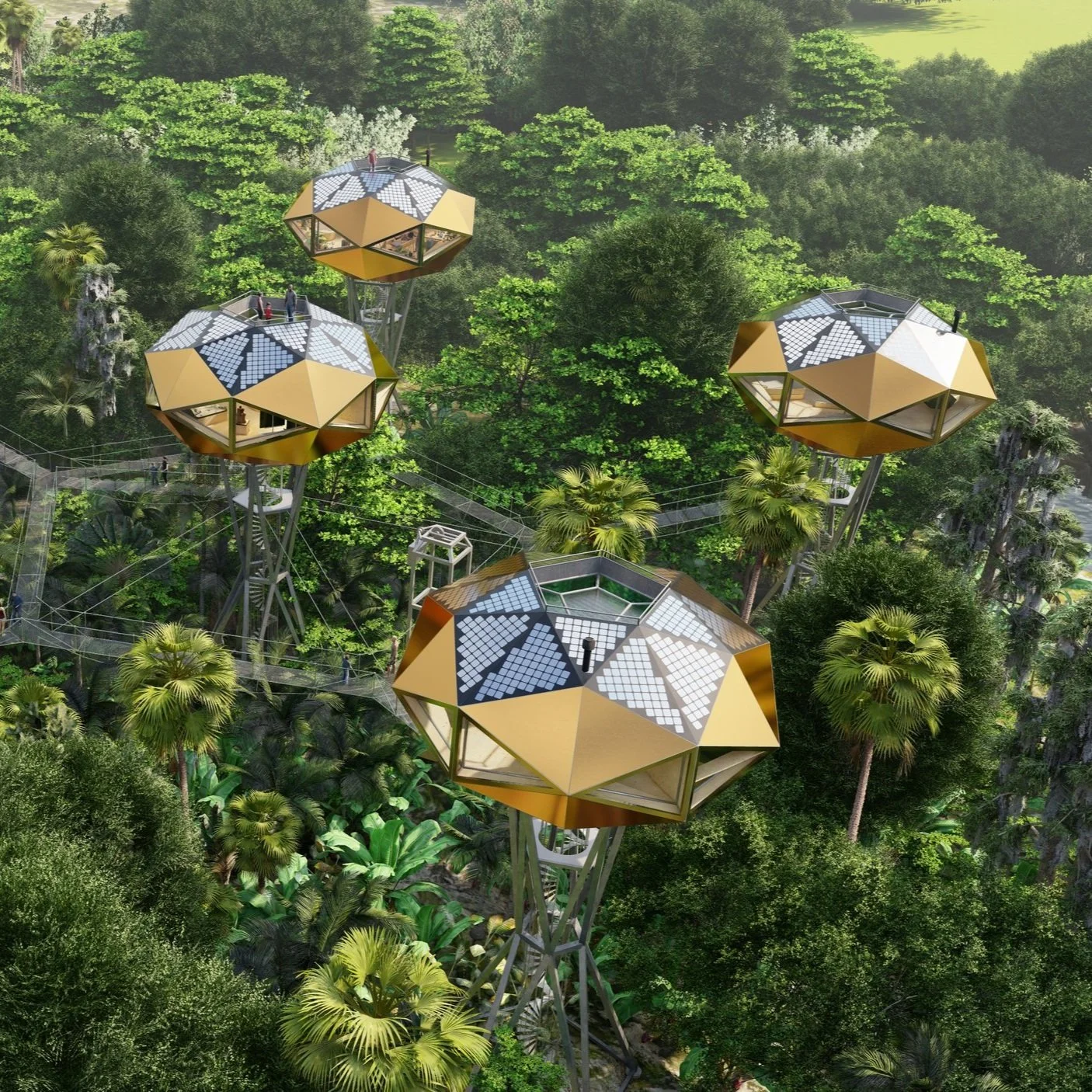
Este proyecto de casas-árbol tiene como intención generar un espacio alternativopara que la gente vuelva a reconectar con la naturaleza, sin renunciar al confort. Con espacios adaptados a nuestras necesidades básicas, que permitan estar cerca de espacios verdes, en simbiosis y armonía.

Ecoturismo responsable con el medio ambiente

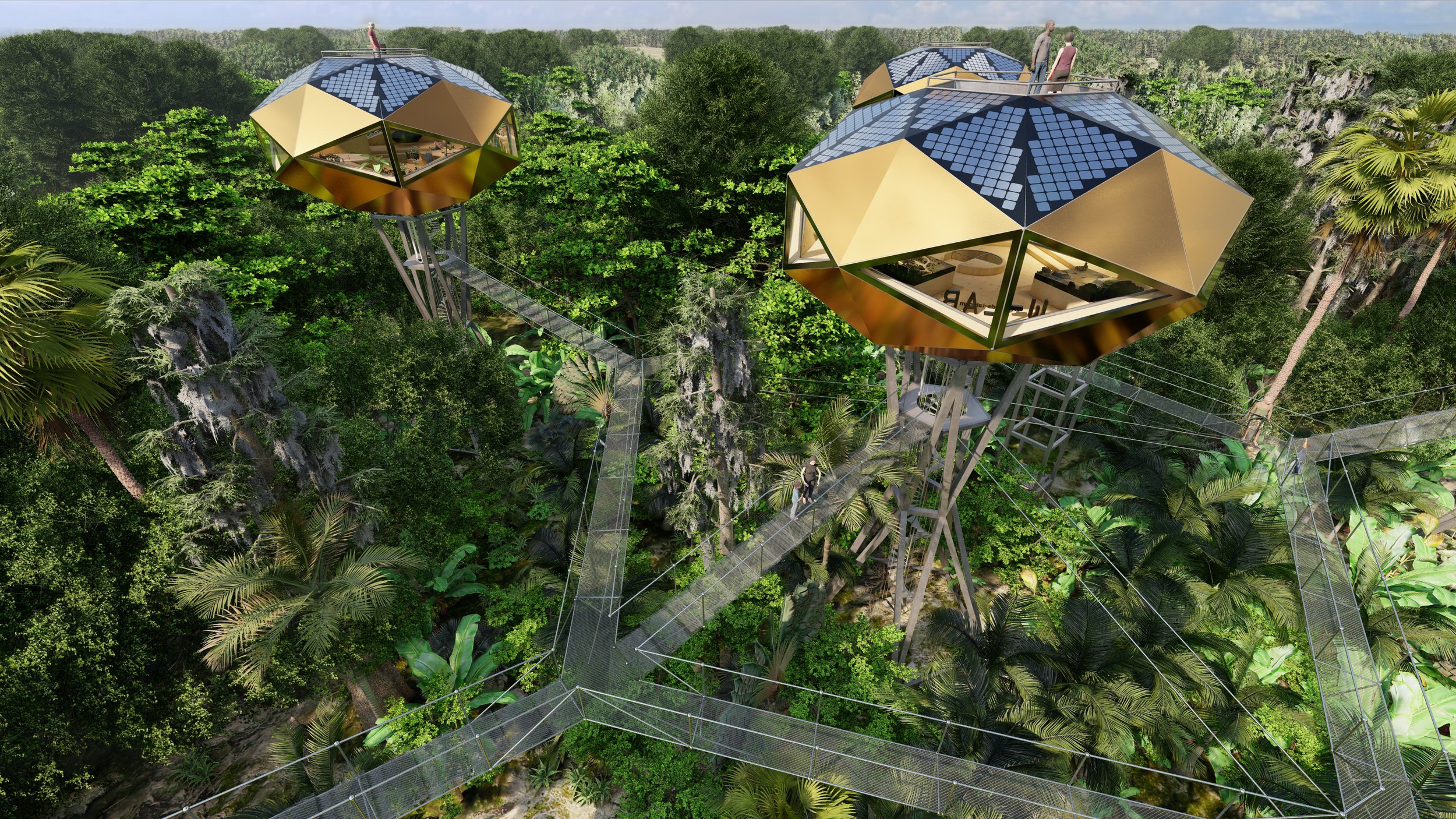
Suspendidas sobre las copas de los árboles, estas cabinas en altura dialogan con el paisaje, posándose en el casi sin contacto.  Concebimos este eco-resort como una alternativa al turismo mas agresivo que transforma el paisaje para amoldarlo a un programa rígido de usos hoteleros comerciales. En WLAB entendemos que la reconexión con los entornos naturales solo se puede hacer si dejamos el entorno en su estado original y es la arquitectura la que se adapta a la naturaleza. Sólo así lograremos coexistir en equilibrio.

Espacios flexibles multifunción.

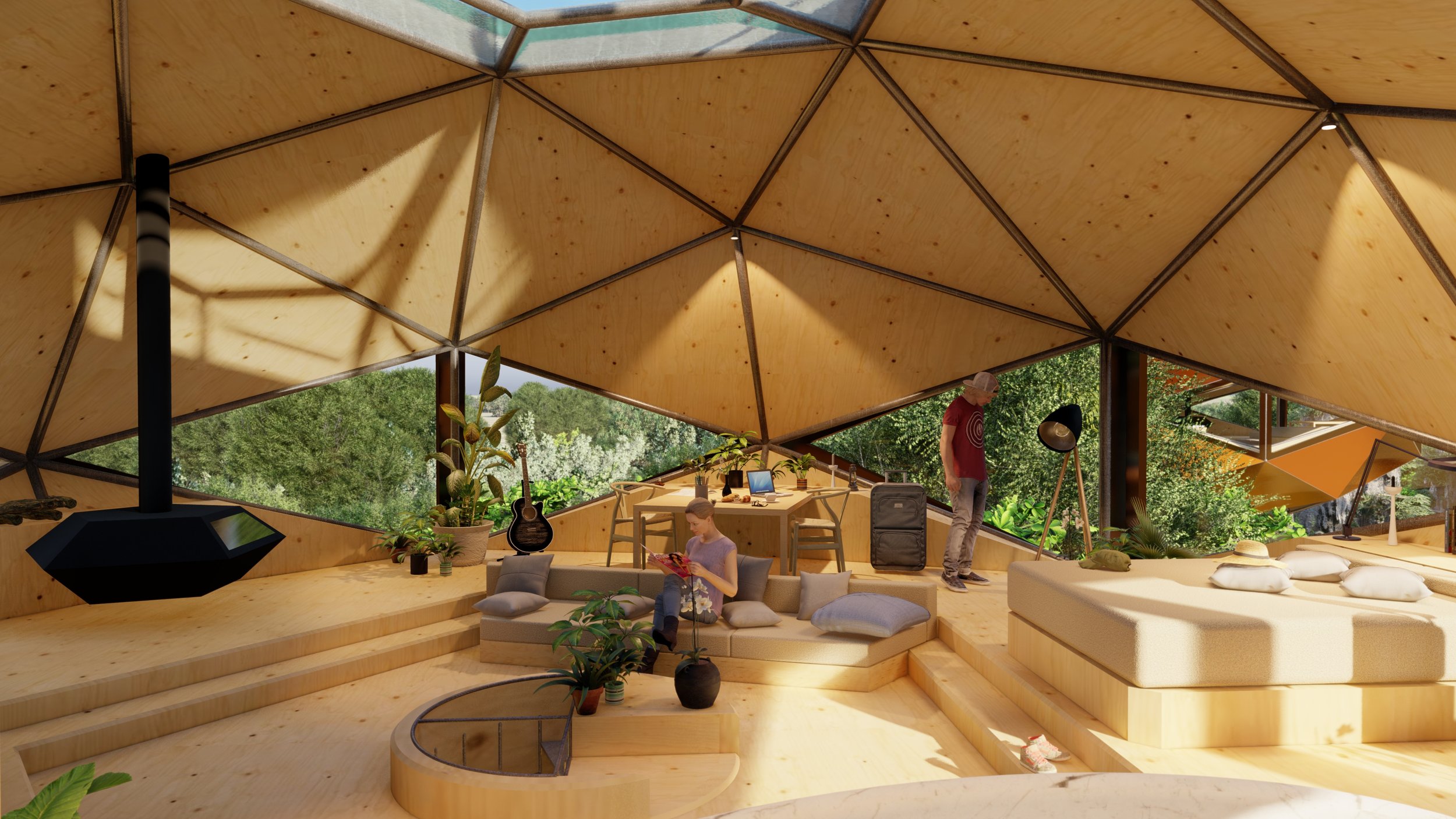
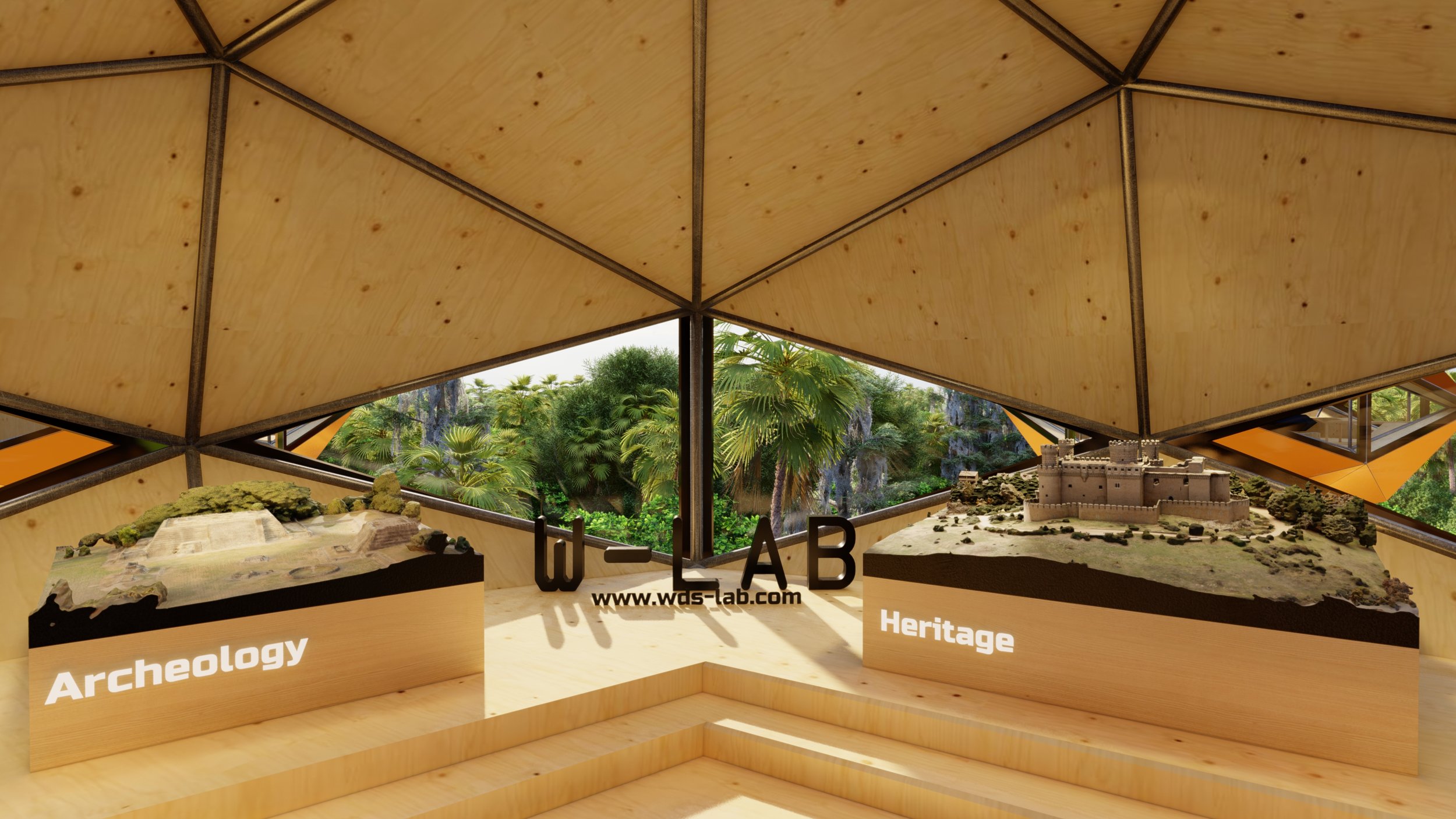
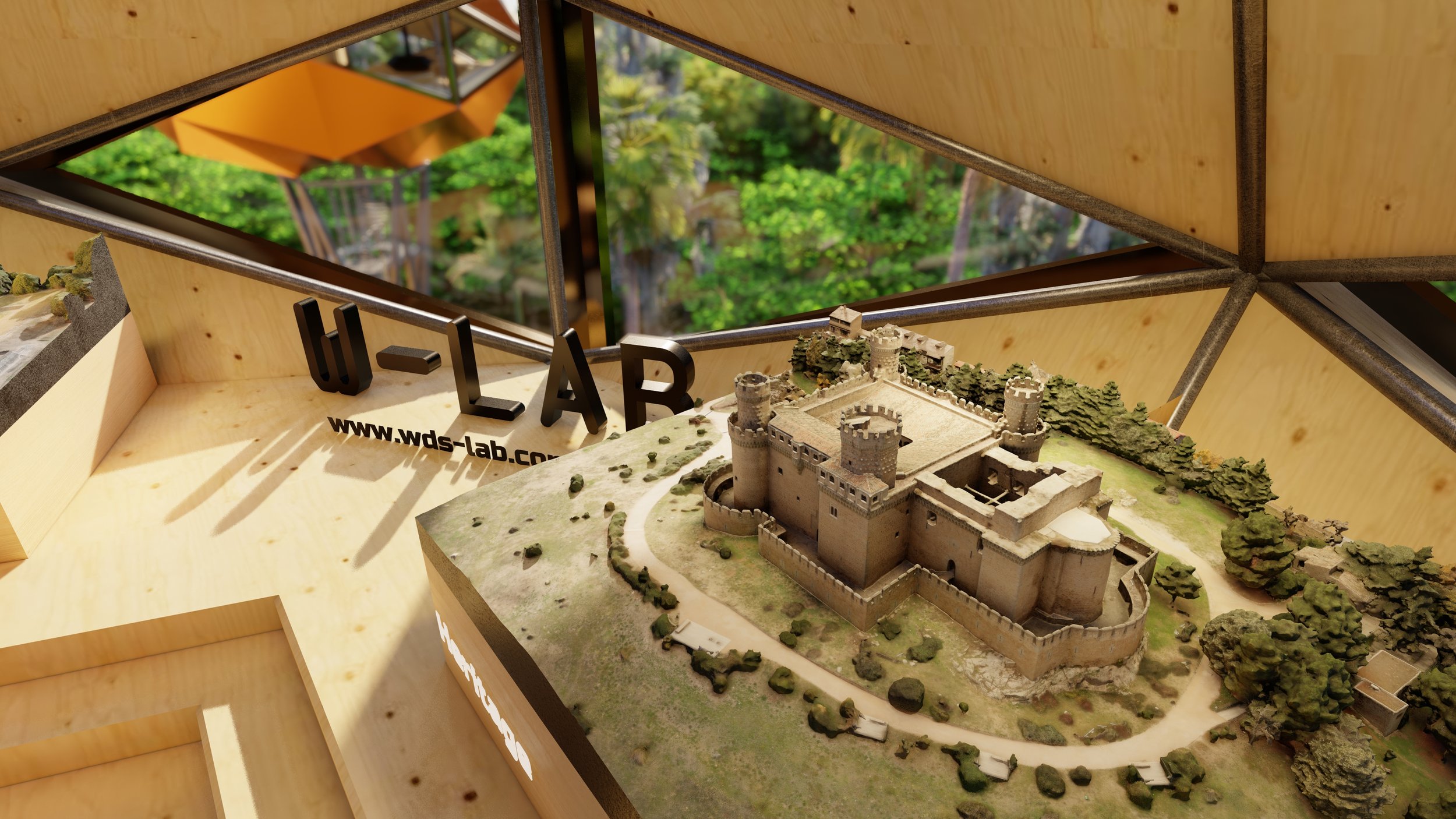
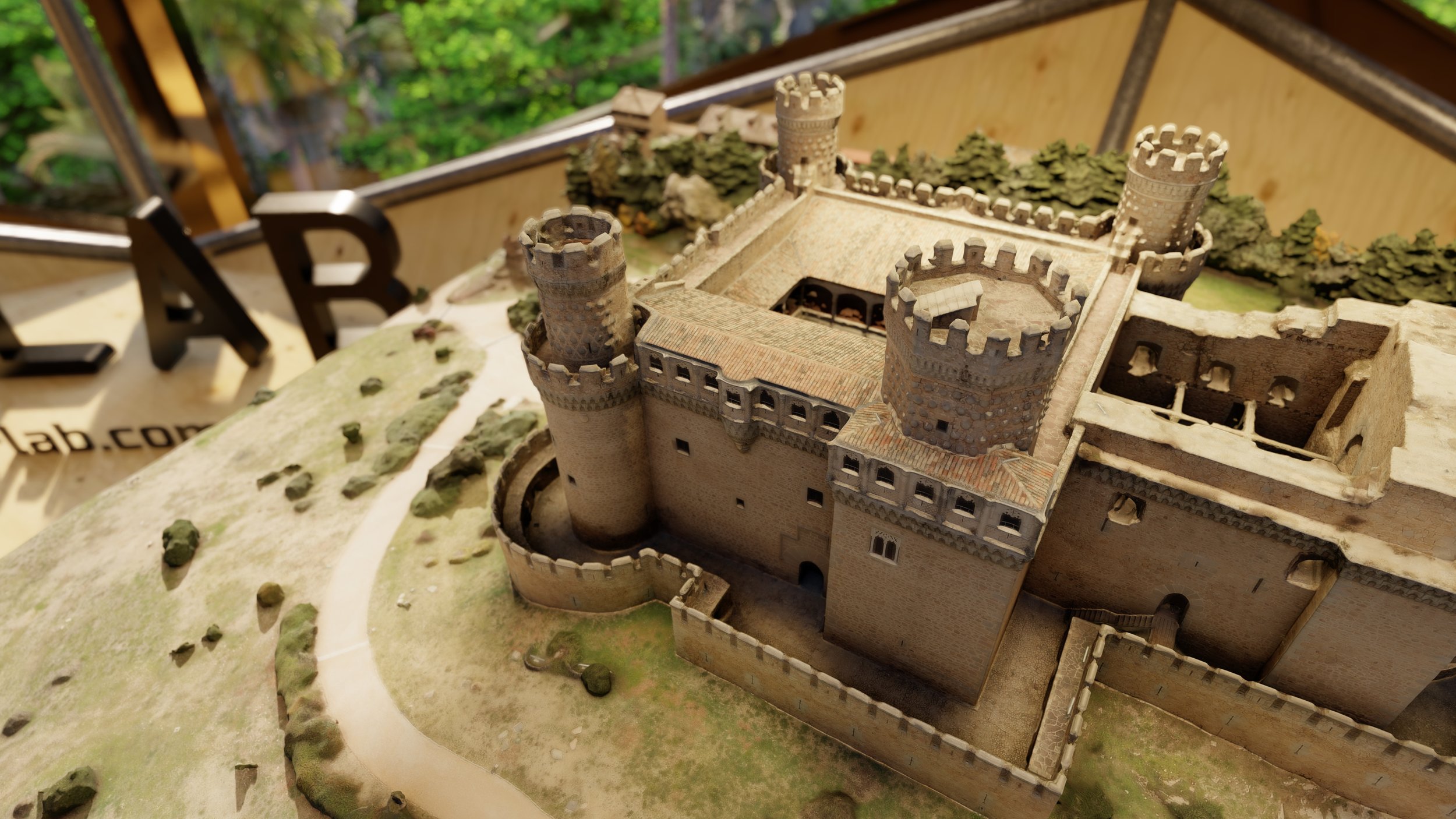
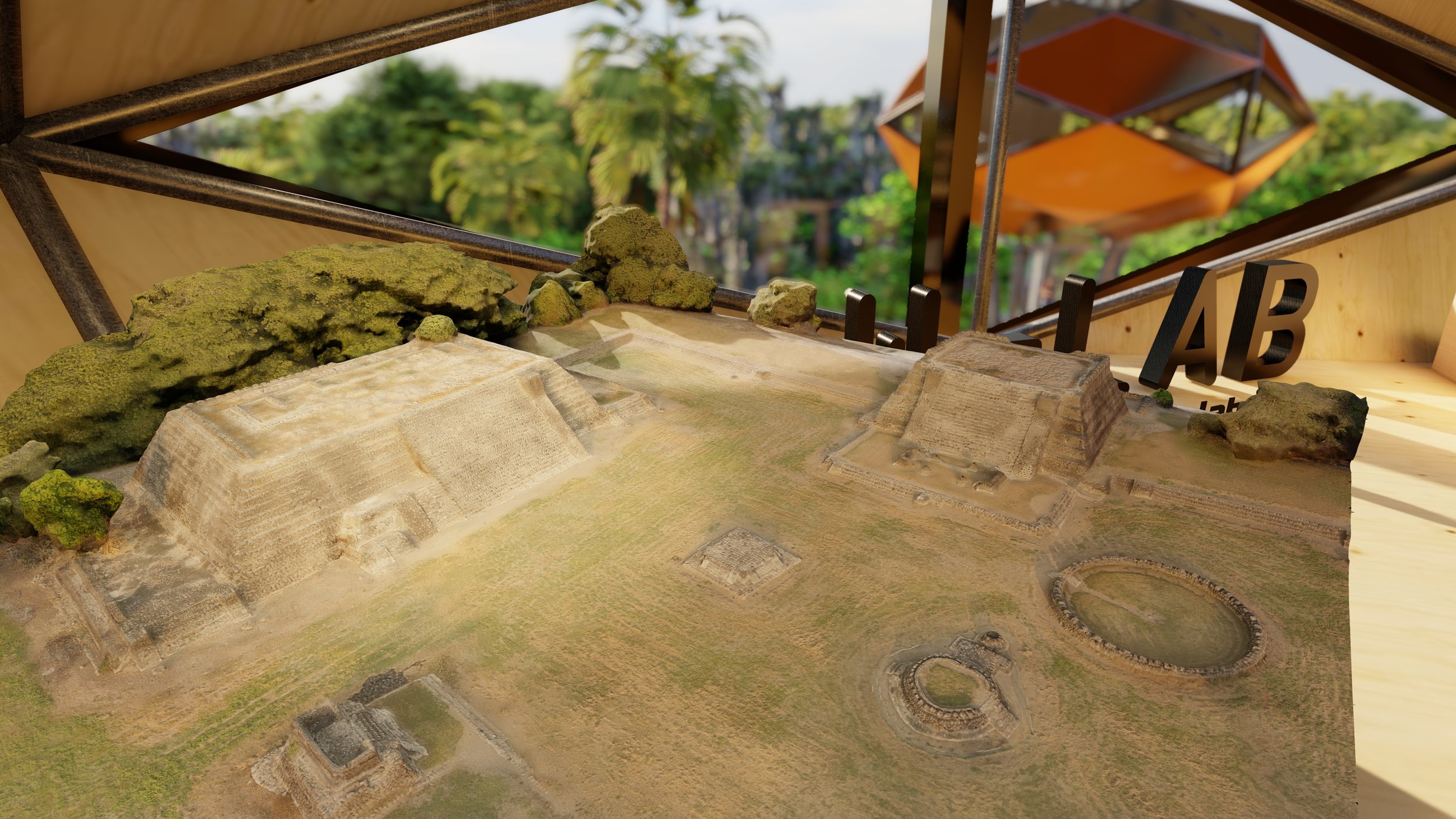
La distribución interior de las cabinas es flexible y puede adaptarse a diferentes usos para acomodar programas mas complejos y necesidades de cada resort. En este ejemplo mostramos una propuesta de museo de sitio local, que bien podría acomodar elementos que se hayan podido encontrar en la zona de intervención o incorporar exposiciones temporales con otro tipo de piezas relevantes. (Todos los modelos mostrados en estas imágenes han sido generados por el equipo de W-LAB mediante Escáner LIDAR y Fotogrametría con drones en sitios existentes entre México y España. Las piezas escultóricas fueron escaneadas en el “British Museum” de Londres)

Materiales Económicos,  duraderos  y de bajo mantenimiento

La construcción esta pensada con elementos modulares prefabricados económicos y low-tech,  que puedan ponerse en obra de manera rápida, reduciendo el tiempo de construcción y el equipamiento necesario. Todos los elementos son planos y rectilíneos. Fáciles de cortar para reducir el tiempo de fabricación. La estructura tanto interna como externa, está constituida por perfiles rectilíneos regulares de acero galvanizado. Estos son económicos y duraderos, además de reciclables una vez concluida la vida útil de la construcción. Son una de las opciones más económicas en el mercado de la construcción de estructuras

  • Estructura:  Perfiles reciclados de Aluminio

  • Revestimiento de paneles exteriores: Panel  sándwich de aluminio con aislamiento térmico interior,

  • Revestimiento interior y suelos: Madera de procedencia certifcada y sostenible

100% Energía renovable

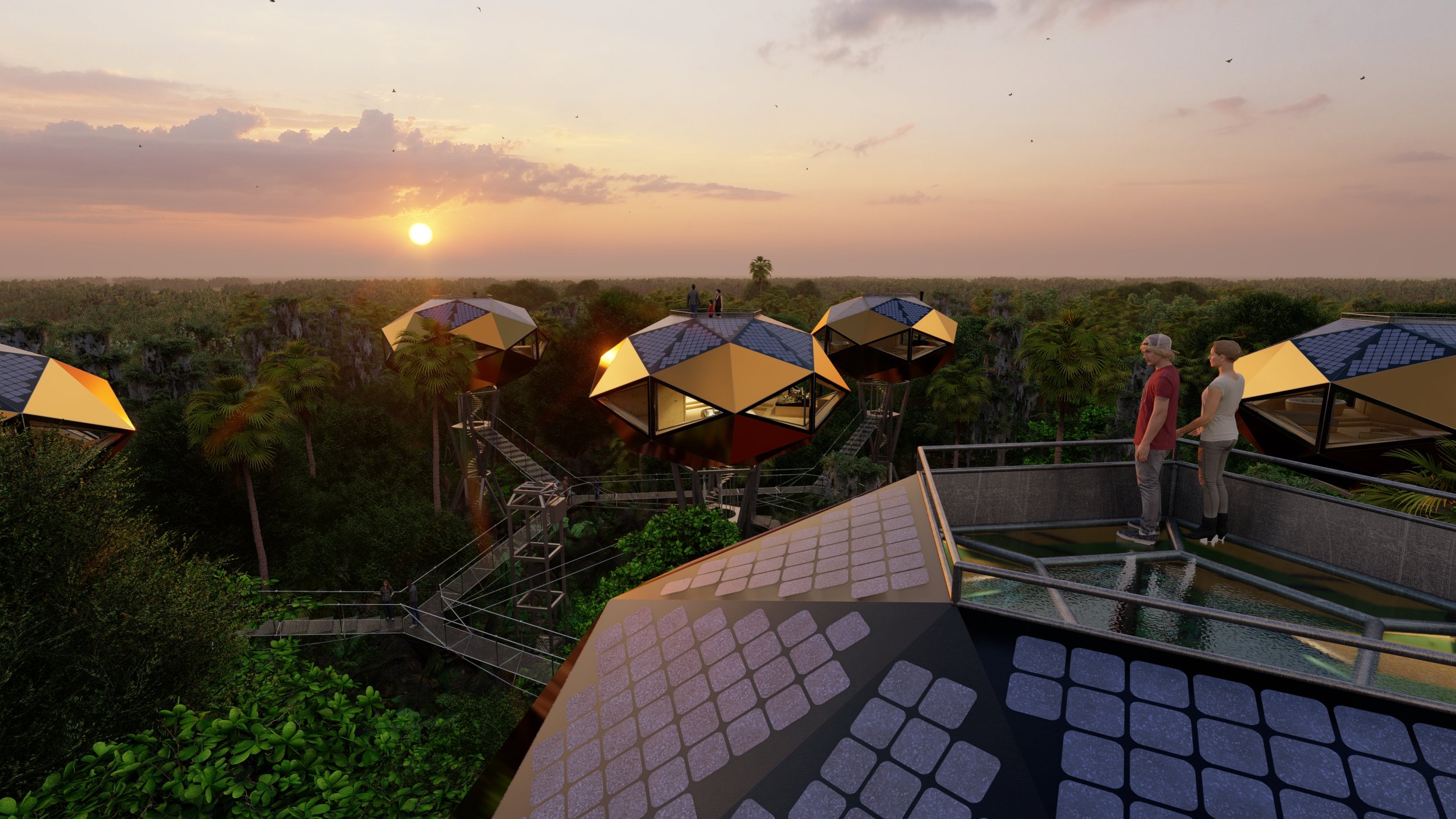
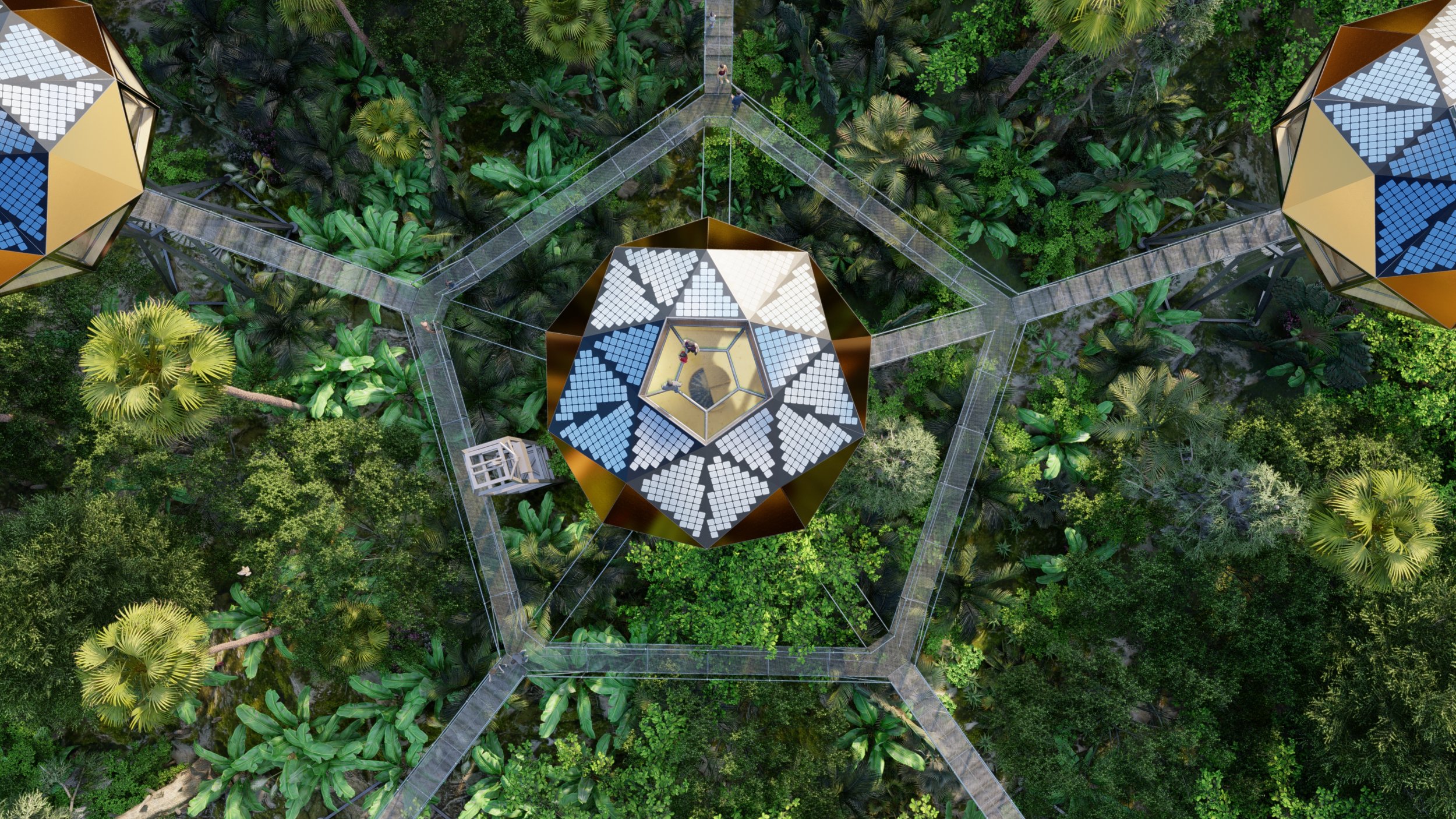
Para conseguir un autoabastecimiento energético autosuficiente, las cabinas cuentan con paneles solares en la cubierta que podrían generar suficiente electricidad para cada módulo. Además cada casa-árbol, cuenta con bolsas biodigestoras de baja presión, conectadas a la salida de aguas residuales, que obtienen gas a partir de materia orgánica. Éste es utilizado para calefacción, agua caliente y cocinas.

Huella de carbono Zero

Con la introducción de paneles solares podemos cubrir toda la demanda energética de cada modulo lo que permite reducir en un gran porcentaje la huella de carbono del asentamiento. Con una propuesta apropiada de reforestación en la propua parcela y en otras áreas necesitadas, este resort podría lograr una huella de carbono negativa, secuestrando más carbono del emitido durante su vida útil. La madera de los árboles nuevos puede secuestrar el carbono equivalente a las emisiones asociadas al proceso de construcción. Así conseguiríamos un balance neutro para el medio ambiente.

Lidar 3D Scanning

El uso de escáneres de mano portátiles para capturas de objetos con gran cantidad de detalles y huecos, hacen la tarea del escaneado mucho más asequible y rápida que con el método fotogramétrico clásico tomando múltiples fotografías desde diferentes ángulos alrededor. Para -digitalizar con precisión objetos cerámicos o escultóricos, nosotros optamos por trabajar al aire libre, en un espacio a cielo abierto con buenas condiciones de luz natural. Esto nos permite conseguir sombras suaves que no desvirtúen las texturas de la pieza objeto de estudio ni sus colores reales permitiendo así mejores resultados a la hora de iluminar el objeto en un espacio virtual.

multi scanner 3D Arrows.jpg

Soporte articulado para mejorar la precisión

Tras diferentes pruebas de escaneando piezas, trabajamos en crear un soporte con brazos articulados de aluminio con los que el soportar el escáner y la pieza objeto de estudio. Gracias a su utilización logramos agilizar el proceso de digitalización, y mejorar la precisión de los resultados. Con este sistema, durante la captura, el objeto siempre queda centrado en la cámara, evitando que el software de procesamiento pierda el seguimiento (algo común al sostener el escáner a pulso o rotar el objecto sobre una base giratoria). Desarrollamos el soporte ajustable, con referencias visibles para la cámara, que permitiera controlar el ángulo de visión centrado con el objeto, sin que este se mueva.

Resultados 3D en apenas unos minutos

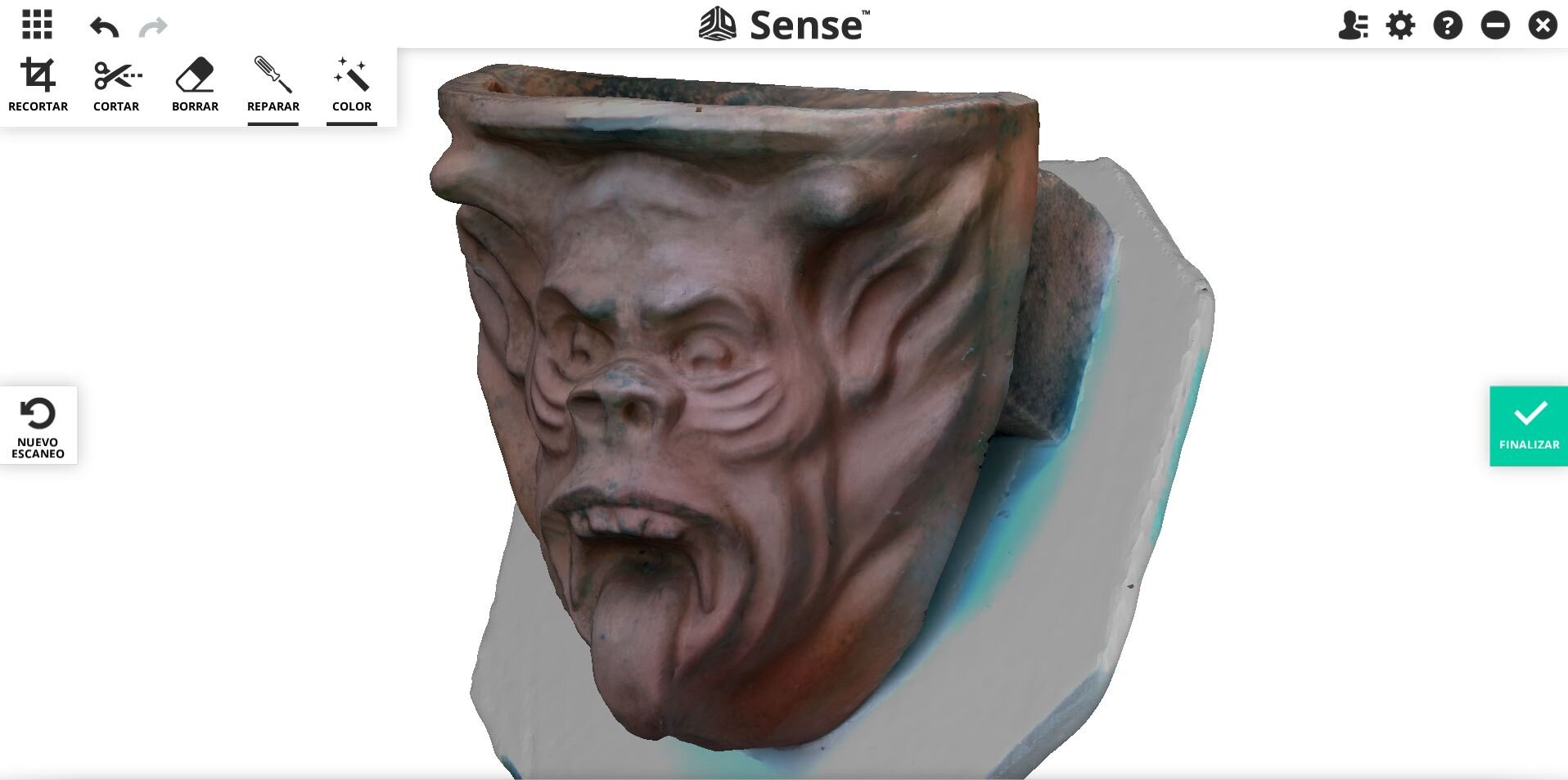
A diferencia del proceso fotogramétrico el cual requiere toma de fotos, ensamblaje en software de edición y retocado del modelo 3d posterior, el uso de un escáner mixto (con cámara y haz de laser) nos va dando un modelo 3D texturizado a medida que nos movemos alrededor del objeto para su digitalización.

Los modelos obtenidos a través del escáner pueden ser retocados en el software de edición con el que viene incluido. Esto nos permite una serie de ajustes básicos en cuanto a correcciones de color y posibles defectos en las superficies del modelo. De esta manera podemos obtener una geometría limpia final sin los elementos de soporte y superficies utilizadas para mantener la pieza a estudiar, en el mejor ángulo para su digitalización. Podemos incluso retocar el color de las texturas y ajustar su brillo y contraste hasta que coincidan con el objeto real.

Exploracion del modelo con sistema de Realidad Mixta.

Una vez finalizado el proceso comprobamos la calidad del modelo visualizándolo con un sistema de realidad mixta, utilizando una Tablet iPad de gran formato, con la que podemos acercarnos al modelo y explorarlo desde todos los ángulos, como si estuviera en el mismo espacio real que nos rodea. Una vez terminado podemos compartirlo desde un espacio 3D:

Para ver el modelo completo en 3D visitad este Link

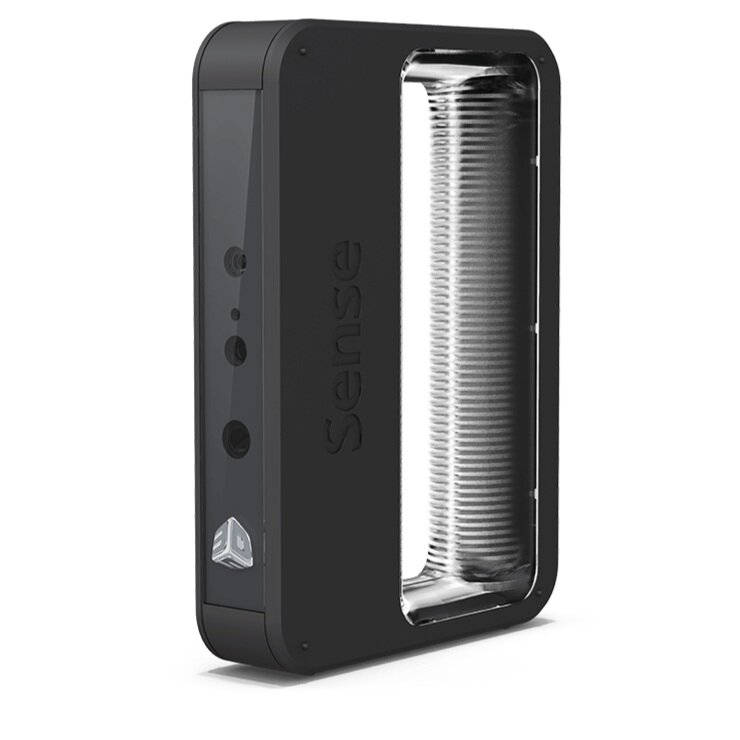
Escáner 2 en 1: laser + fotografía “ 3D sense 2

Para la captura de objetos de geometrías complejas difíciles de procesar con el método fotogramétrico básico, esta escáner con cámara y haz de láser, nos permite crear modelos detallados con textura, óptimos para proyectos creativos. Su versatilidad y relación calidad precio, hace que sea una herramienta de gran utilidad a la hora de generar materiales digitales de contexto para espacios virtuales con finalidad artística, educacional o de divulgación cultural.

3d-systems-sense-hero.jpg

Workflow for indoors Light levels measurements

A la hora de hacer estudios de distribución de iluminación en interiores en WLAB hemos desarrollado un flujo de trabajo con software e instrumentos de medición, que nos permite obtener con precisión los niveles de luminancia e iluminancia en espacios de oficinas, zonas comerciales y espacios públicos. Con estas mediciones y análisis podemos entender si un lugar cumple o no con las regulaciones de así como con los estándares de sostenibilidad y confort

Contamos con un equipo fotográfico profesional e instrumentos de medición científicos, que nos permite hacer todo tipos de estudios lumínicos. Podemos hacer mediciones en estaciones, aeropuertos, museos, oficinas, viviendas etc. Con nuestros estudios podemos mostrar a nuestros clientes si los espacios que han construido, cumplen con la normativa de iluminación y los estándares de sostenibilidad tipo LEED, WELL, BREAM, PASSIVE HOUSE etc.

Facade Thermal Inspection

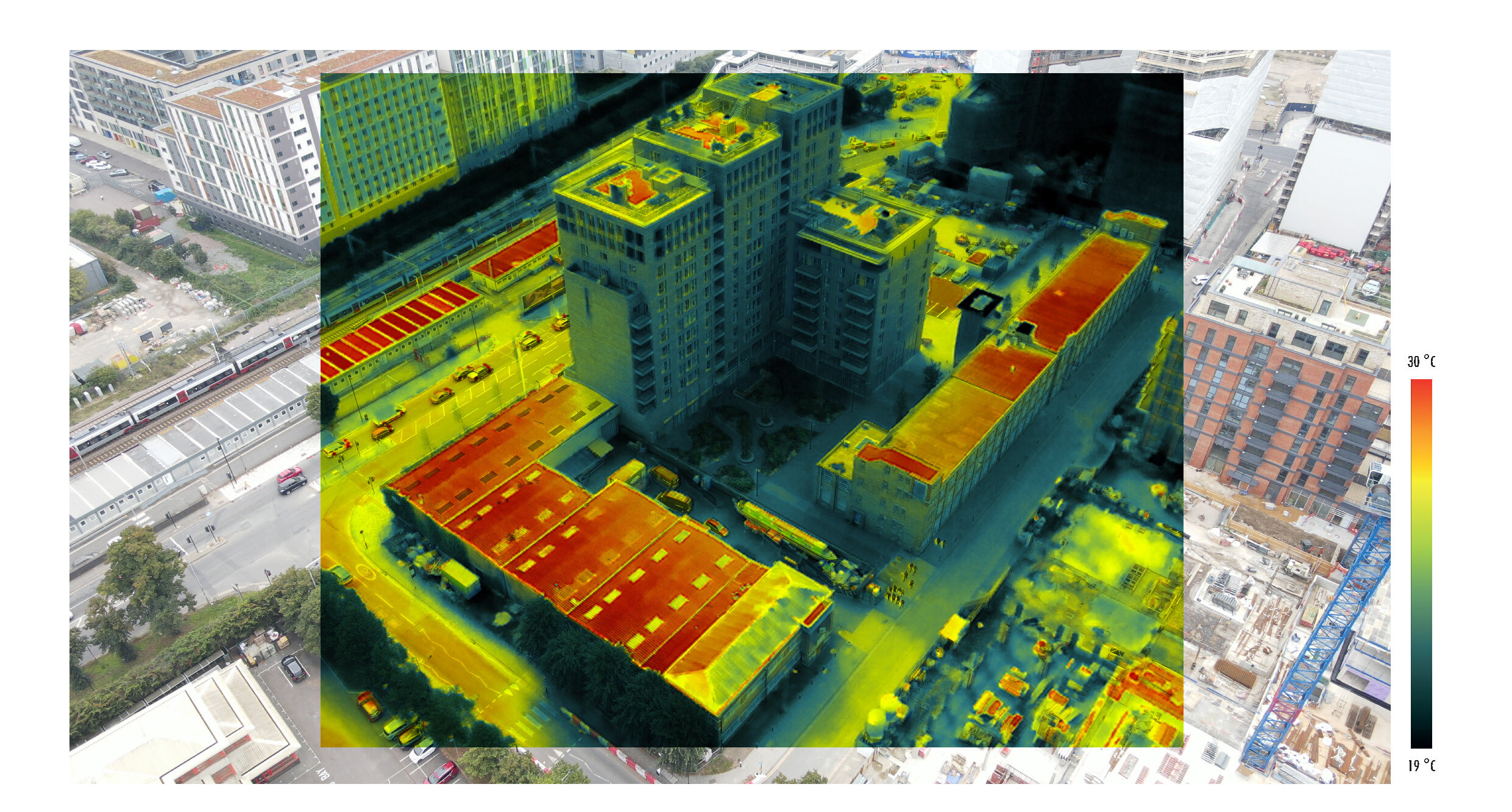
AT W-LAB we work with thermal Drones equipped with high-resolution thermal cameras. With them we can perform facade inspections at high altitudes even beyond Eyesight. We can also check roofs and evaluate their current Thermal performance detecting any issues.

Facades of London_Page_1.jpg

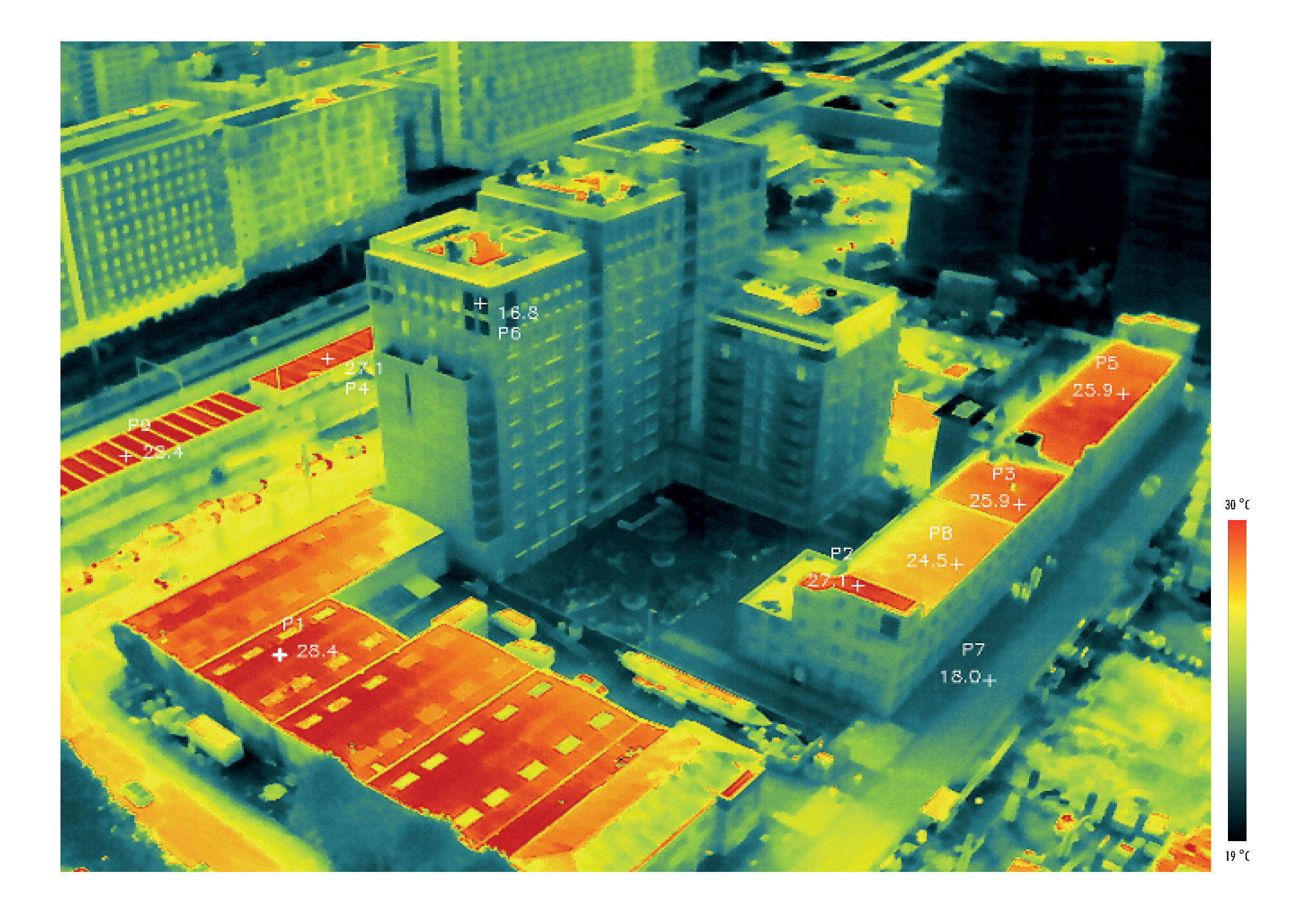
Thermal information gets stored in Radiometric JPEG files with contain the temperature stored per pixel. Thanks to this we can perform different analysis operations and consult information in image date sets we generate with the thermal drone. This allow us to measure Min, and Max temperature in an image and detect unusual temperatures to inform engineers of the findings during one inspection.

On the other hand is also possible to measure average temperature within a polygon drawn in the image.

Facades of London_Page_2.jpg

We can Evaluate how the surface of a building deal with thermal insulation, Solar exposure and the heat island effect, using Thermal Drone surveying. Using Drones we can take shots at high altitudes reducing operative risks without the need of having engineers climbing cranes or scaffoldings

Facades of London_Page_3.jpg

This thermal maps show buidlings under cosntruction in London.

Get in touch for more details and to understand how we can help you with your Thermal survey.

More info

Drone remote sensing for water detection with Thermography

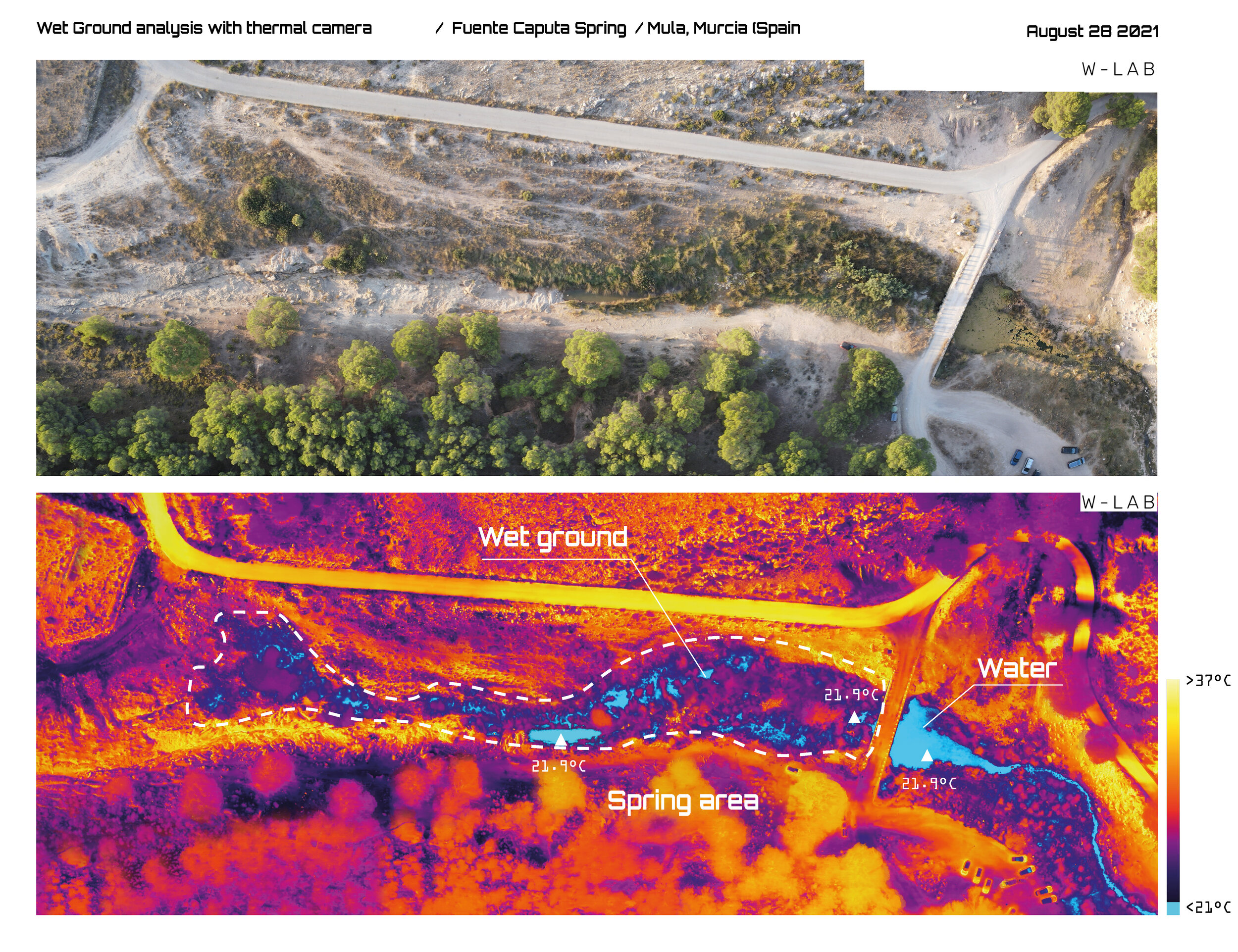
Mediante el uso de termografía Aérea con dron, realizamos un estudio para determinar con exactitud las áreas donde el agua aflora en superficie y determinar así la extensión total del manantial en epoca estival. Este manatial conocido como “Fuente Caputa” en la Region de Murcia y cuyo nombre deriva del latín "Caput Aquae" ( “Caput” significa “recogida” o “almacenamiento”), se encuentra al norte del conocido Embalse de la Cierva y a tan sólo 2 kilómetros de Yéchar. Se trata de un manantial del que salen aguas procedentes de los Llanos de Ardal y de la zona suroccidental de la Sierra de Ricote.

Spring Area_Page_1b.jpg

El manantial principal alimenta uno de los accidentes geográficos que recorren su extensión, la “Rambla de Perea”, que se ubica entre la “Loma de Herrero” y el “Cejo Cortao”. Se pueden visitar distintas pozas y manantiales en las que el agua limpia fluye constantemente, algo que evidencia aún más el interés que ya despertó la zona para los antiguos romanos.

Spring Area_Page_2.jpg

El método de medición que utilizamos para determinar las zonas con agua, lo definimos con algoritmos de análisis de elaboración propios de WLAB. Con ellos analizamos los metadatos de las imágenes térmicas para localizar los lugares con agua oculta entre la vegetación.

Spring Area_Page_3.jpg

Este afloramiento se encuentra a unos 460m sobre el nivel del mar. Con el modelo 3D topográfico, obtenido a partir de las imágenes tomadas y algortimos propios creados en WLAB, definimos las cotas y el modelo DSM. Con este material generado podemos evaluar la profundad del terreno, y averiguar dónde se enceuntran las zonas de afloramientos de agua.

Untitled Extract Pages.jpg

En este pequeño oasis,a poco más de 10 kilómetros de Mula, se conservan dos yacimientos romanos, relacionados con el uso del agua, que documentan un importante poblamiento de esta zona durante el Imperio Romano. La visita a los yacimientos, los restos de un complejo termal y una presa, se puede completar con una excursión junto al manantial de Fuente Caputa y hasta el abrigo de Cejo Cortado, que conserva pinturas rupestres pertenecientes al arte naturalista levantino.


Photovoltaics Thermography inspection with Drones

Ahorrando tiempo y dinero con inspecciones aéreas térmicas con drones profesionales

PV_Report_Page_03.jpg

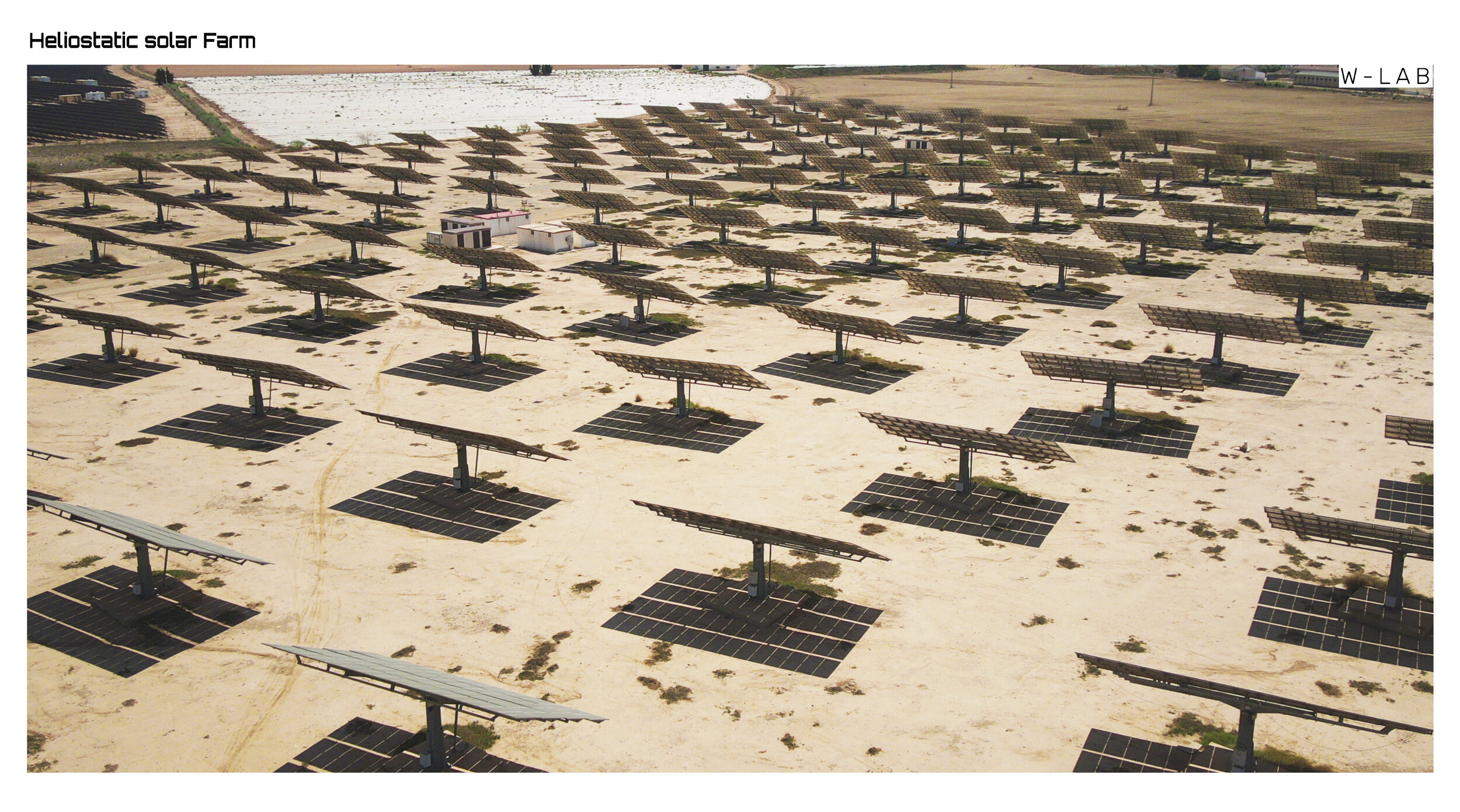
Mediante el uso de drones equipados con cámara térmica, el ahorro de tiempo y dinero a la hora de inspeccionar el estado de los paneles es considerable.  Mediante este tipo de herramientas y técnicas de análisis de imágenes térmicas, podemos mapear granjas solares completas en cuestión de horas y encontrar que paneles tiene celdas defectuosas o detectar cuales no estar trabajando a su máximo rendimiento. Las celdas pierden eficiciencia cuando transforman energia electrica en calor, lo que destaca en las imagenes termicas. Durante la inspeccion, éstas aparecen sobrecalentadas, más allá de lo normal.

PV_Report_Page_09.jpg

Las ortofotos de alta resolución las generamos a partir de gran cantidad de imágenes tomadas secuencialmente con vuelos programados. Cada toma fotográfica captura una imagen térmica y una imagen RGB de alta resolución. Una vez ensambladas estas quedan georreferenciadas permitiéndonos detectar con precisión que celdas puede estar dañadas y además conocer su posición precisa.

El uso de drones nos permite obtener imágenes de calidad profesional, iguales que una imagen satelital, pero de manera más económica. Gracias a este sistema aceleramos el proceso de inspección.  Con un dron podemos hacer la toma de datos más rápido que si la inspección se hiciera en tierra con equipos de técnicos. Además, podemos revisar desde múltiples ángulos, y obtener datos en formato de imagen estática y video.

PV_Report_Page_01.jpg

The Biocabin project

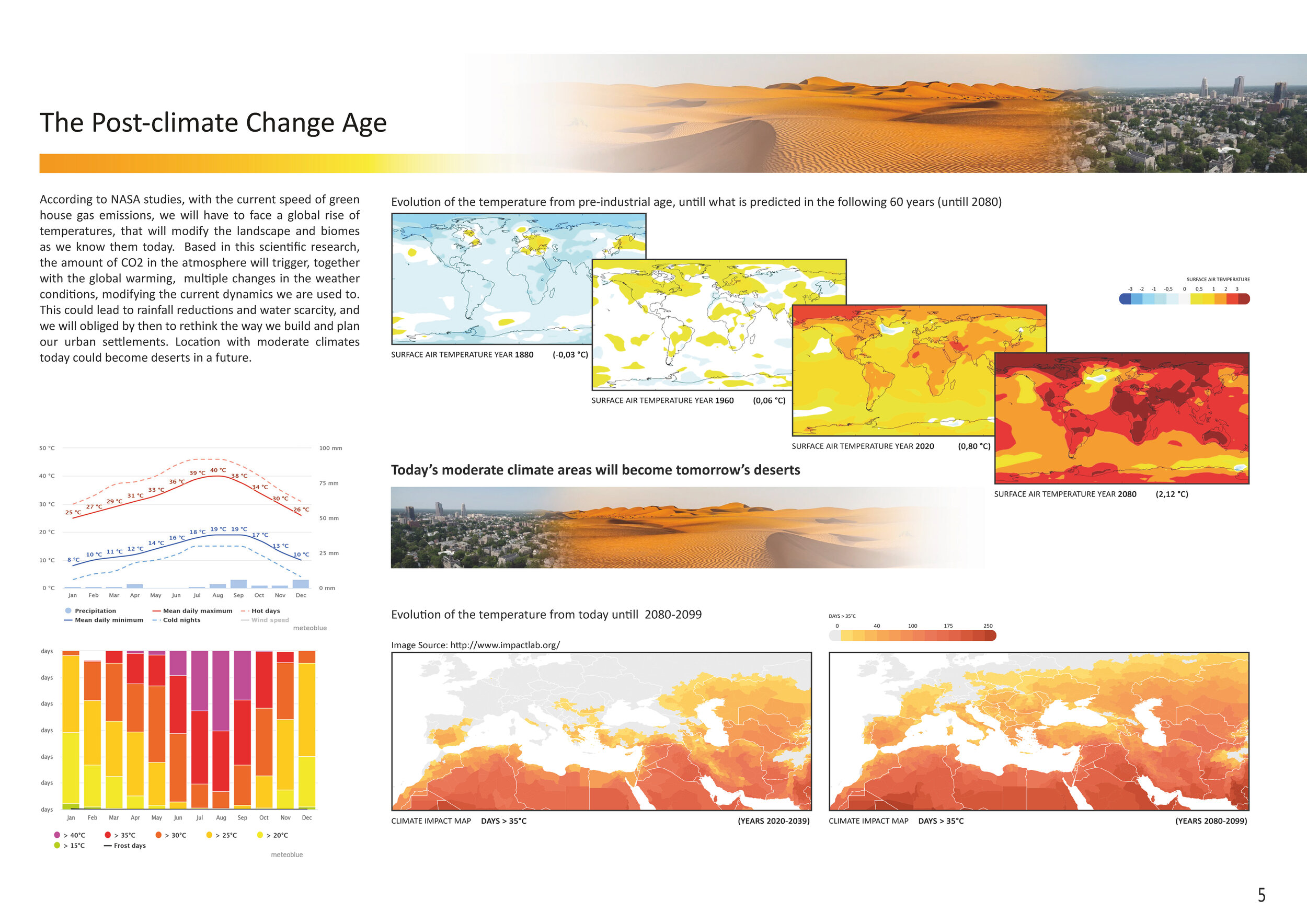
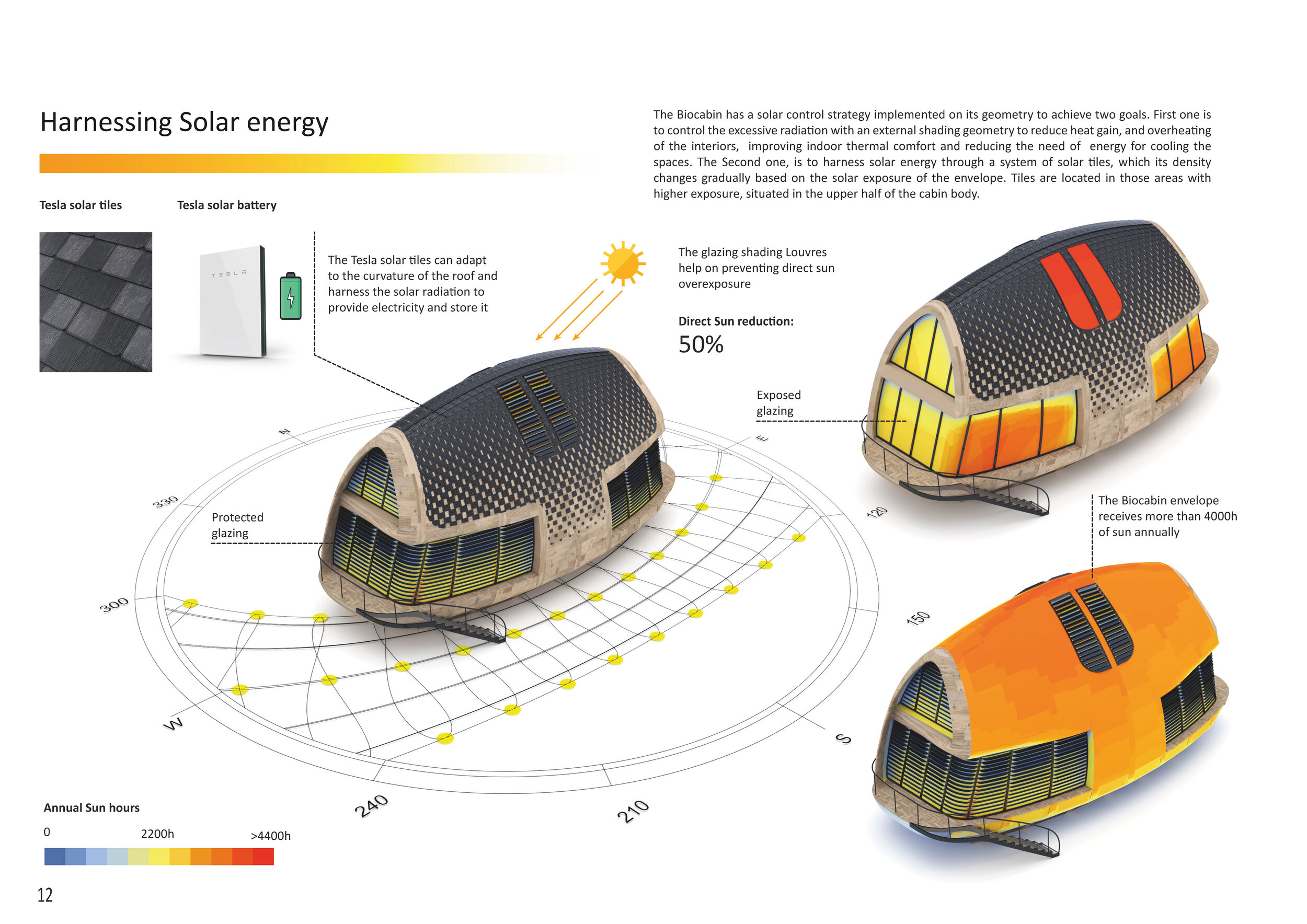
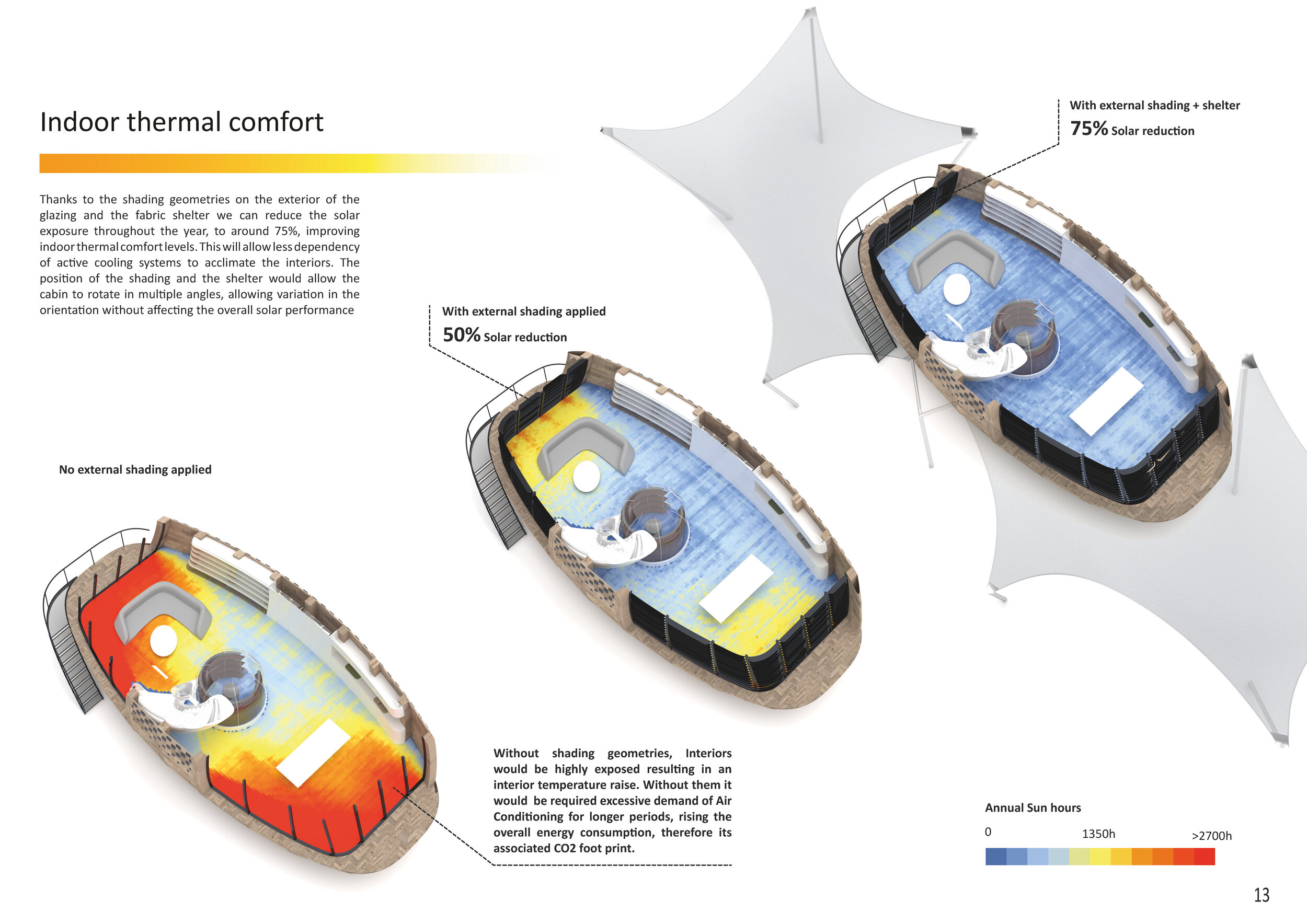
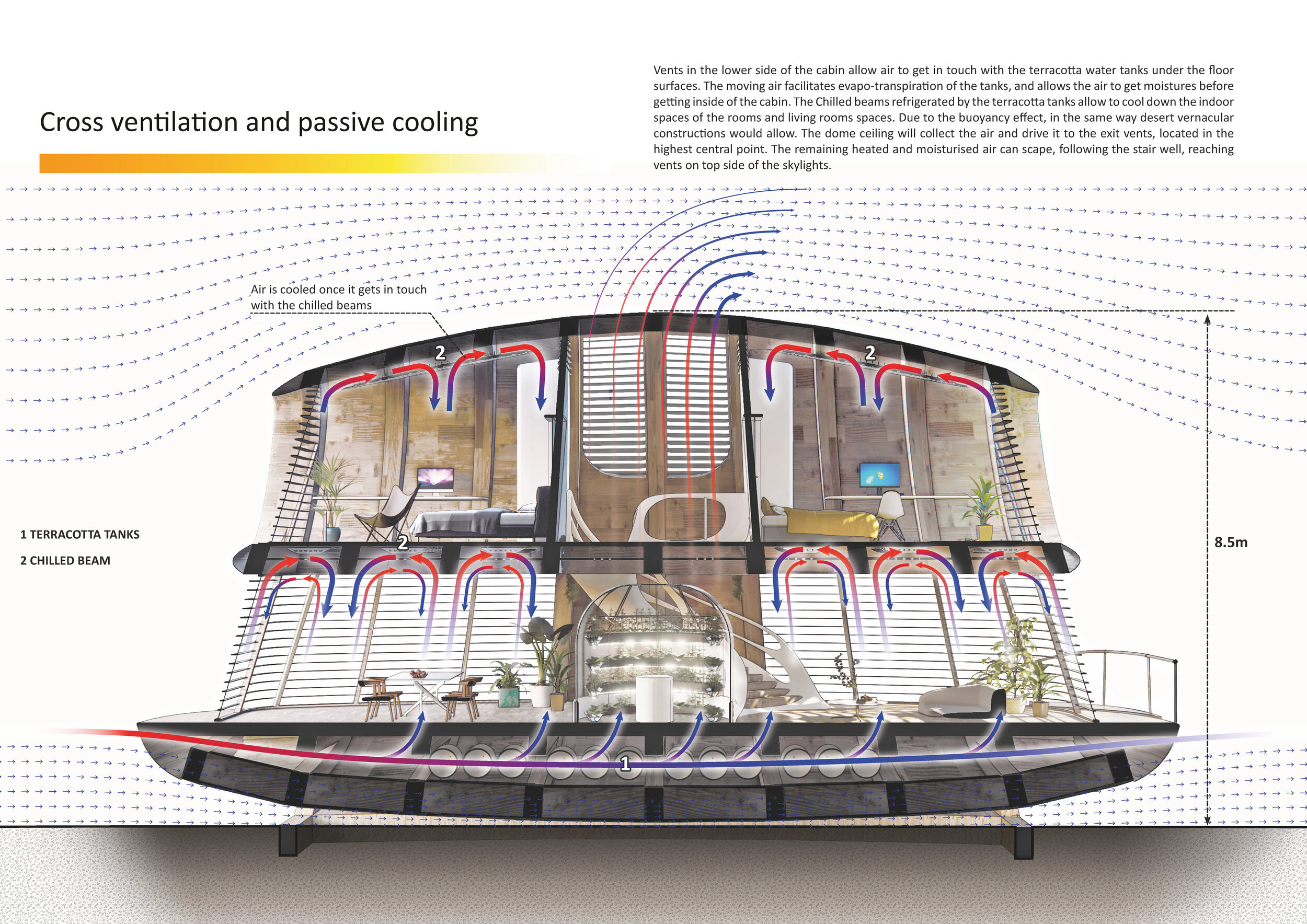
Given the current rate of greenhouse gas emissions saturating our atmosphere, the scientific community agrees that we will have to face a global rise in temperatures that will alter existing climate dynamics. Over the course of the next century, this shift will transform ecosystems and landscapes as we know them today, forcing contemporary construction systems to adapt to new environmental conditions. As an architect, I believe it is essential to explore alternatives that can improve our quality of life in future scenarios where climatic conditions may become extreme and where basic natural resources could be even more scarce than they are today.


Find this article in Archdaily, Designboom y Plataforma Arquitectura

The Post–Climate Change Scenario

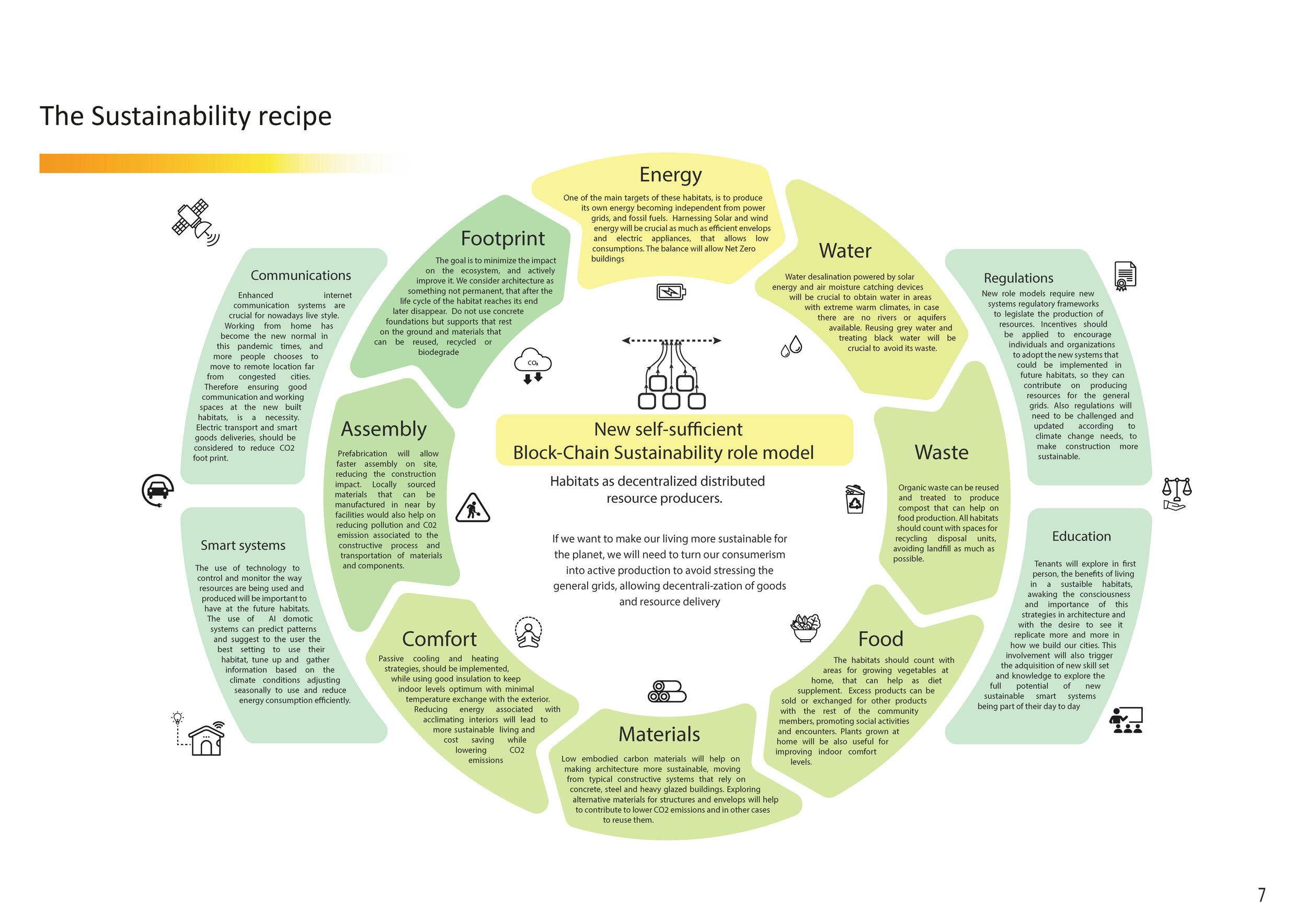
The predictions generated through computational simulations present scenarios that differ significantly from those we experience today. These analyses indicate that many temperate climate regions could transform into arid areas with harsh environmental conditions. Extreme temperatures and new climatic dynamics will require a fundamental rethinking of urban settlements and construction methods in these regions. Aware of this possible future, I explore how housing could evolve in a context of limited natural resources and extreme climatic conditions. For this post–climate change design study, I use solar analysis tools to investigate how a low-tech habitat, built with bio-construction materials, can respond to these challenges. The goal is to propose more sustainable, flexible solutions capable of adapting to environments characterized by extreme heat and resource scarcity.

Protection Against Environmental Adversity

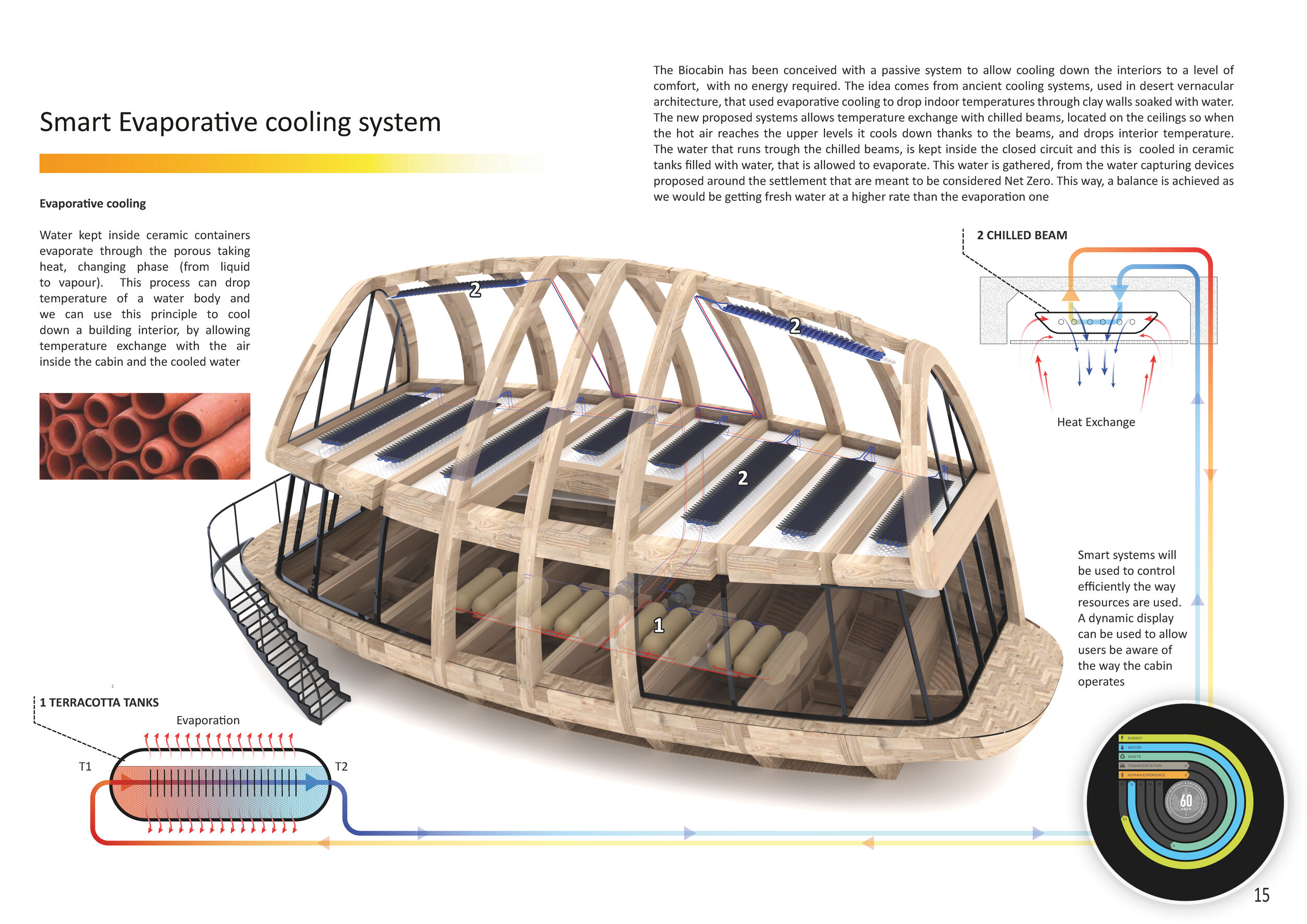
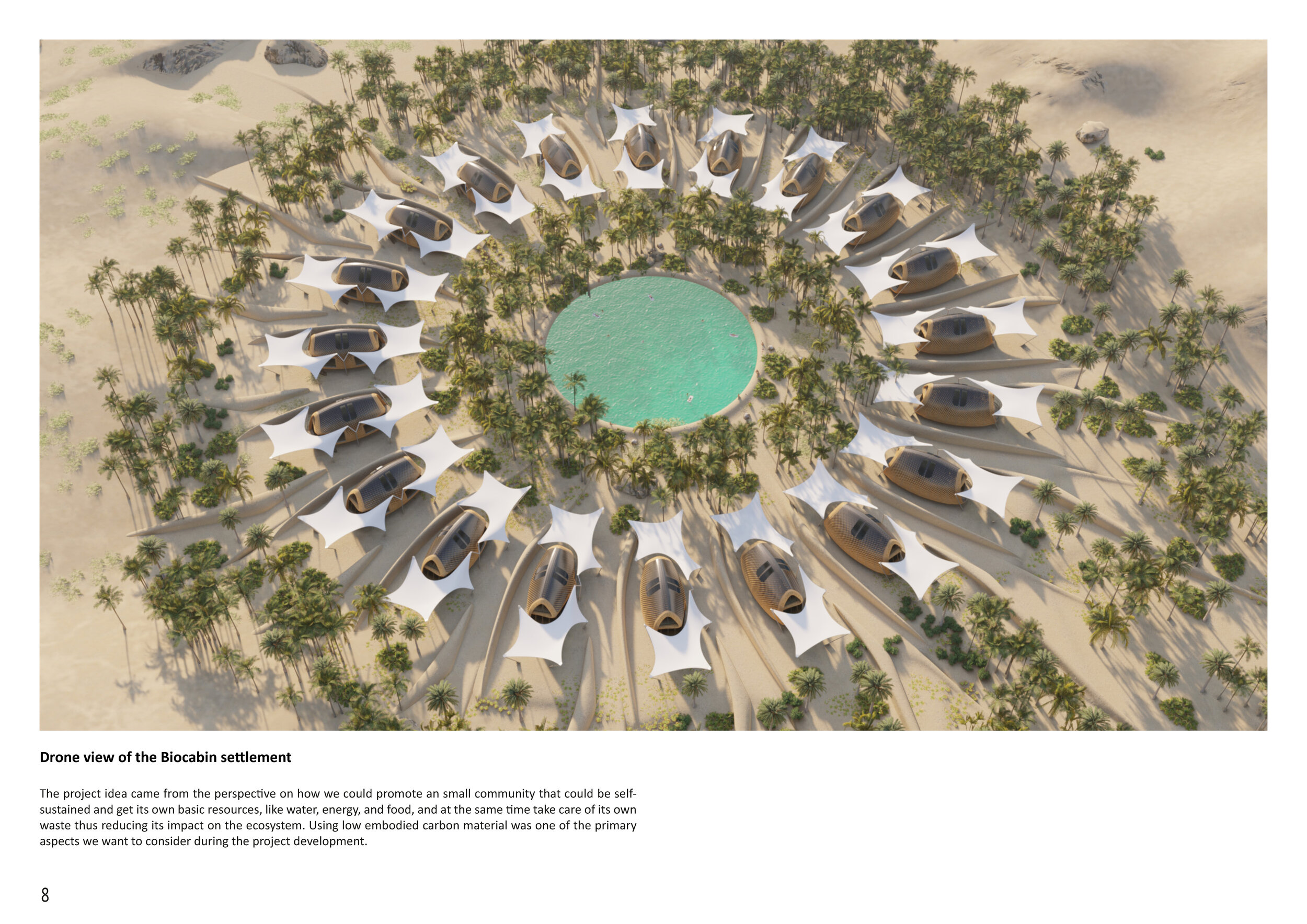
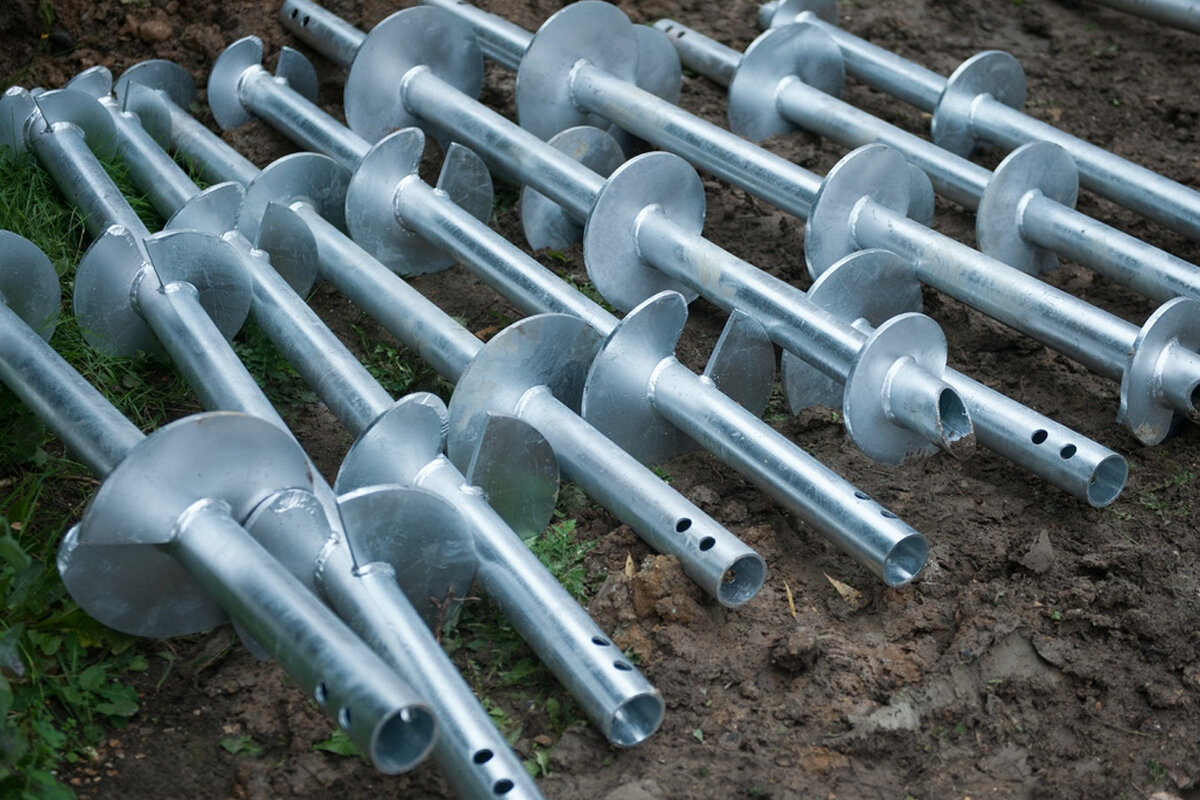
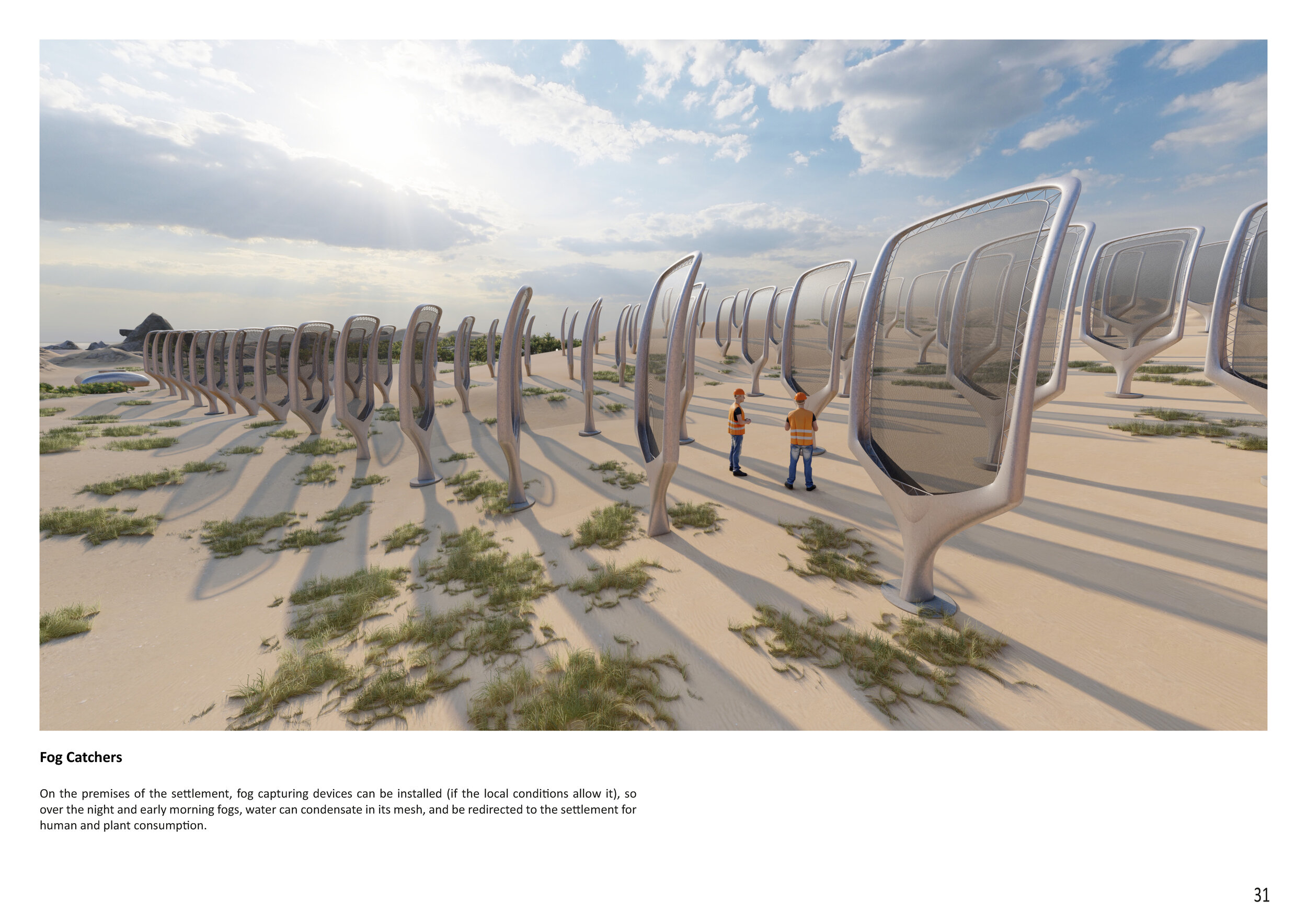
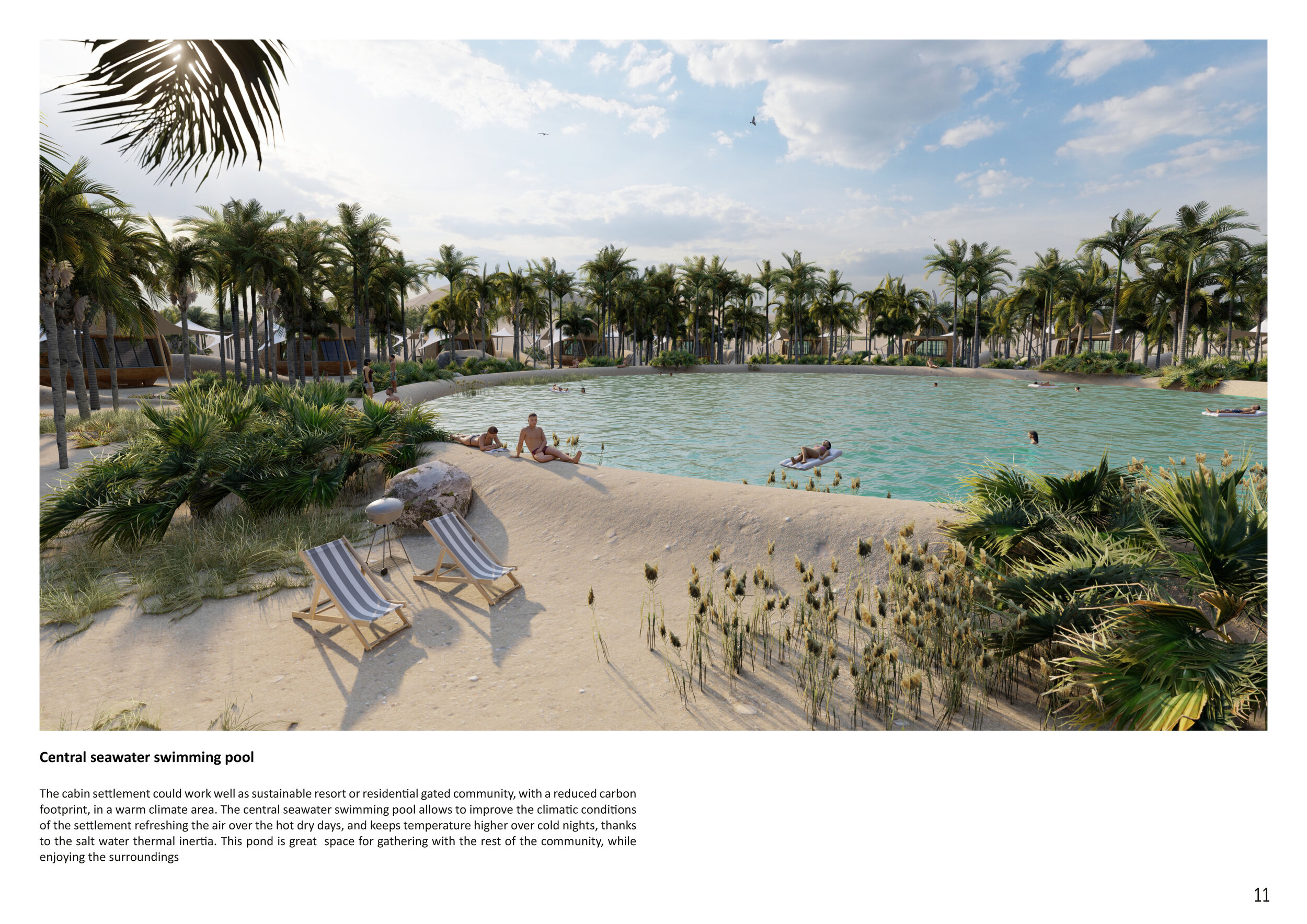
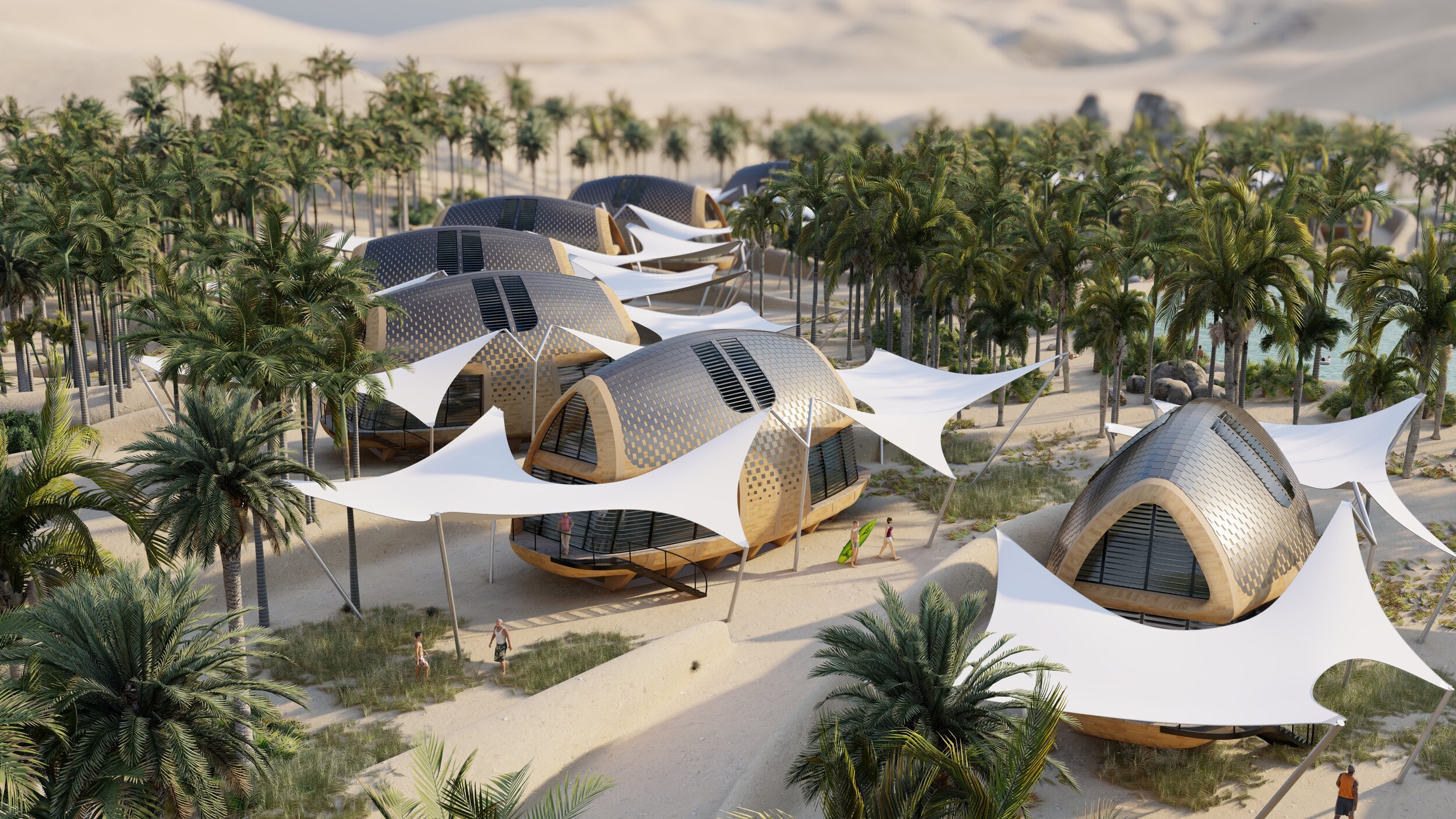
For a settlement located in an arid environment, I propose transportable living units that rest lightly on the ground using screw pile foundations. These foundations can be removed without leaving permanent marks on the site, further minimizing the environmental footprint. I envision a radial arrangement of low-rise habitable modules, designed to define a protected central space for outdoor communal activities. The integration of vegetation, shading elements, and low perimeter walls helps shield the settlement from strong winds and intense solar radiation. Together, these strategies create sheltered spaces organized around an artificial oasis, supplied with water from a solar-powered desalination system and fog-harvesting devices. This system enhances outdoor comfort and contributes to lowering temperatures in the immediate surroundings of the settlement.

Vegetation as Wind Protection

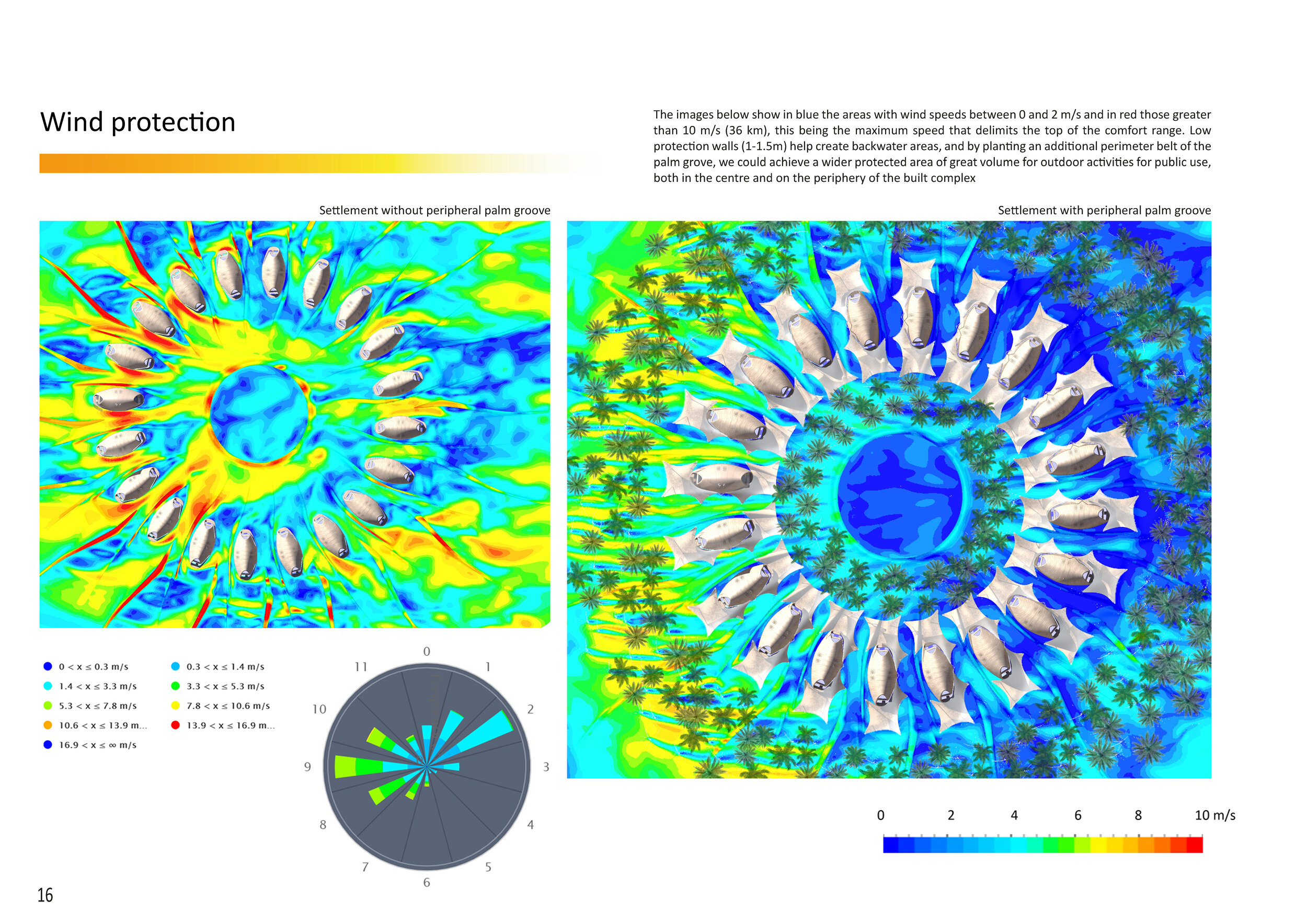
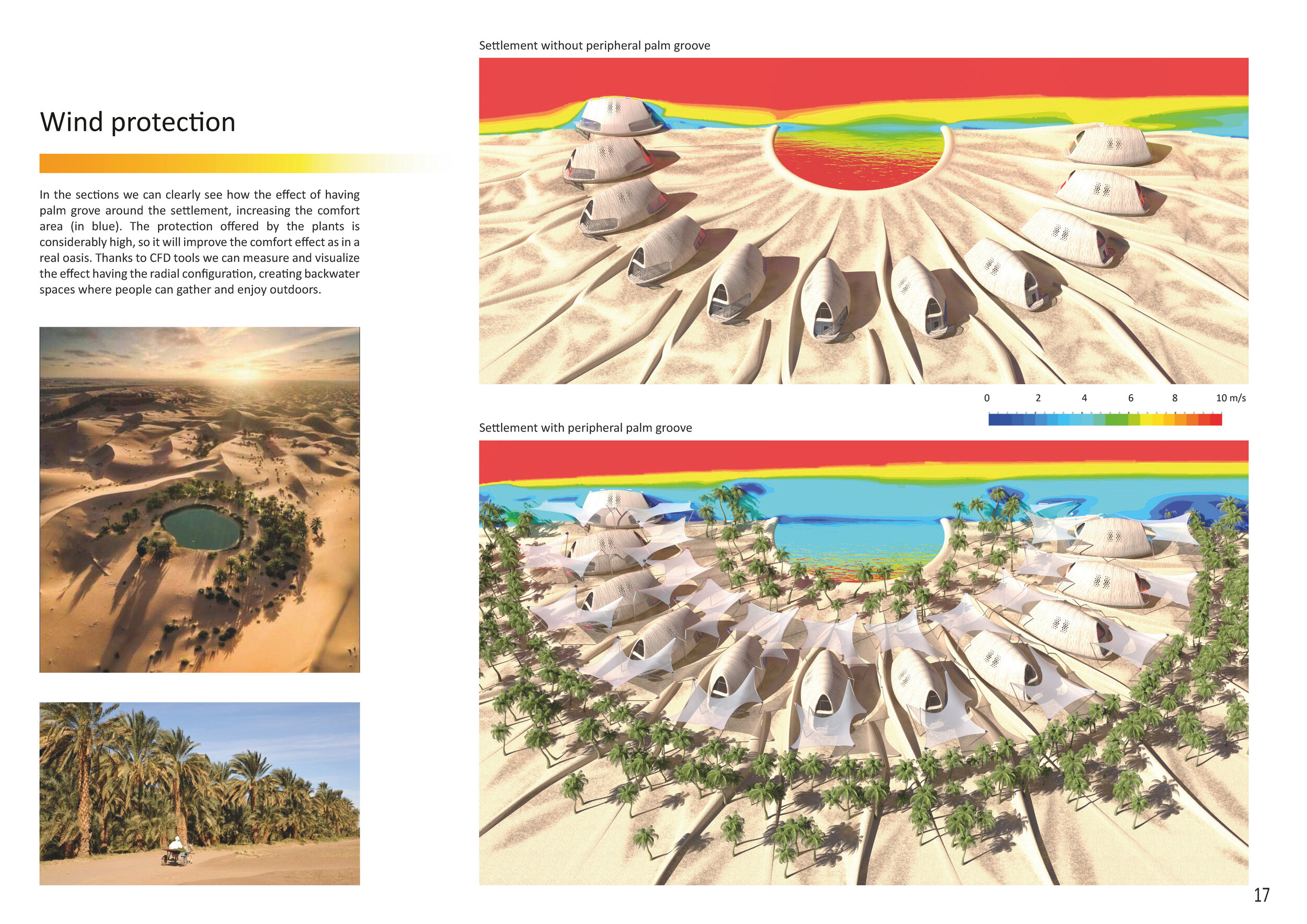
My wind dynamics studies confirm the effectiveness of palm groves and desert vegetation in reducing wind intensity in highly exposed environments. Green belts are known to act as filters for airborne particles while also providing shelter. Through computational CFD tools, I am able to validate the performance of this strategy and quantify the volume of protected space it creates.
In the images below, blue areas represent wind speeds between 0 and 2 m/s, while red areas indicate speeds above 10 m/s (36 km/h), which defines the upper threshold of the comfort range. The use of low protective walls (1–1.5 m) helps create localized wind-shadow zones, but proves insufficient on its own. As shown in the vertical sections, the addition of a peripheral palm grove allows for the creation of a large, protected volume suitable for public outdoor activities, both at the center and along the perimeter of the built complex.
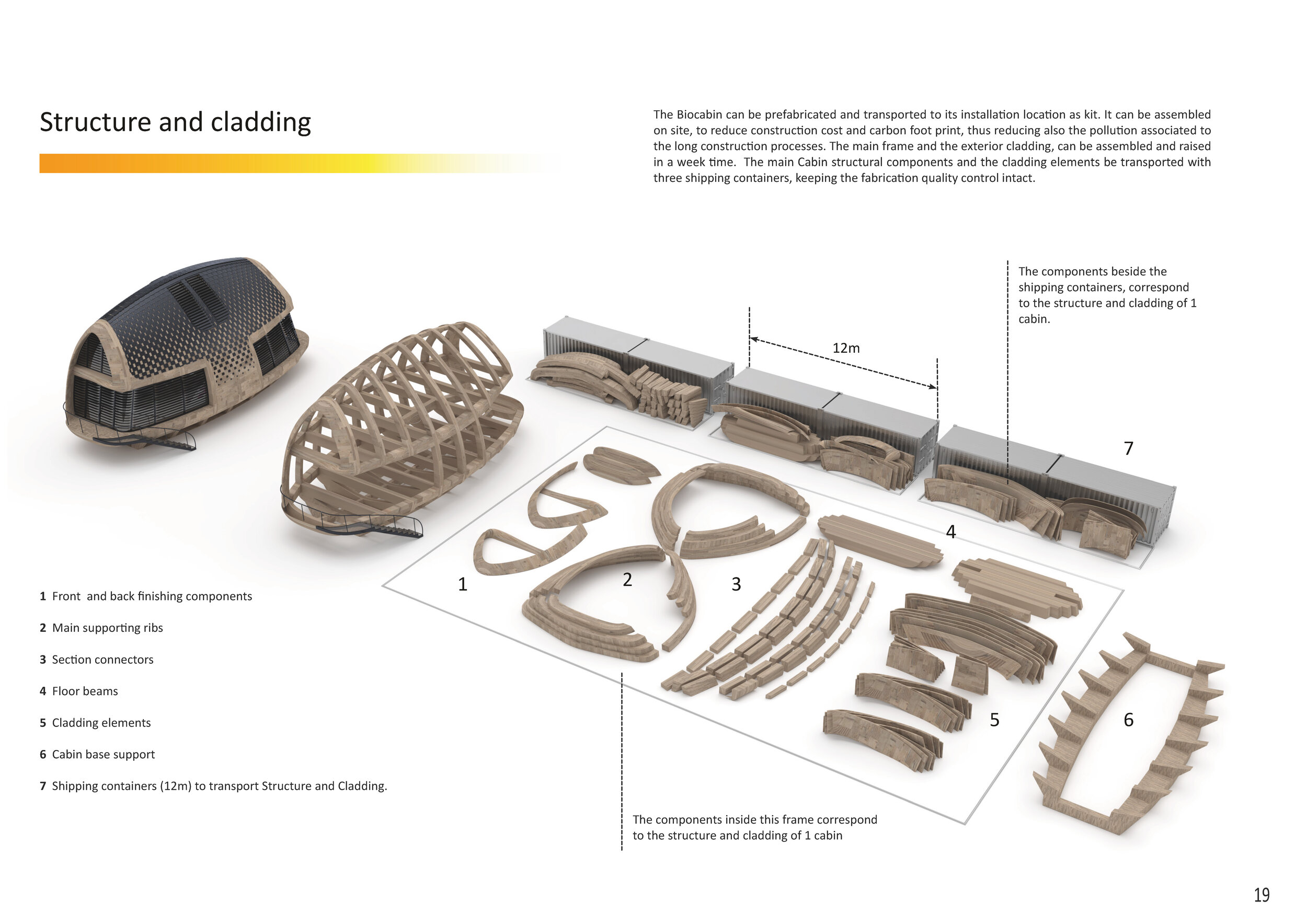
Prefabricated Habitats for Rapid Assembly

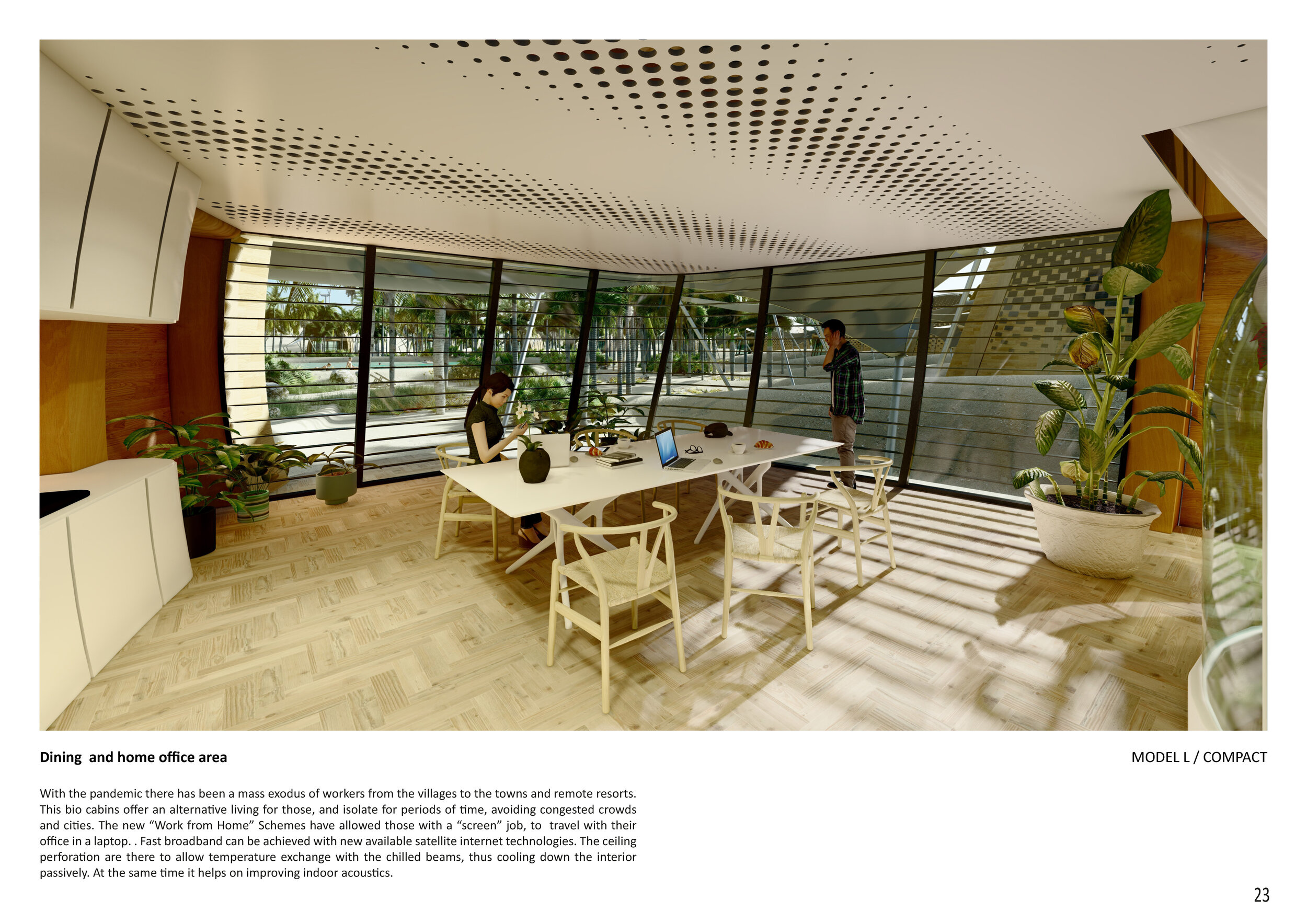
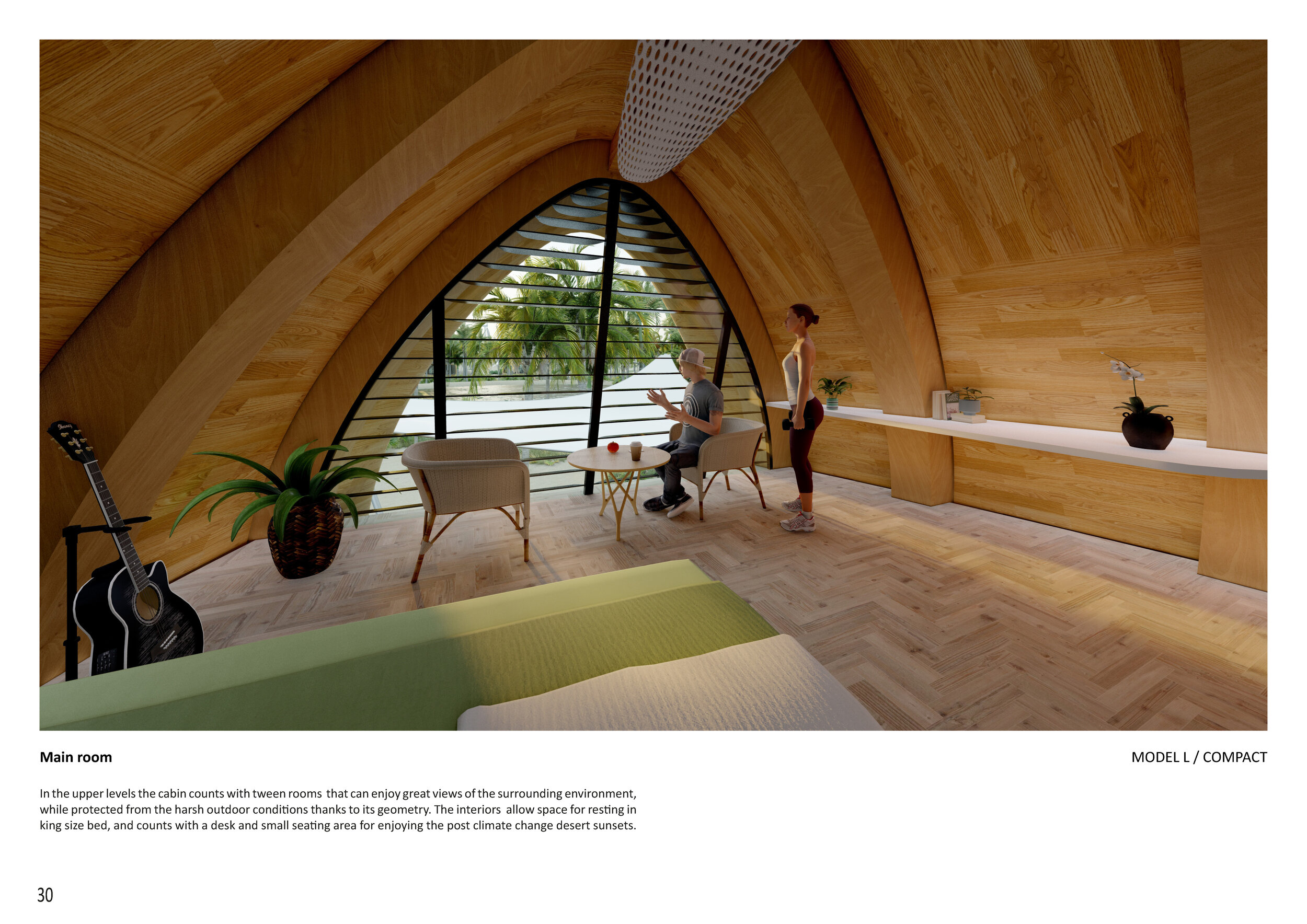
The ability to remain mobile and work from remote locations has become an essential requirement in the current global context. Future settlements should therefore be planned at a smaller scale, avoiding high density, while being sustainable, self-sufficient, and technologically hyperconnected. These qualities are key to providing healthier living conditions and a higher quality of life for their inhabitants.

Sustainable Materials

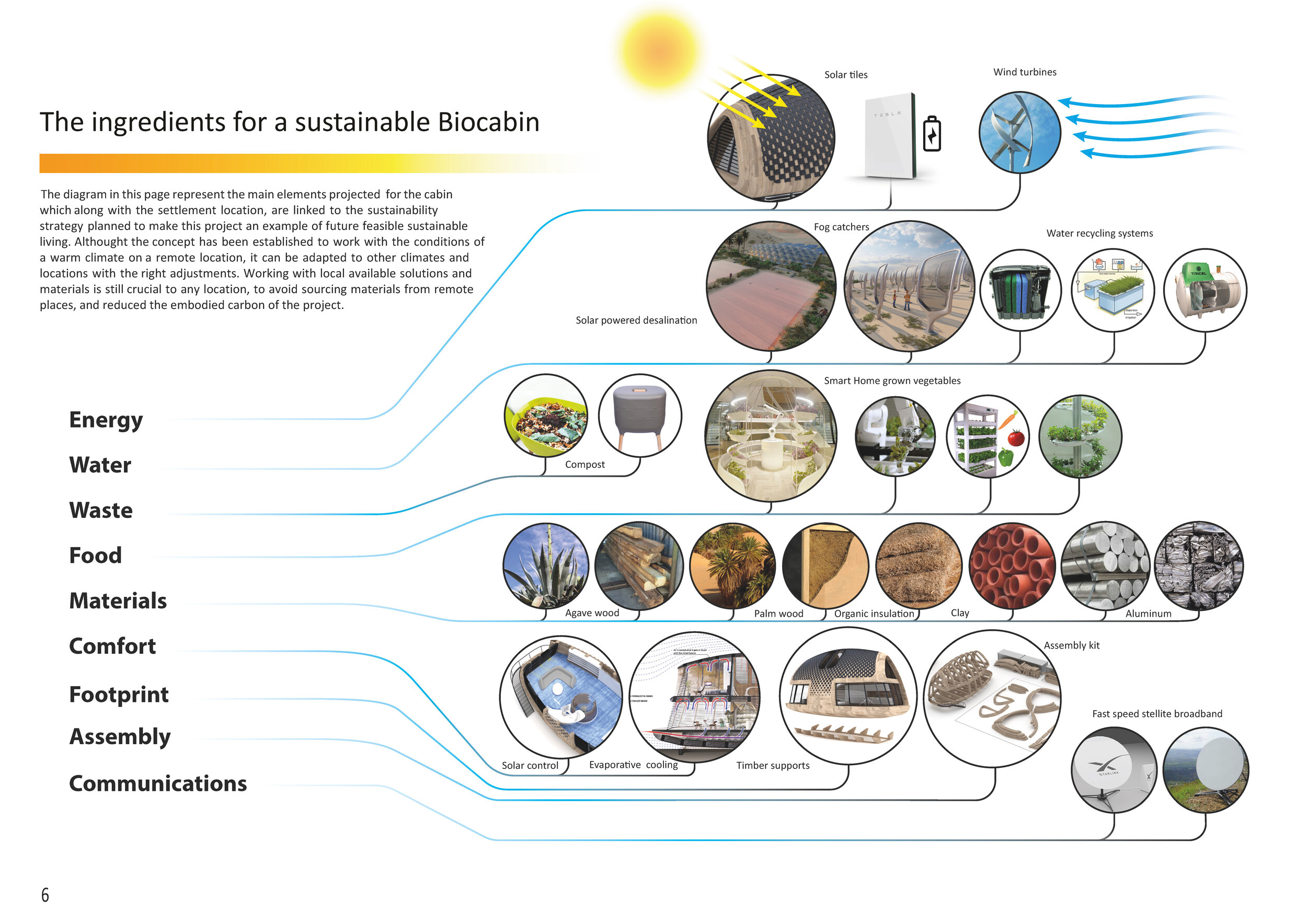
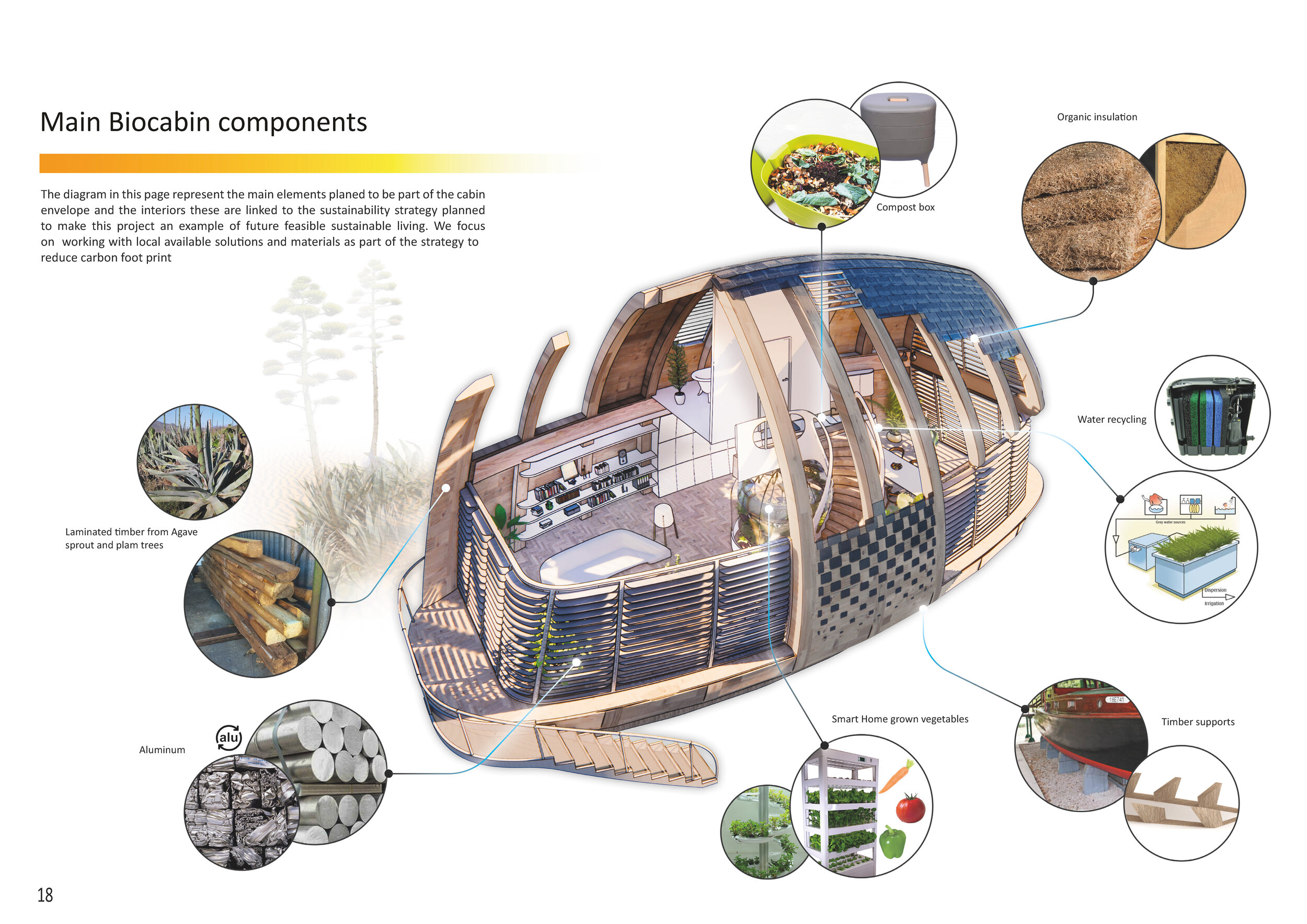
In this concept for housing in extreme climates, I explore the use of natural materials or materials with a high degree of reuse and recyclability. To achieve a truly sustainable solution, I prioritize locally available resources to avoid the high energy costs associated with long-distance transport.

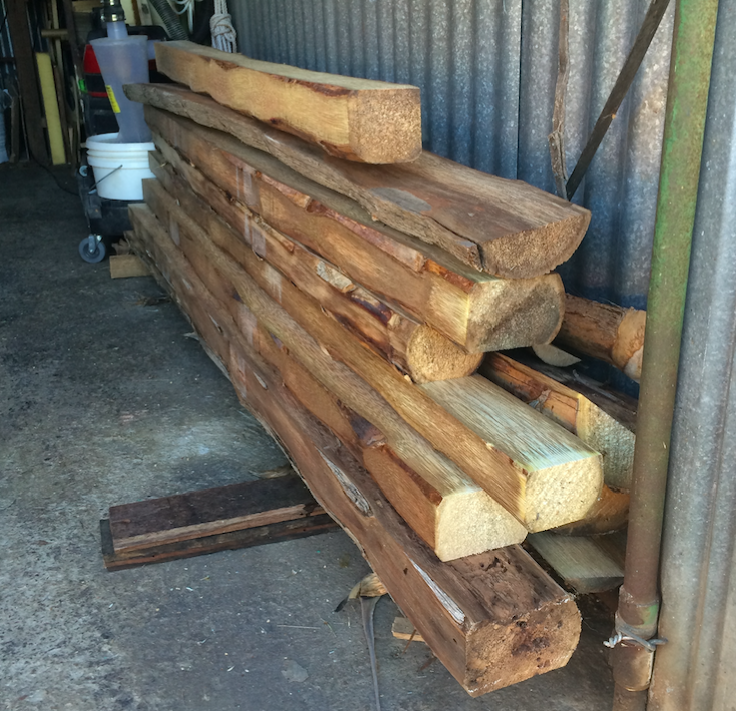
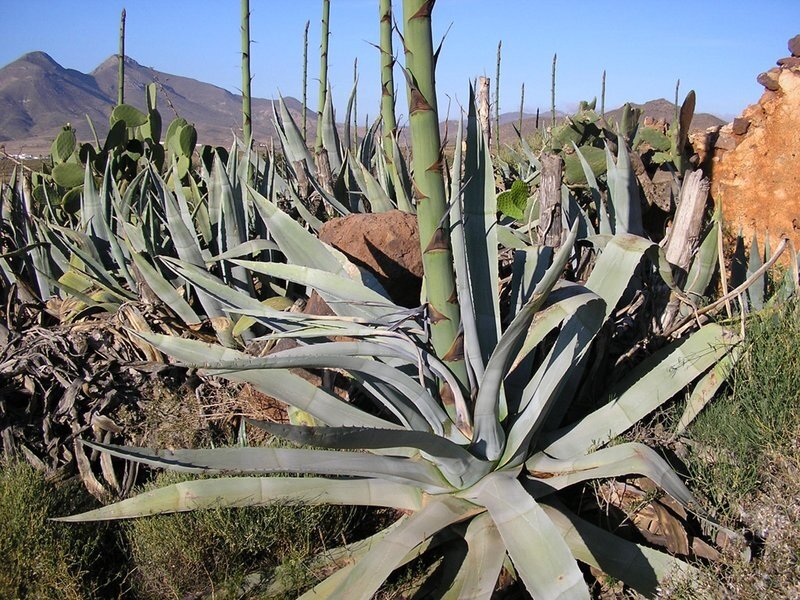
Structure and Cladding: I propose using alternative woods derived from American agave plants. Often referred to as “desert wood,” it thrives in arid climates and has been widely used in bio-construction for centuries. It can be processed into panels and laminates that are as durable as conventional construction woods. Its fibers are also reusable, allowing them to be transformed into other construction materials.

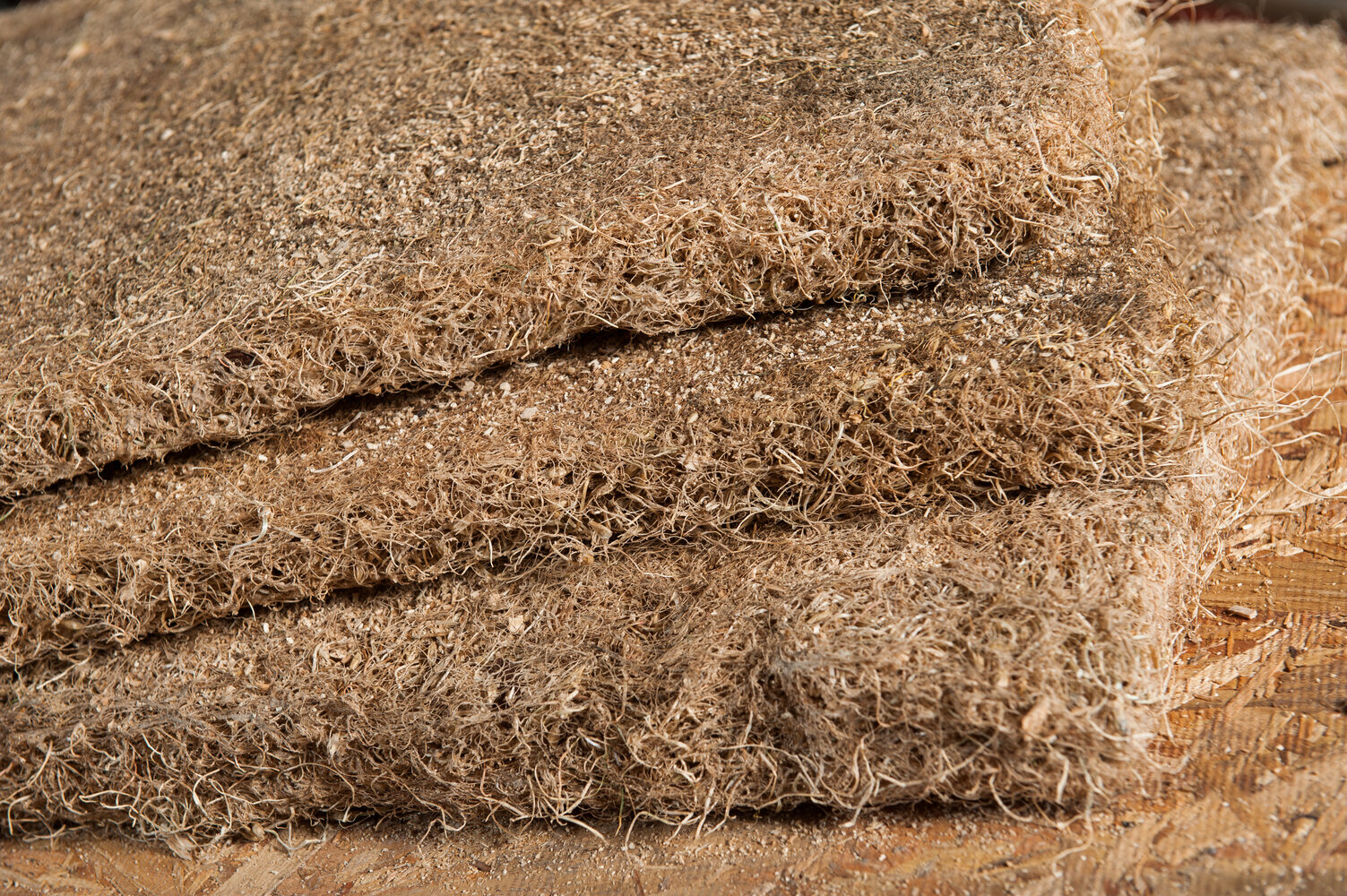
Interior Insulation: Using fibers from the agave plant—even including its roots—I can create thermal insulation without chemical additives. Commercial examples exist, such as panels produced by Rootman, made from a blend of various roots. These panels provide both thermal and acoustic insulation for interior spaces, enhancing comfort in extreme conditions.

Base Supports: To avoid permanent concrete foundations while maintaining durability, I propose a screw-pile system that can be inserted directly into the ground. The main advantage is mobility: these supports can be removed once the cabin reaches the end of its service life, or if the structure needs to be relocated.

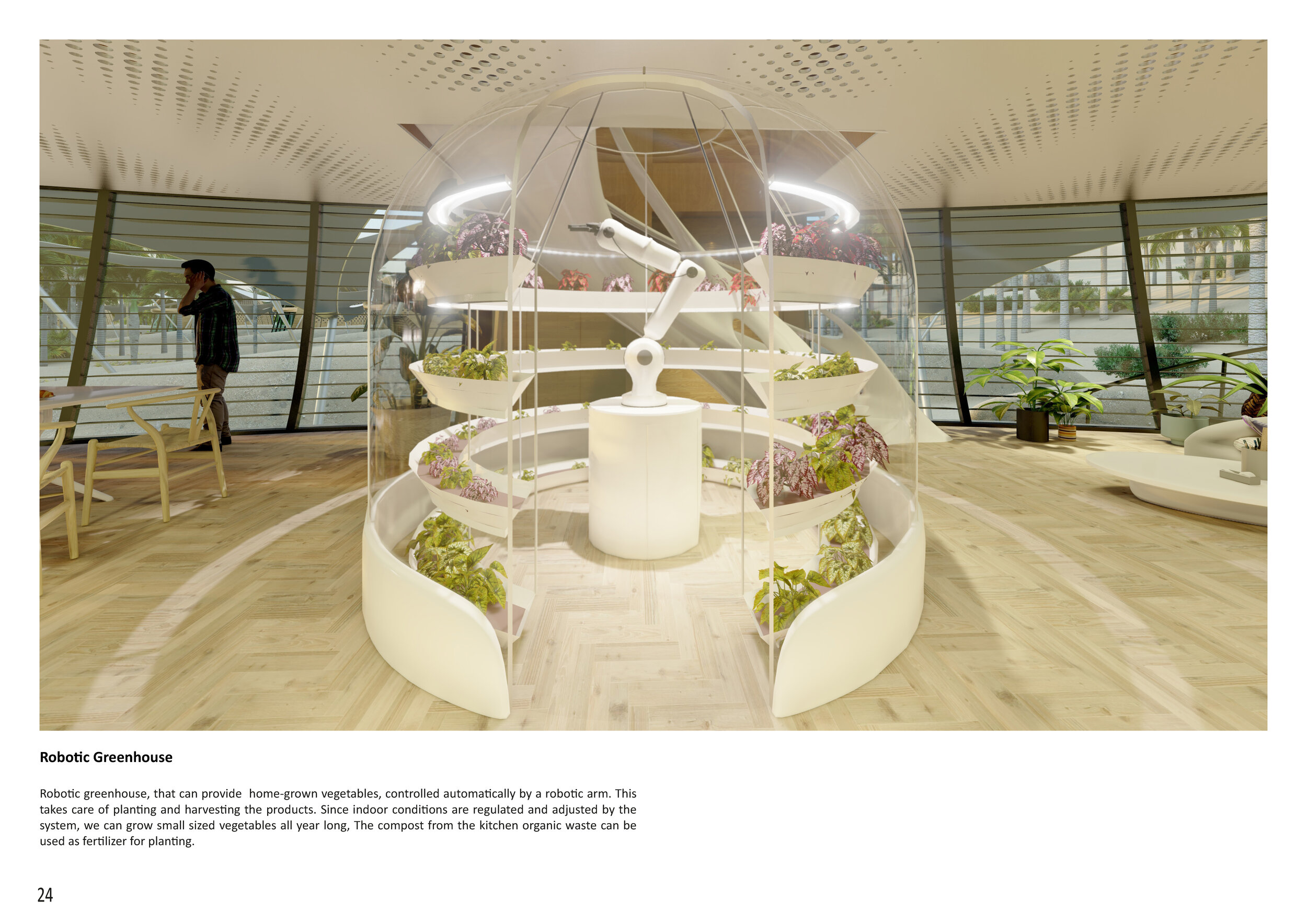
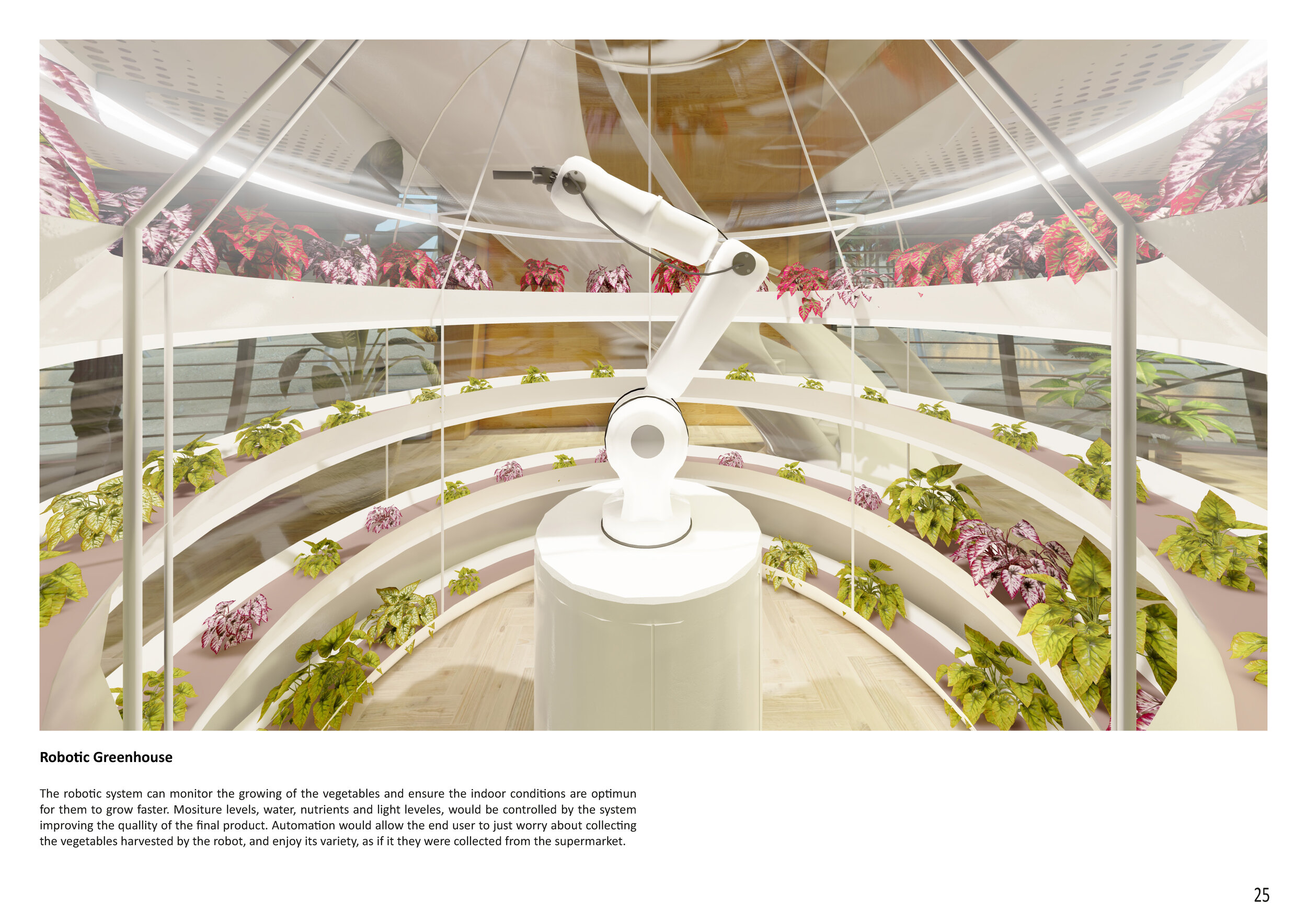
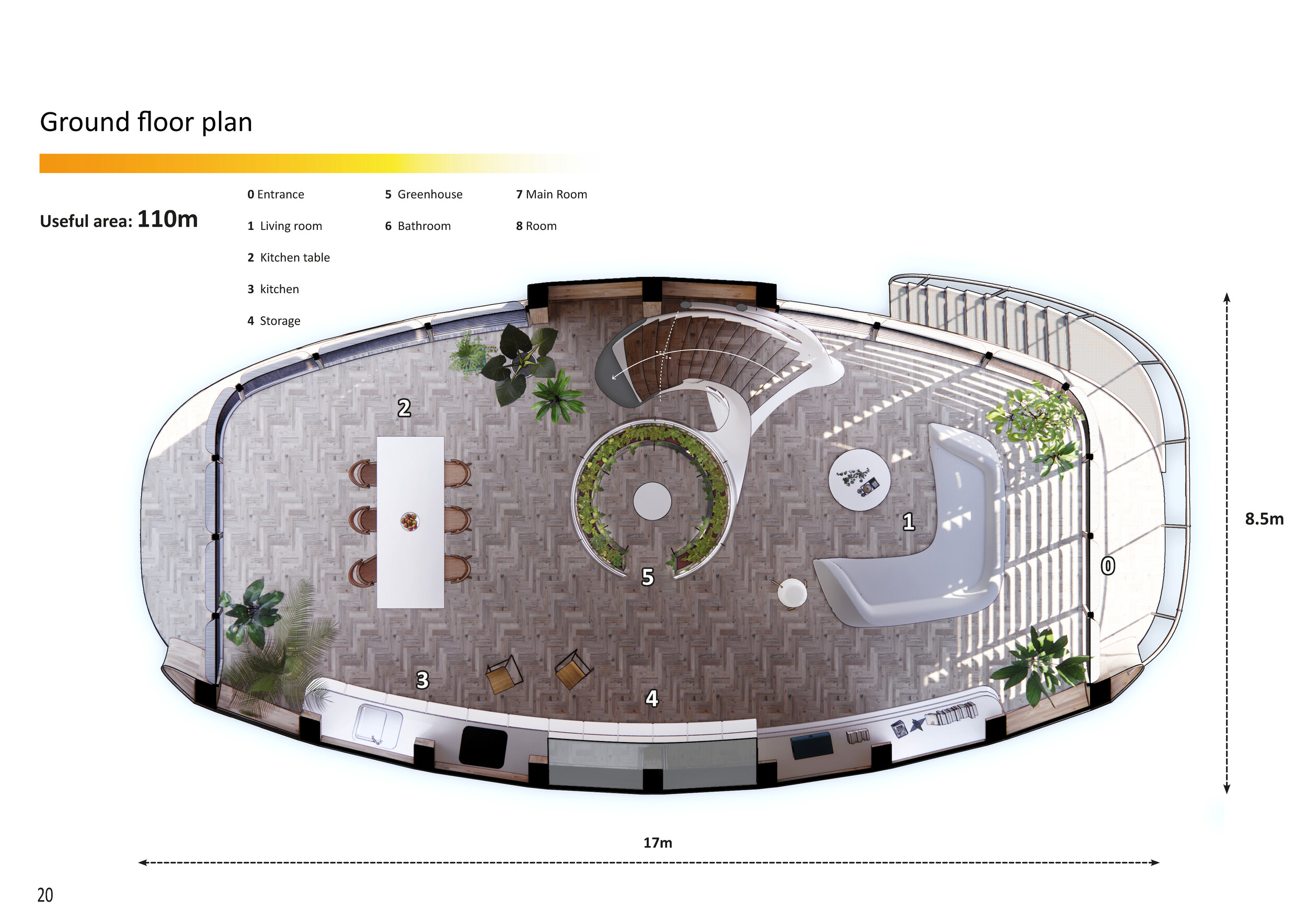
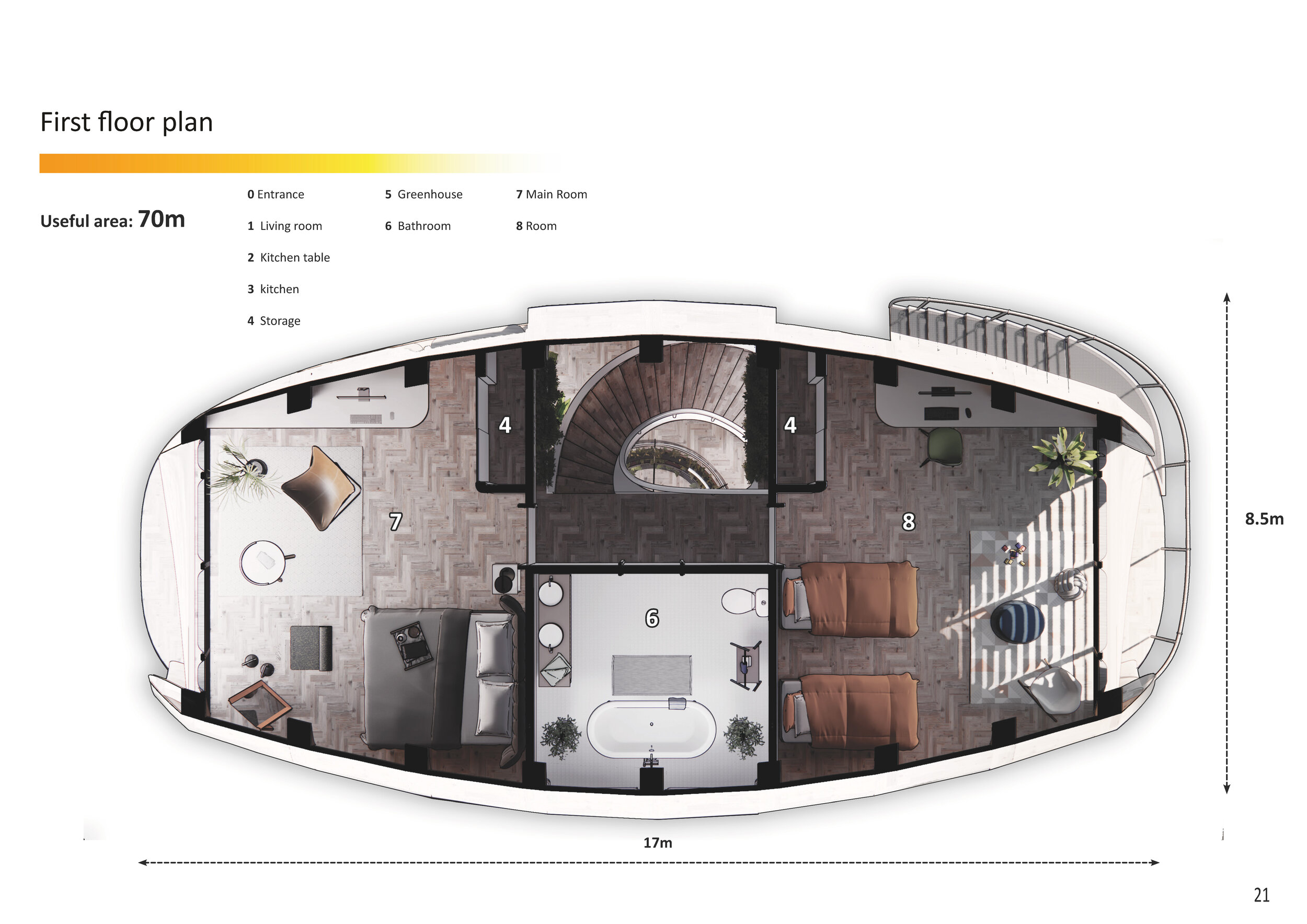
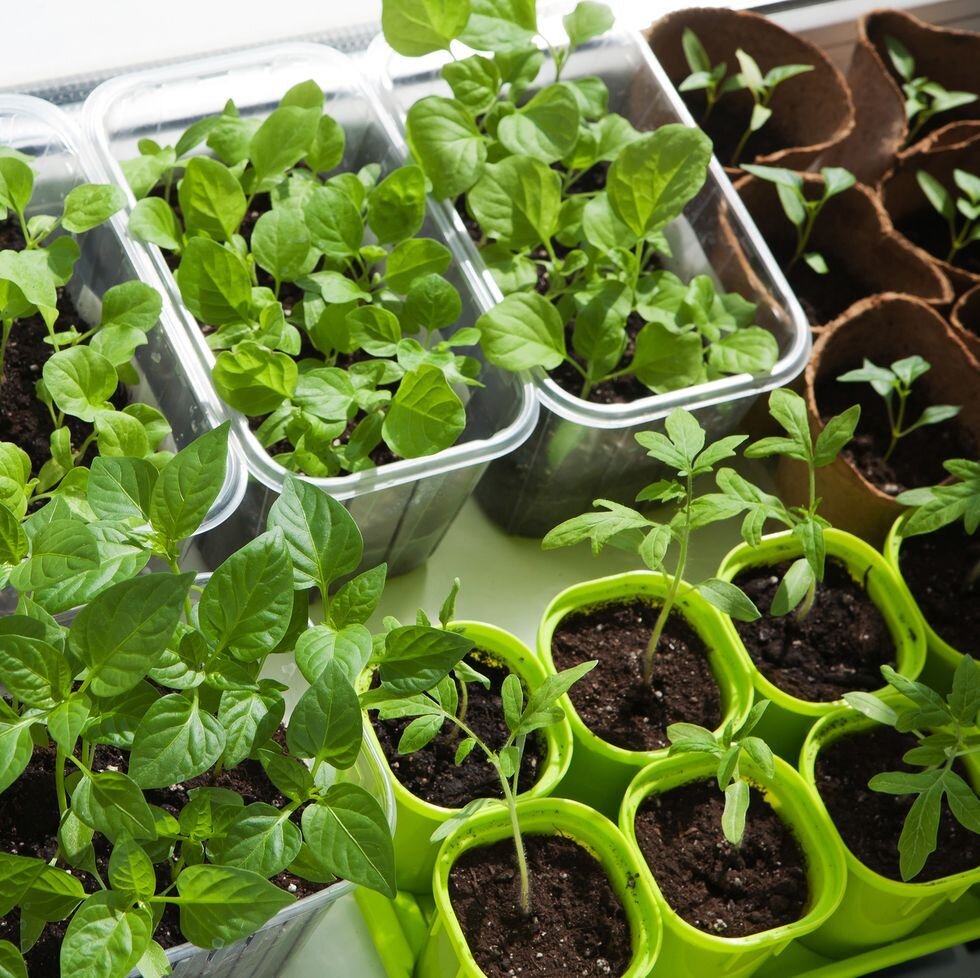
Greenhouses: I conceive the interior of this home as a space capable of housing plant- and vegetable-growing units for human consumption. This allows residents to live healthily, with fresh produce available directly in their living room or kitchen. The house would include a detailed instruction manual for planting and caring for the crops until harvest, promoting self-sufficiency and enhancing survival skills.

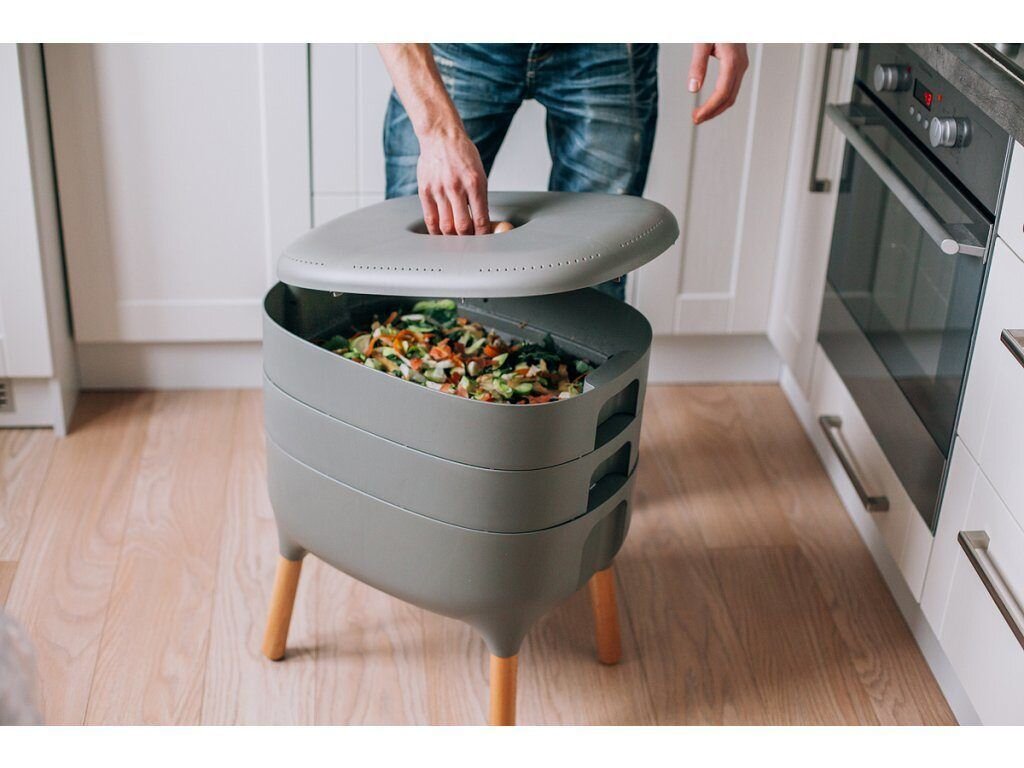
Organic Waste Composting: Organic waste and plant trimmings are composted to serve as fertilizer for the plants. Various safe indoor composting systems can be used, supporting the goal of a sustainable and closed-loop living environment.

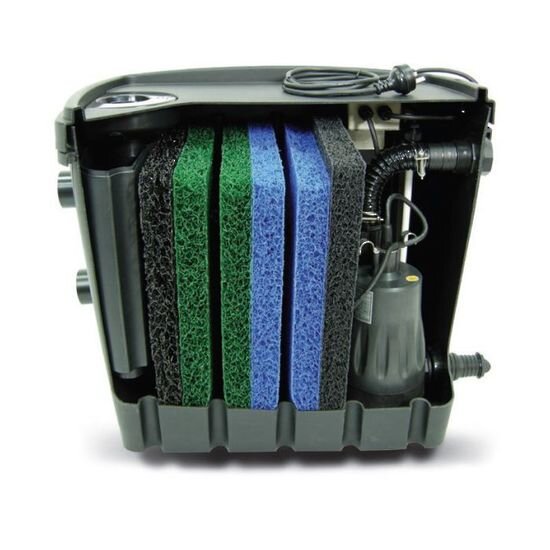
Greywater Recycling: Greywater and wastewater are treated through systems located beneath the house, enabling reuse for irrigating crops within the greenhouses and other planting areas.

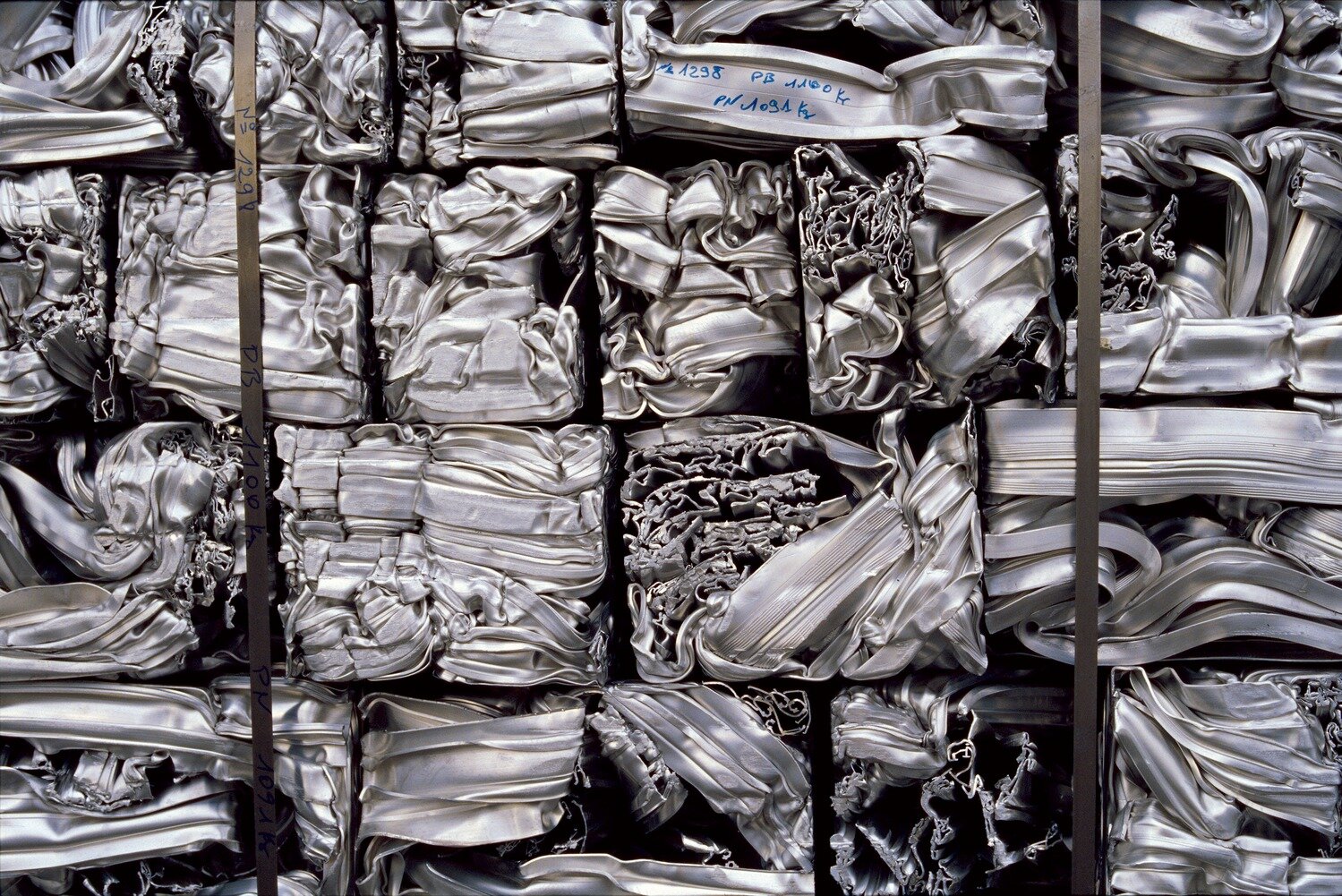
Recycled Aluminum: Any elements that must be metallic are designed using aluminum due to its high recyclability and potential for reuse.

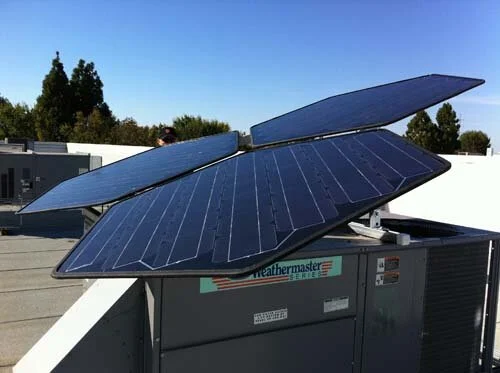
Energy Production: This housing unit includes solar panels and external wind turbines to generate renewable energy, which is stored in batteries installed underground. These systems provide energy for nighttime use, ensuring the home remains functional and self-sufficient.

Fresh Water Systems: In designing a post–climate-change settlement, I explored systems for obtaining potable water that could ensure self-sufficiency. I proposed two potential solutions to secure water directly from the air and from the sea. A reliable water supply is essential for resilient and autonomous living, so I designed a combined system to provide continuous water access throughout the year:

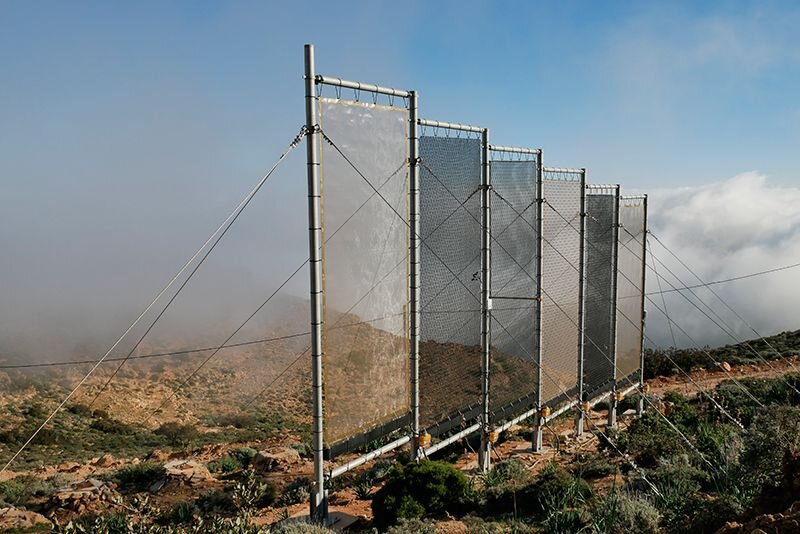
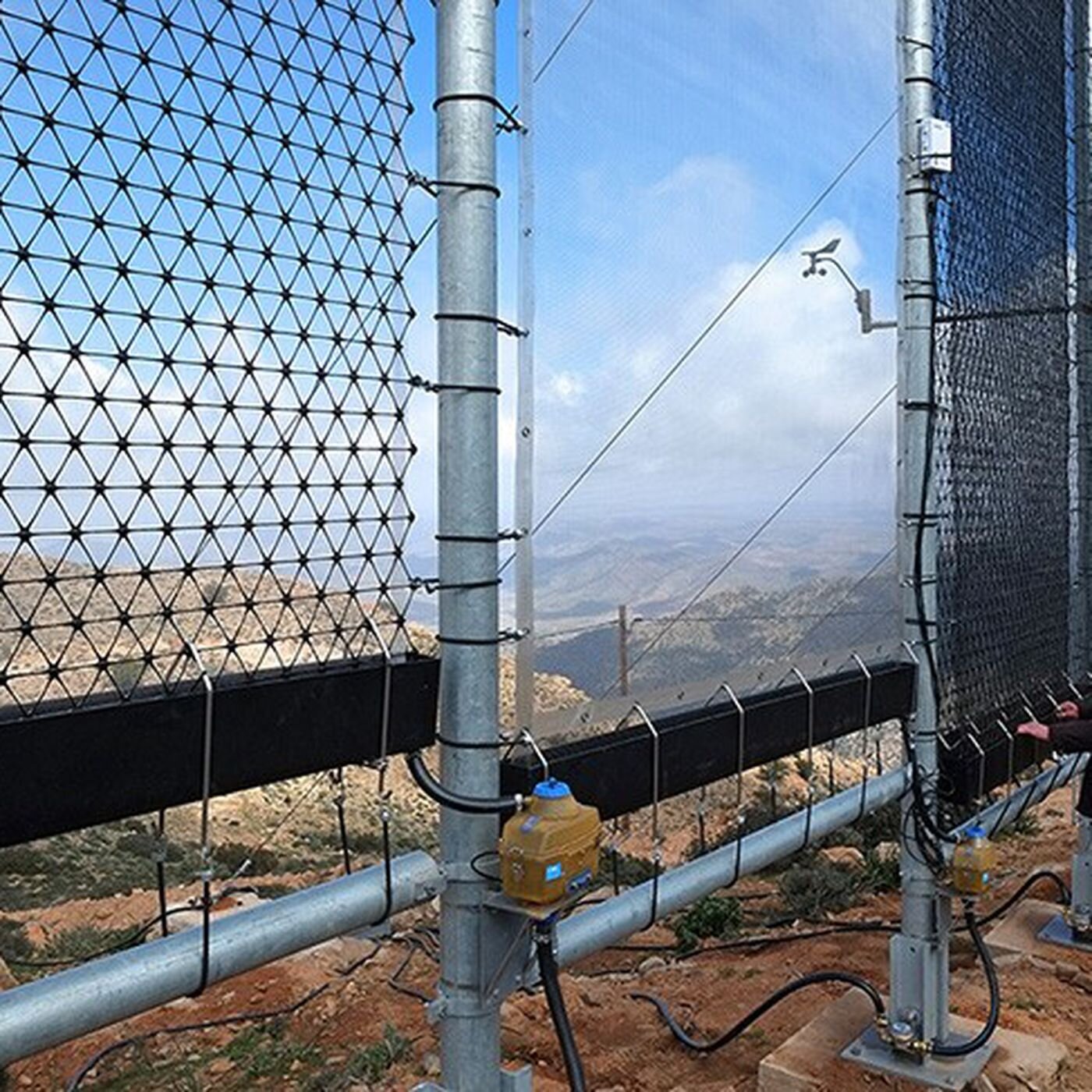
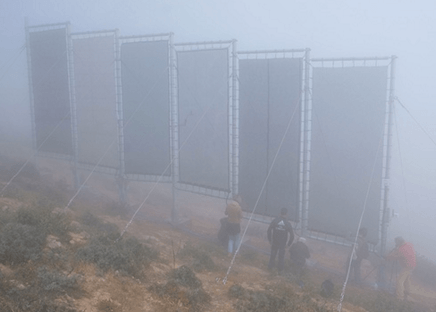
Fog Harvesting: In both mountainous and arid coastal climates, fog can be captured using polyethylene nets (a recyclable plastic) when the right atmospheric conditions occur. This system can collect between 4 and 14 liters per square meter by condensing dispersed moisture in the air. With enough units installed, it is possible to maintain a constant water supply for a community, such as the one envisioned in this settlement. Similar systems have been implemented in areas along the coasts of Morocco, as well as in Chile and Peru, demonstrating the viability of fog harvesting as a sustainable water solution.

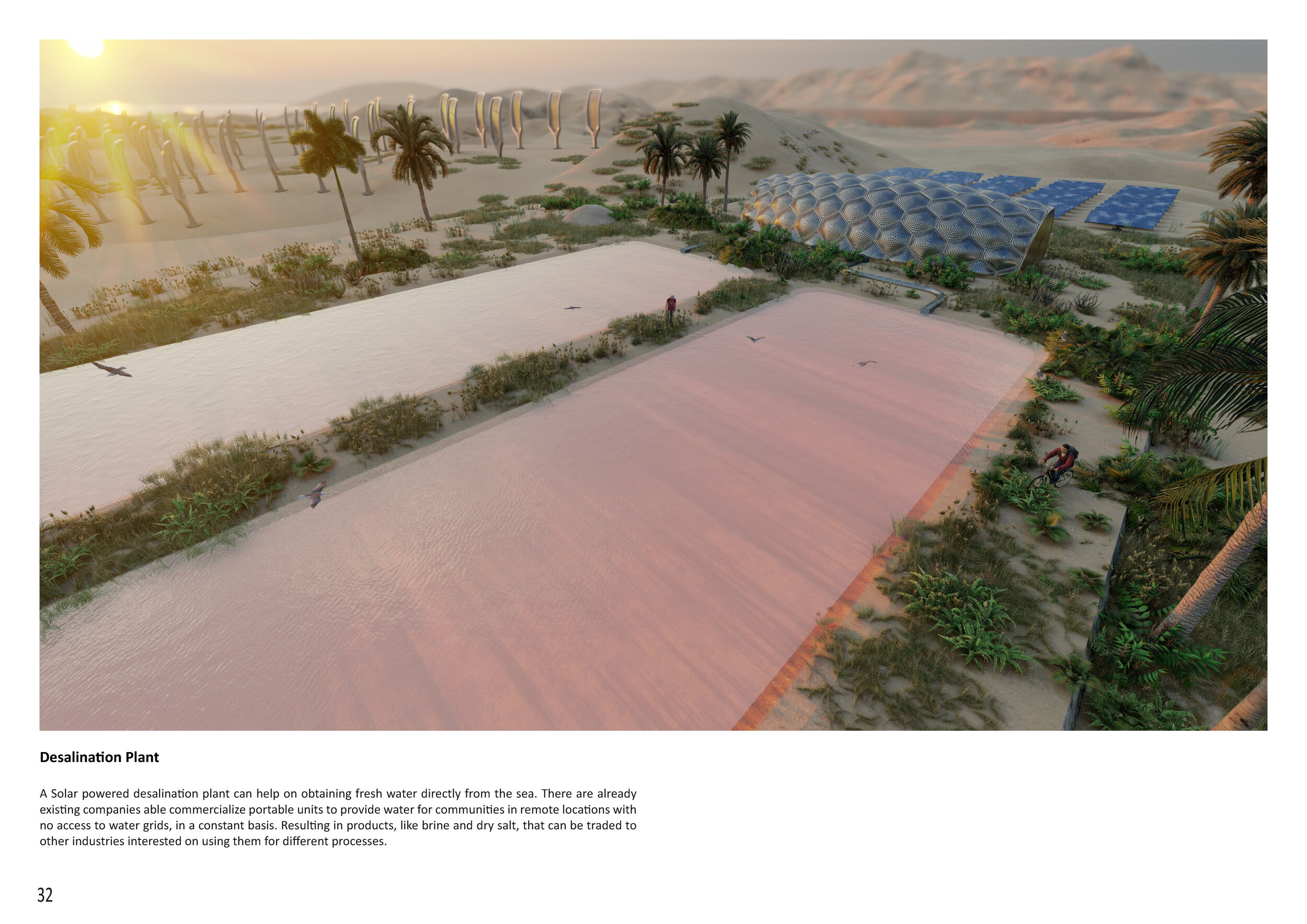
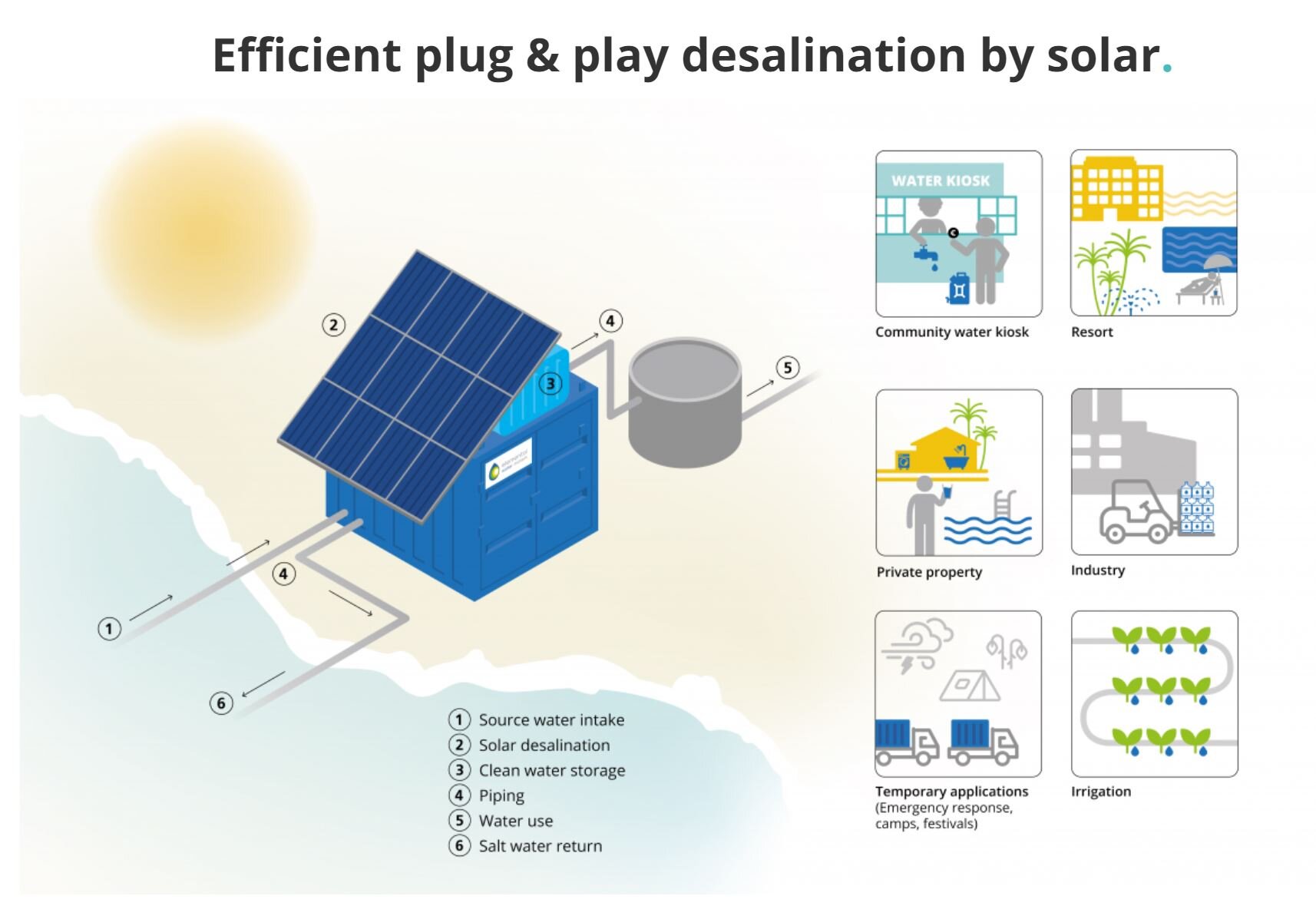
Solar-Powered Desalination: If no extractable water is available from nearby aquifers or rivers, seawater desalination becomes an alternative. I explored the use of modular desalination units powered by solar energy, which can provide freshwater for settlements of varying sizes. These systems offer a sustainable solution to secure water in areas with limited natural sources.

Brine Reuse to Prevent Environmental Impact: The brine produced during desalination can be treated to extract chemicals for use in other industrial processes. Research conducted by engineers at MIT demonstrates that this approach is both feasible and environmentally beneficial, addressing the common ecological concerns associated with desalination.

Workflow for Solar convergence detection from Glass Curved Facades

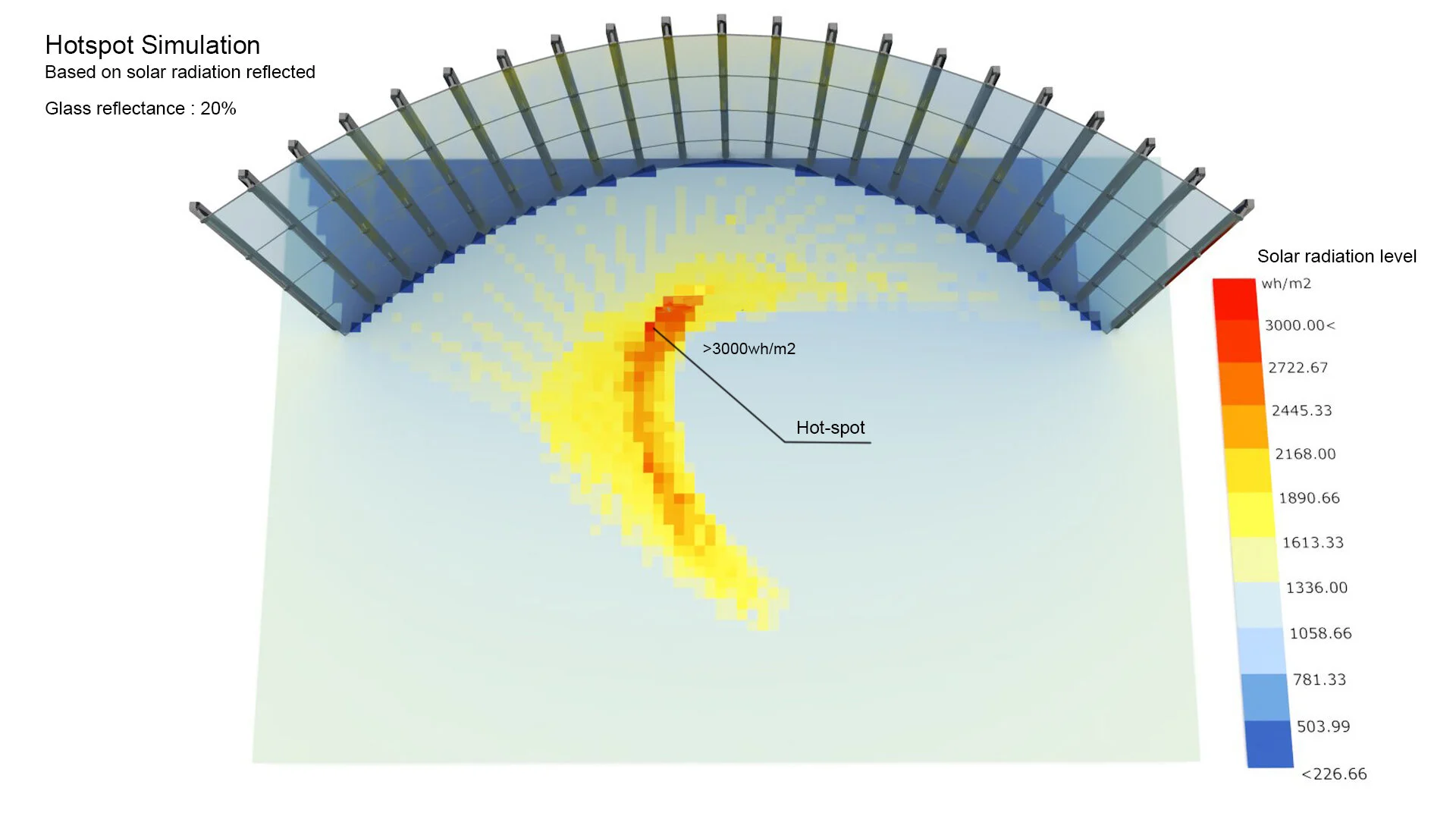
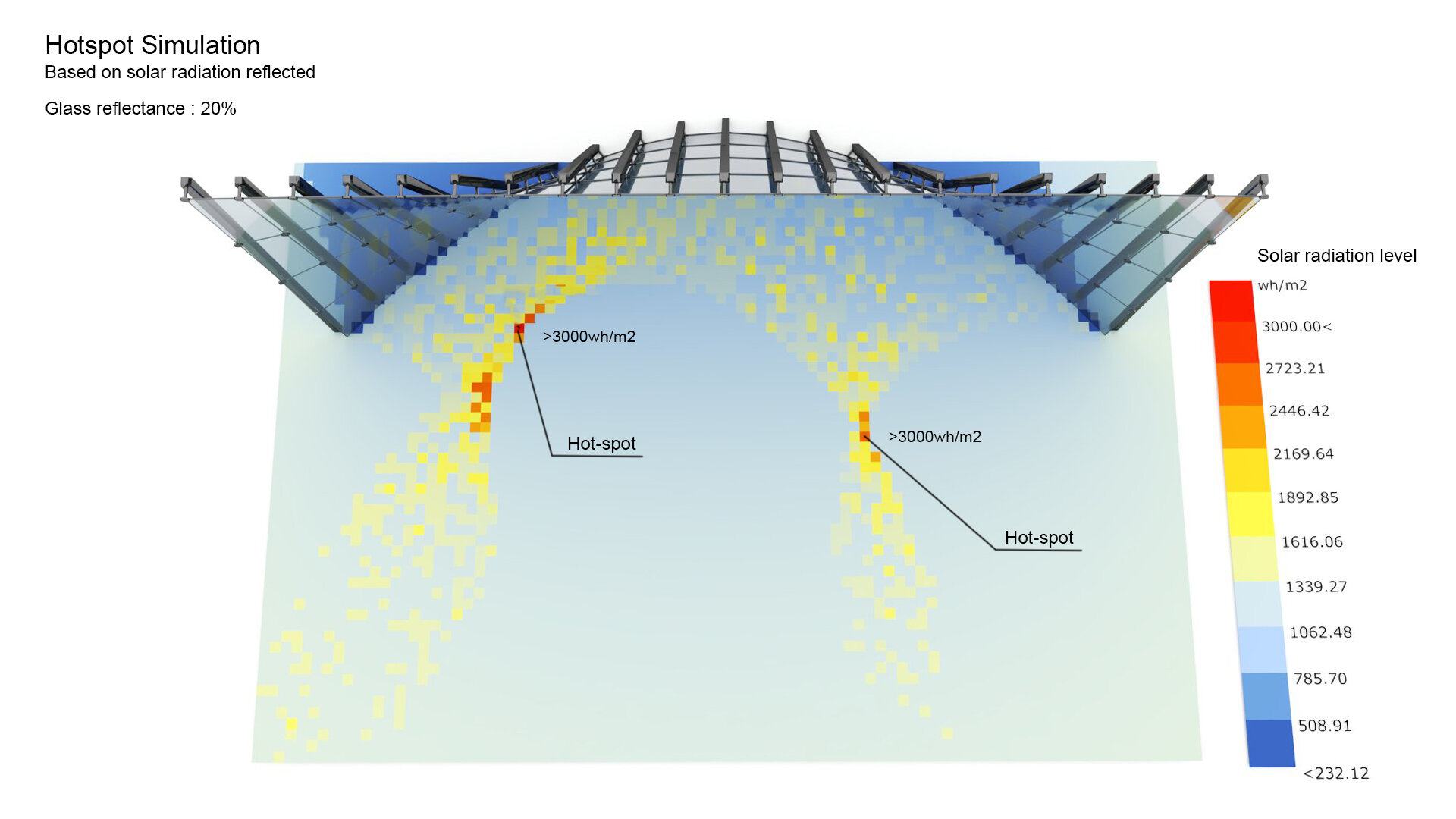
El incremento de edificaciones con fachadas acristaladas y geometrías cada veza mas complejas o curvadas, ha traído consigo nuevos retos a superar por la industria de la arquitectura y la ingeniería. Contar con los especialistas y las herramientas adecuadas para evaluar a tiempo los efectos que una propuesta arquitectónica pueden tener en el entorno, es crucial para encontrar las soluciones apropiadas antes de finalizar el diseño.  Es por ello que en W-LAB nos hemos especializado en sistemas de detección temprana de concentración solar, para evaluar y cuantificar los riesgos que un acristalamiento puede suponer para los transeúntes del espacio público y demás edificios colindantes.

Representacion datos ambientales

En los ejemplos aquí presentados hemos visualizado como los cambios en la curvatura de un cerramiento de vidrio pueden afectar la cantidad de radiación reflejada. Para ello utilizamos herramientas y algoritmos de medición energética, vinculados una herramienta de modelado 3D. Las animaciones renderizadas nos permite visualizar los resultados del análisis de manera diagramática, conectado directamente al algoritmo que genera la geometría 3D.

Los riesgos y beneficios de la concentración solar

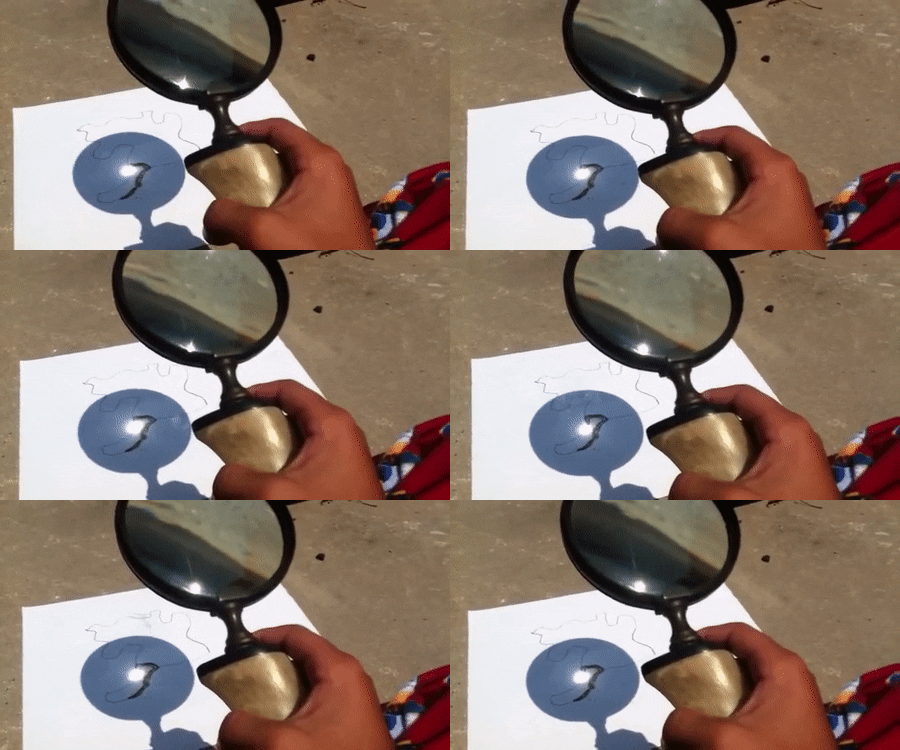
El efecto de la concentración solar debido a fachadas de vidrio curvo puede generar incrementos de temperatura puntuales capaces de quemar materiales y personas tras pocos segundos de exposición. Este efecto sería equivalente al de una lente de gran formato que concentre los rayos solares en un punto. A mayor superficie más energía será reflejada y concentrada en un área pequeña. Cuanto más pequeña sea el área en la que se concentren los rayos habrá un mayor riesgo de quemadura.

Hay centrales de captación energética solar que se basan en este principio utilizando espejos curvos que permiten reflejar grandes cantidades de energía en áreas controladas para así conseguir concentraciones  de radiación muy elevadas para diversos usos. En la imagen inferior, podemos ver el horno solar de Odeill, que es un laboratorio de investigación del CNRS conjuntamente con la Universidad de Perpiñán, especializado en estudios térmicos a alta temperatura, sistemas termo-portadores, conversión energética , y comportamiento de materiales a alta temperatura en medio ambiente extremo.

FirmClearcutHyrax-size_restricted.gif
Odeillo-Solar-Furnace-013.jpg

Parametric dynamic shading for high rise

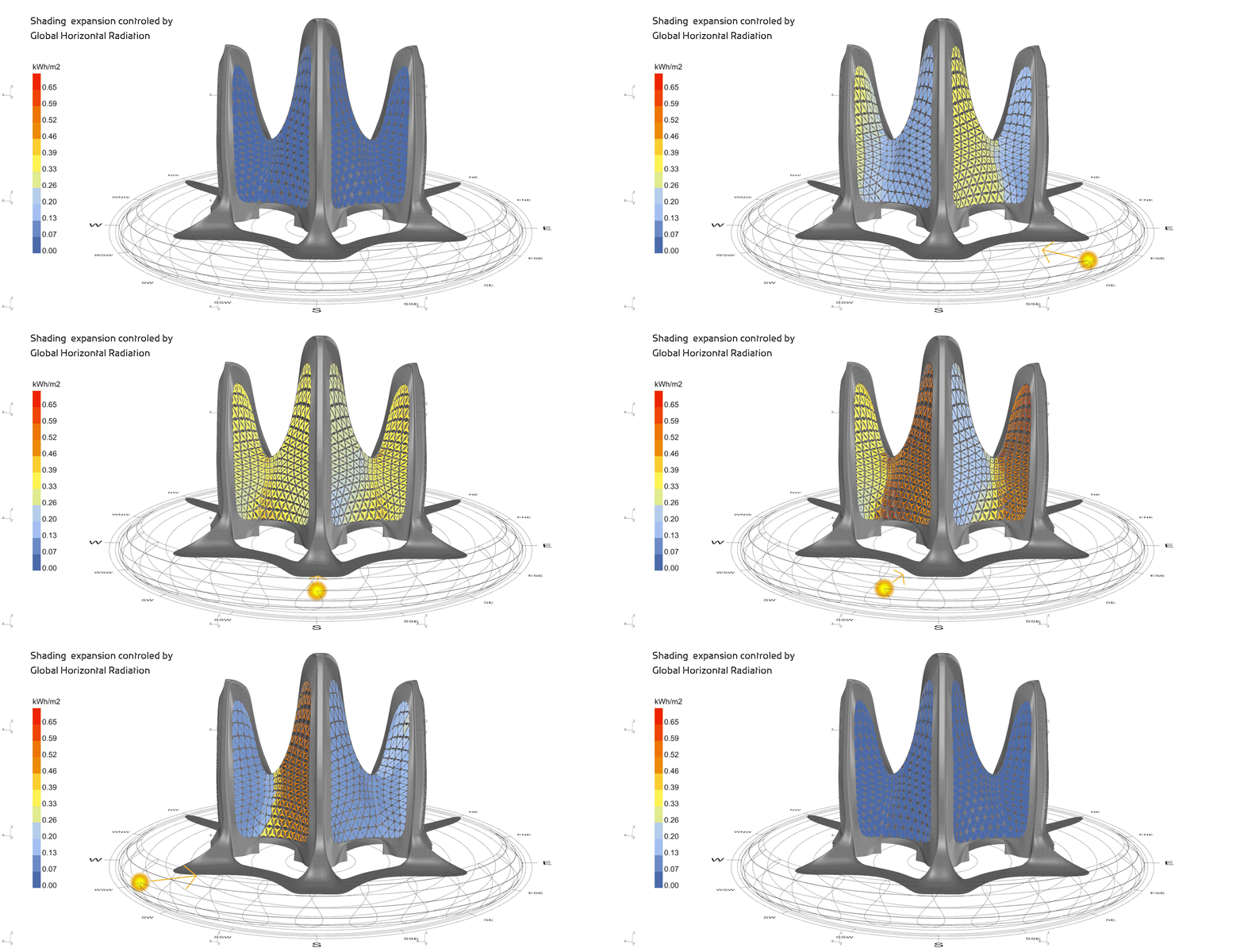
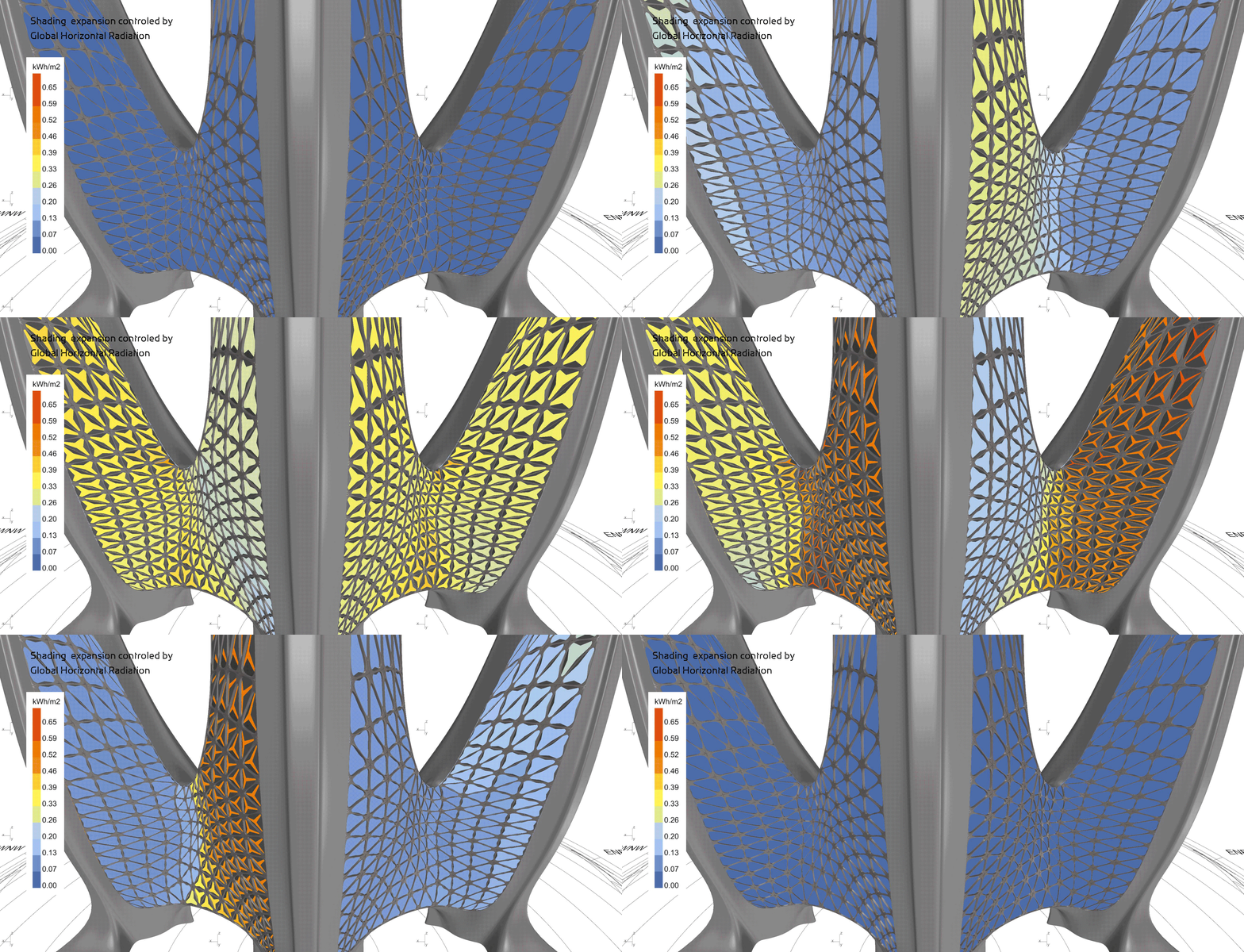
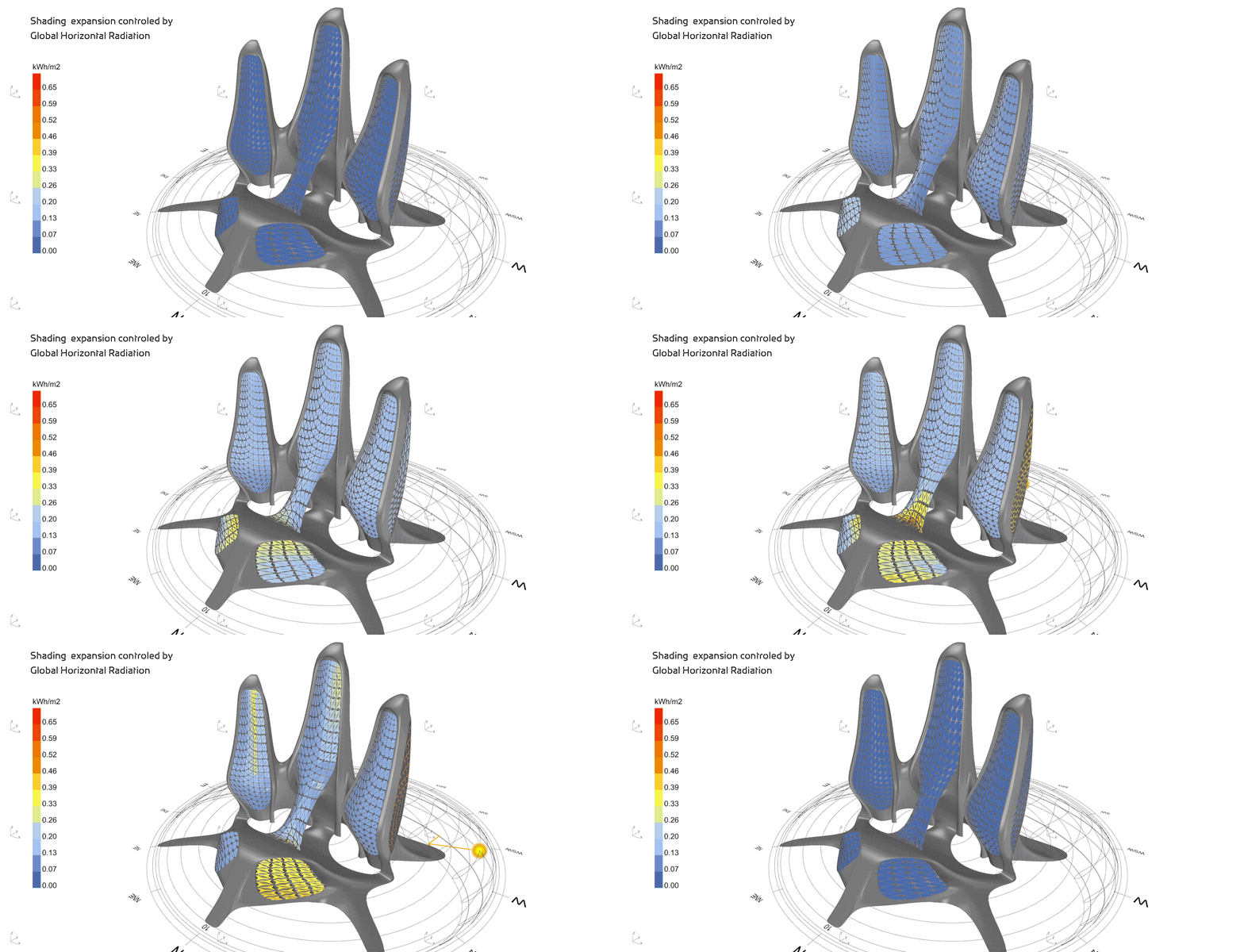
Algorithmic shading design has become a popular choice among international architectural firms which base their designs heavily on the use of parametric design tools. I have been working in that field for almost a decade now, and I have seen the benefits of their usage. The patterns used for shading can be controlled by the amount of incident radiation. The example below displays and kinetic façade structure that tracks the sun, and deploys sails based on the incidence of the sun.

Solardemo.0002.png

Because from the earth's surface we perceive the sun as a dynamic body, it’s more logical that a façade could adapt to its movement to shade the interiors more efficiently. This will help on reducing solar exposure only in those areas that would require it the most therefore reducing the need for Air Conditioning when outdoor temperatures are high

Solardemo.0034.png

Workflow for assessing Pedestrian Wind comfort

A la hora de realizar una nueva propuesta urbana, es importante conocer como los vientos locales van a influenciar el espacio público, y como nuestros edificios bloquearan o canalizaran estos. Podemos realizar cálculos de viento precisos en 3D y 2D para visualizar el aire. Estos son útiles para ayudar a buscar sistemas y soluciones que ayuden a mejorar el confort exterior, a nivel peatonal en espacio público ( existente o futuro ) y  terrazas o jardines de nuestra propuesta.

Estudiamos el viento en espacios urbanos

Todos hemos experimentado alguna vez las fuertes rachas de viento que se perciben al andar entre edificios de altura, o al doblar una esquina. Esto es debido a la aceleración que se produce cuando una masa de aire en movimiento pasa a través de una zona de sección estrecha.

.

tenor (1).gif

El Efecto Ventury

Con las simulaciones de viento podemos detectar en que zonas se va a producir este efecto cuando estamos diseñando una nueva intervención urbana, para actuar dónde es debido y tratar la zona afectada.

CFD shots_Page_2.jpg

En W-Lab contamos con las herramientas computacionales más avanzadas en el mercado para poder realizar cálculos de viento exterior, con precisión, basados en las características climatológicas y vientos registrados en cualquier localización geográfica. Con ellas podemos realizar mapas que ayuden a arquitectos e ingenieros a entender la influencia que los vientos tendrán en la zona que van a trabajar y proponer así sistemas que mejoren las condiciones de confort externo.

CFD shots_Page_3.jpg
SpiritedPastAurochs-size_restricted.gif

Energía Eólica Urbana.

Con los mapas de velocidad del viento podemos saber de antemano si una zona será buena para insertar aerogeneradores urbanos que ayuden en la obtencion energía alternativa limpia, que suministre electricidad a los espacios públicos, o a la red local.

CFD shots_Page_1.jpg

Workflow for Urban scale solar analysis

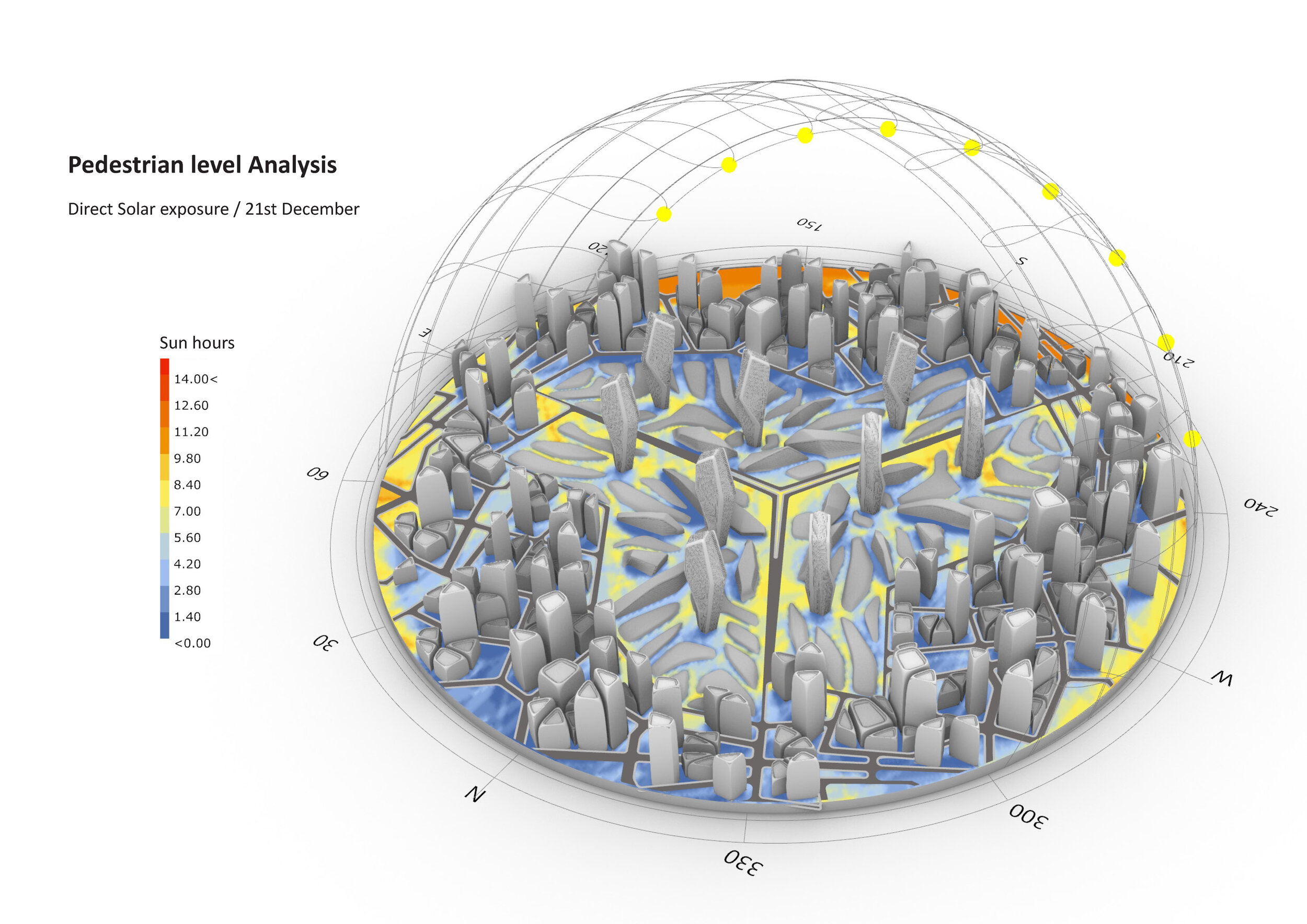
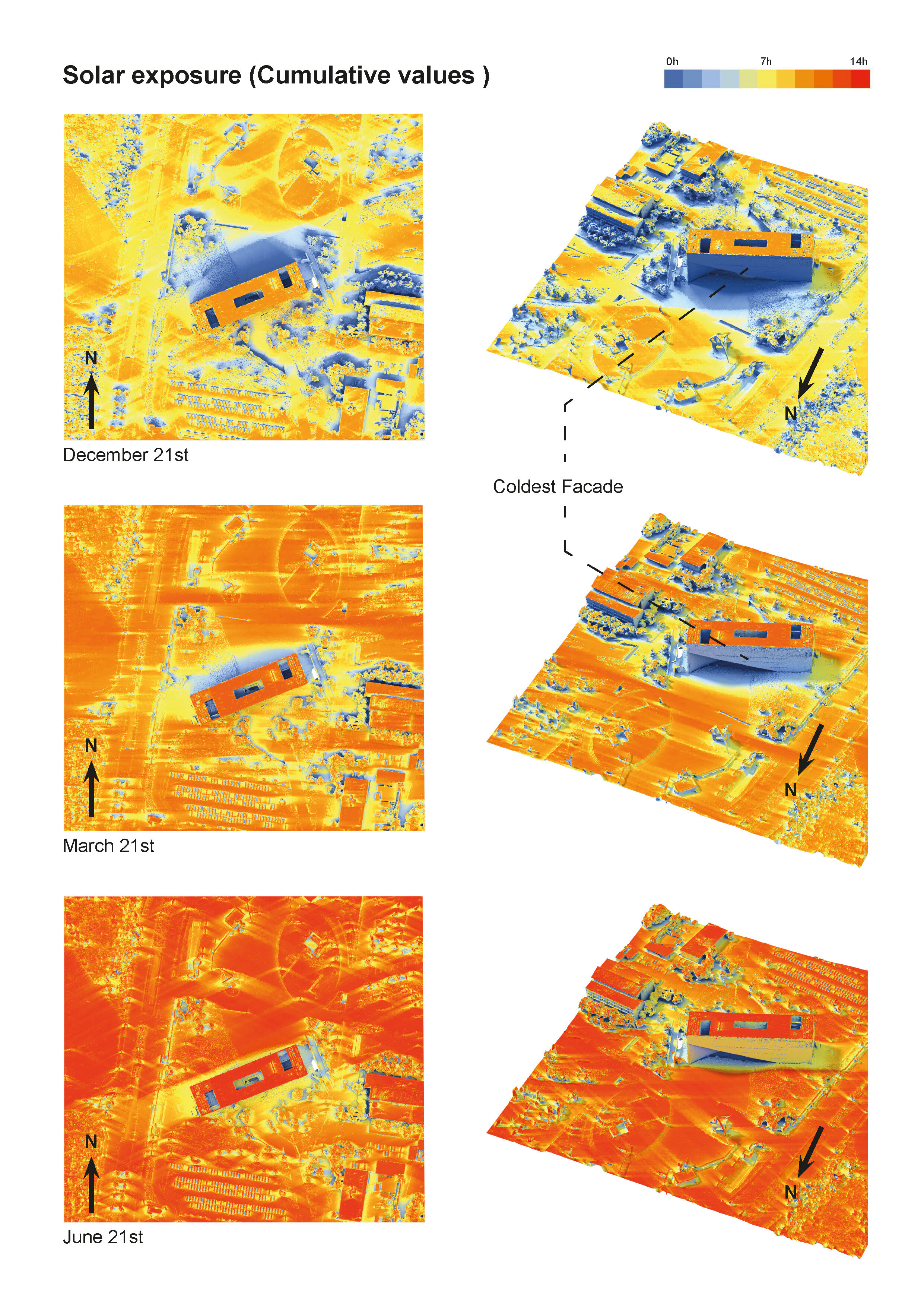
A la hora de trabajar en el ámbito de la sostenibilidad, Los estudios solares en a nivel de espacio público son útiles para entender el impacto que las soluciones de nuevo ordenamiento podrían tener el confort exterior. Conocer las horas o la cantidad de energía incidente pueden ayudar en la concepcion de un nuevo ordenamiento, y commprender mejor su impactio en el tejido urbano adyacente.

Para esta propuesta hipotética de tejido urbano en las imagenes de este articulo, analizamos un segmento de territorio localizado en una latitud cercana al núcleo de la ciudad de Barcelona con un clima mediterráneo. Con las coordenadas geográficas podemos entender las dinámicas solares y conocer los ángulos de Altitud y Azimut, en cada hora y minuto. Con ellos podemos calcular los vectores que nos ayudaran a saber la exposición que una superficie tendrá al sol.

Una vez calculadas las dinámicas solares, podemos saber en diferentes días la posición solar de cada hora con lo que es posible medir la cantidad de horas que recibiremos en cada metro cuadrado de superficie de aquellas zonas que queramos analizar. Esto nos permite cuestionar si un área estar por encima o por debajo de un cierto valor y con ello determinar el porcentaje de área que cumpla con el requisito.

Las normativas de cada país y certificaciones de sostenibilidad internacionales, nos exigen unos valores mínimos requeridos  en fachadas que variarán con la orientacion de cada plano de fachada,  el clima de la ubicación en la que estamos trabajando. Los requerimientos para espacios de vivienda que normalmente son obligatorios se aplicarán la las fachadas de viviendas, para asegurar una mínima cantidad de sol en los meses de invierno, y un máximo en los meses de verano que deberá ser contrarrestado con sistemas de sombreamiento y control de exceso solar.

En espacios públicos tendremos que observar el clima y sus fluctuaciones a lo largo del año para proponer soluciones que nos permitan mejorar el confort en las zonas exteriores. Algunas de ellas serán geométricas parea controlar el soleamiento, como estructuras para dar sombra, (pérgolas con maderas, textiles tensados, piezas plásticas o metálicas). Otras soluciones se centrarán más en cambiar las condiciones atmosféricas de manera pasiva, reduciendo temperatura con sistemas de enfriamiento evaporativo utilizando difusores o vaporizadores, fuentes y cursos de agua. La inserción de vegetación y arbolado, autóctonos, producirá sombra en verano y evaporación, lo que reducirá la temperatura ambiental, evitando ademas con su sombra el sobrecalentamiento de las superficies de pavimentos y materiales de construcción reduciendo el conocido efecto “Isla de calor”.

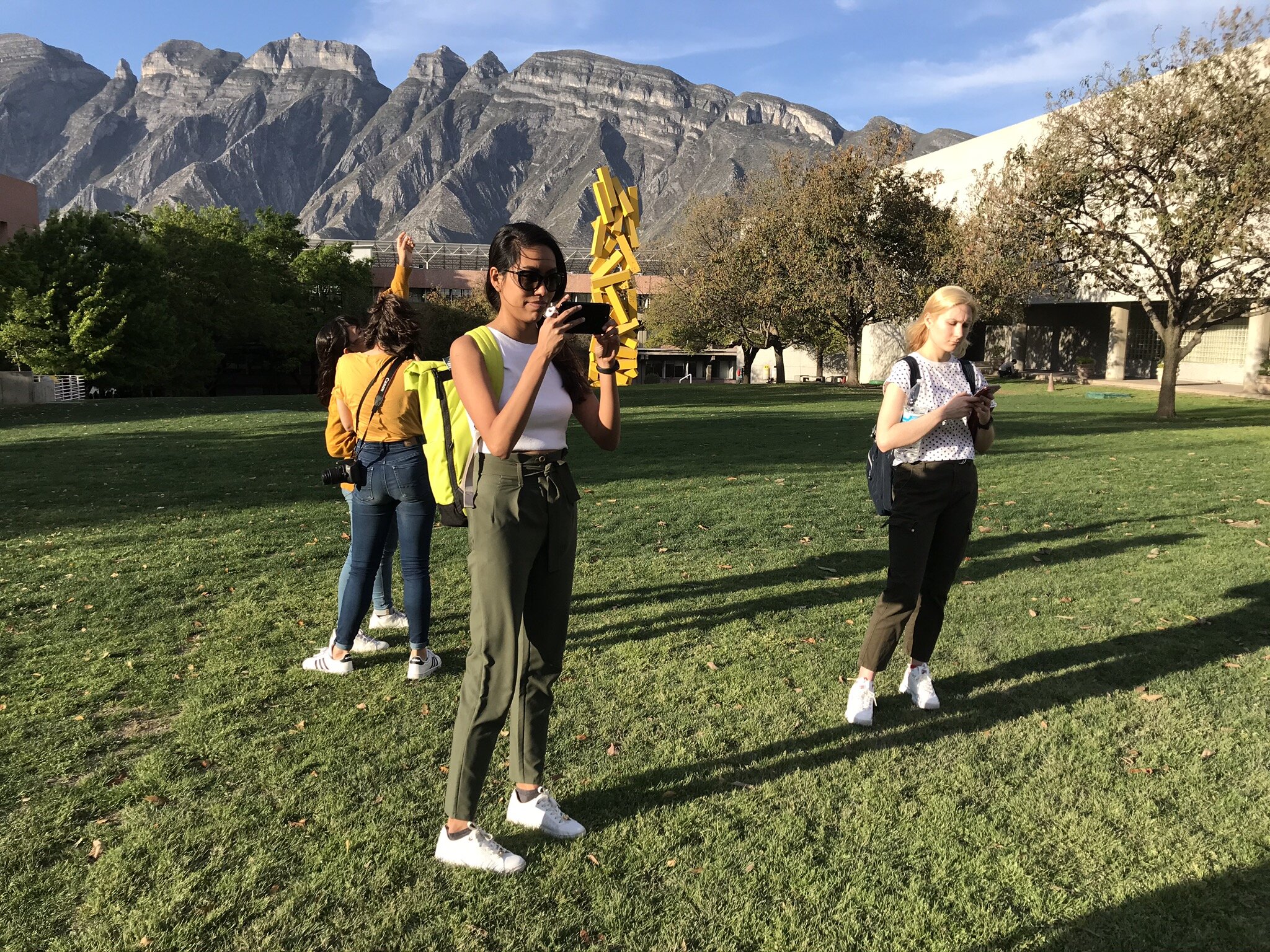
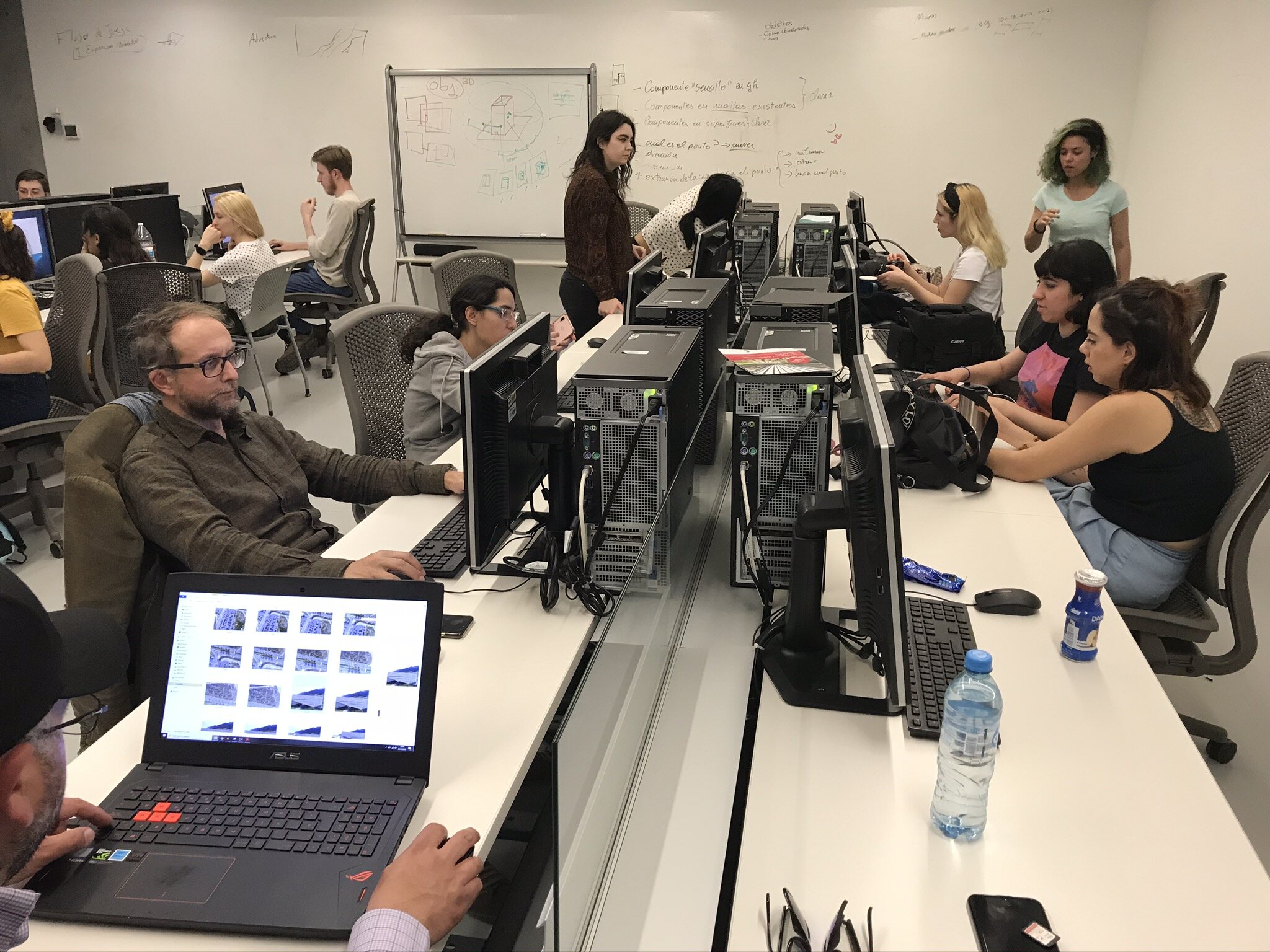
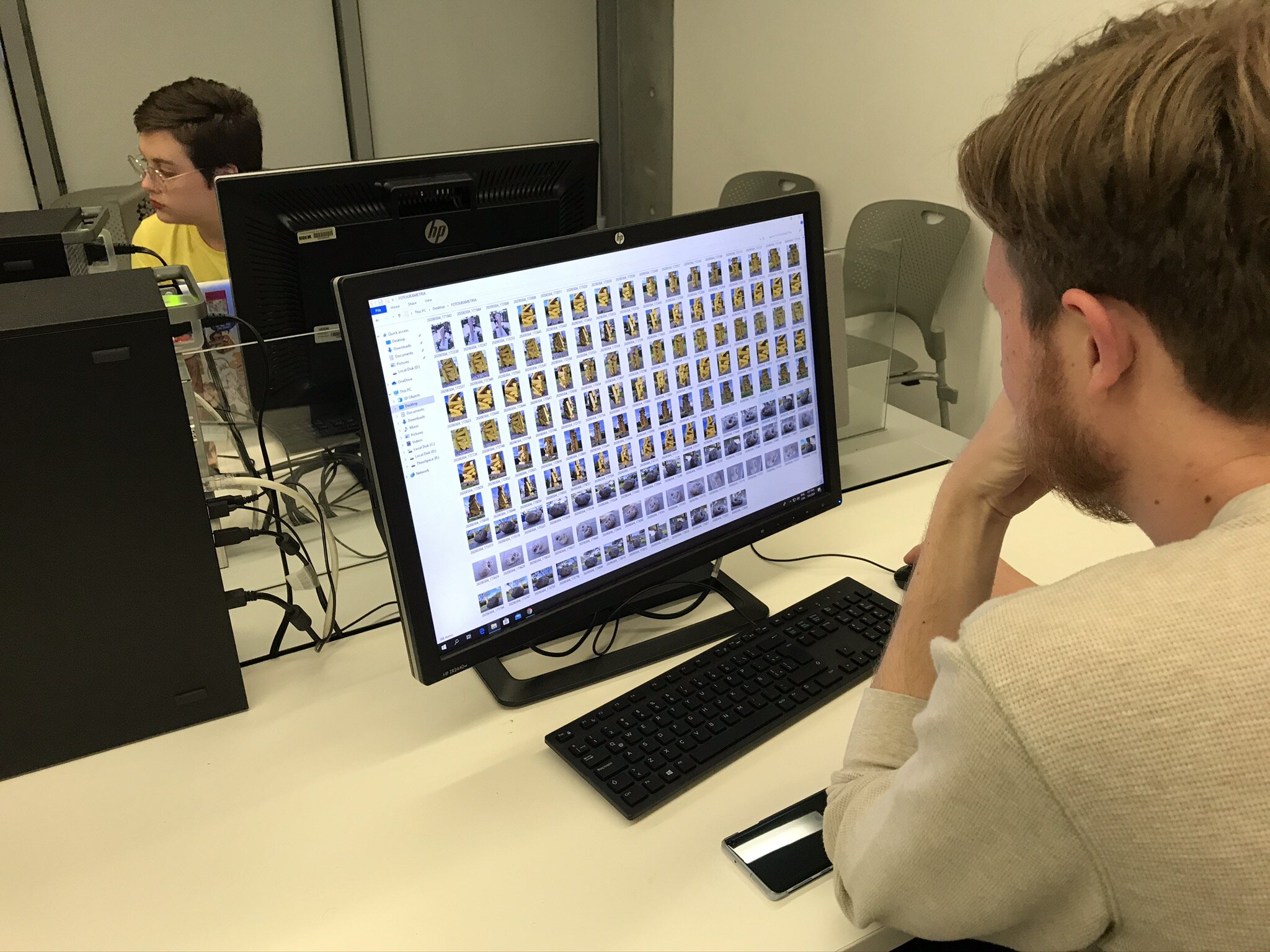
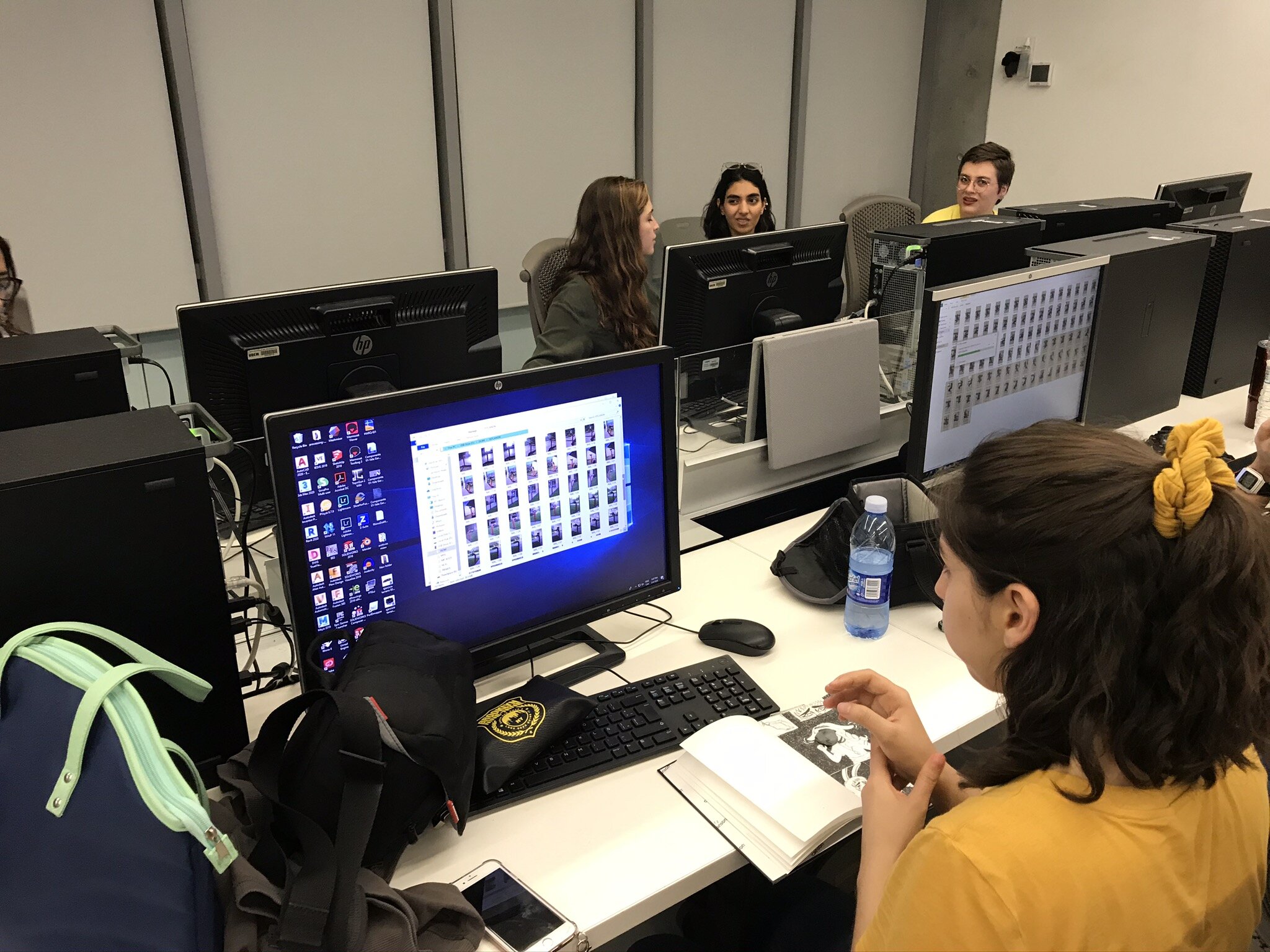
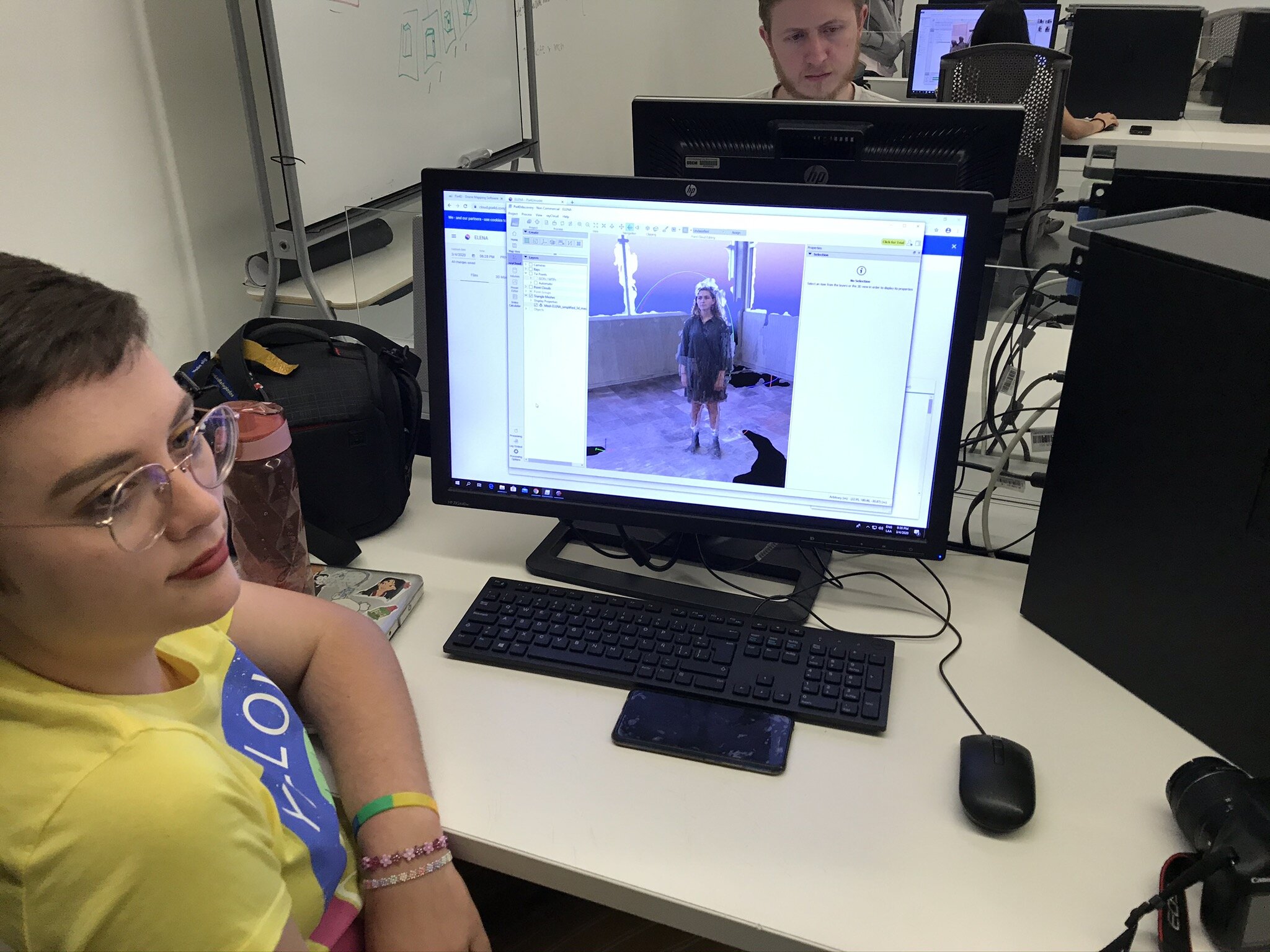
Photogrammetry workshop at UDEM (Monterrey)

UDEM Report_Page_3.jpg

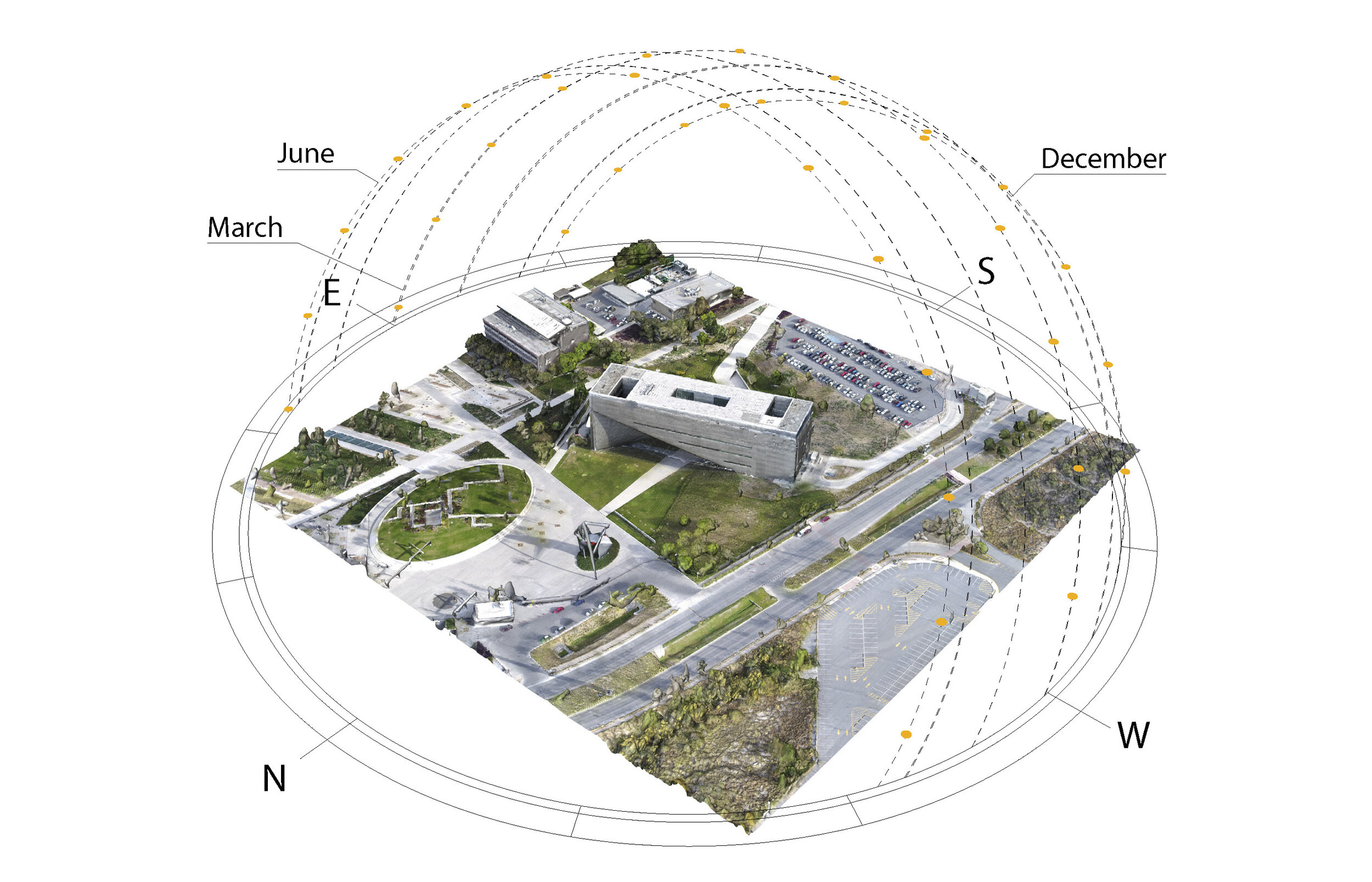
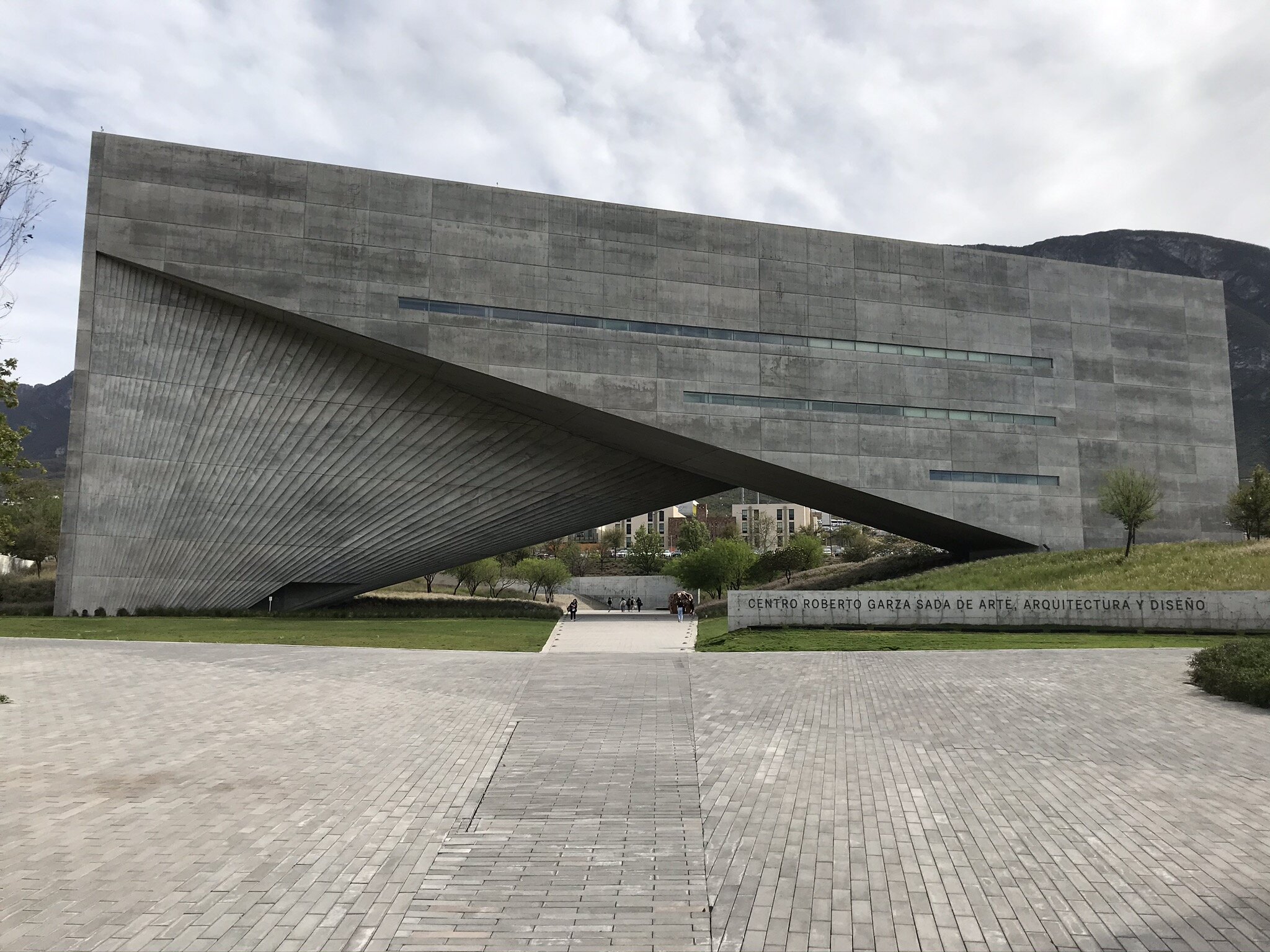
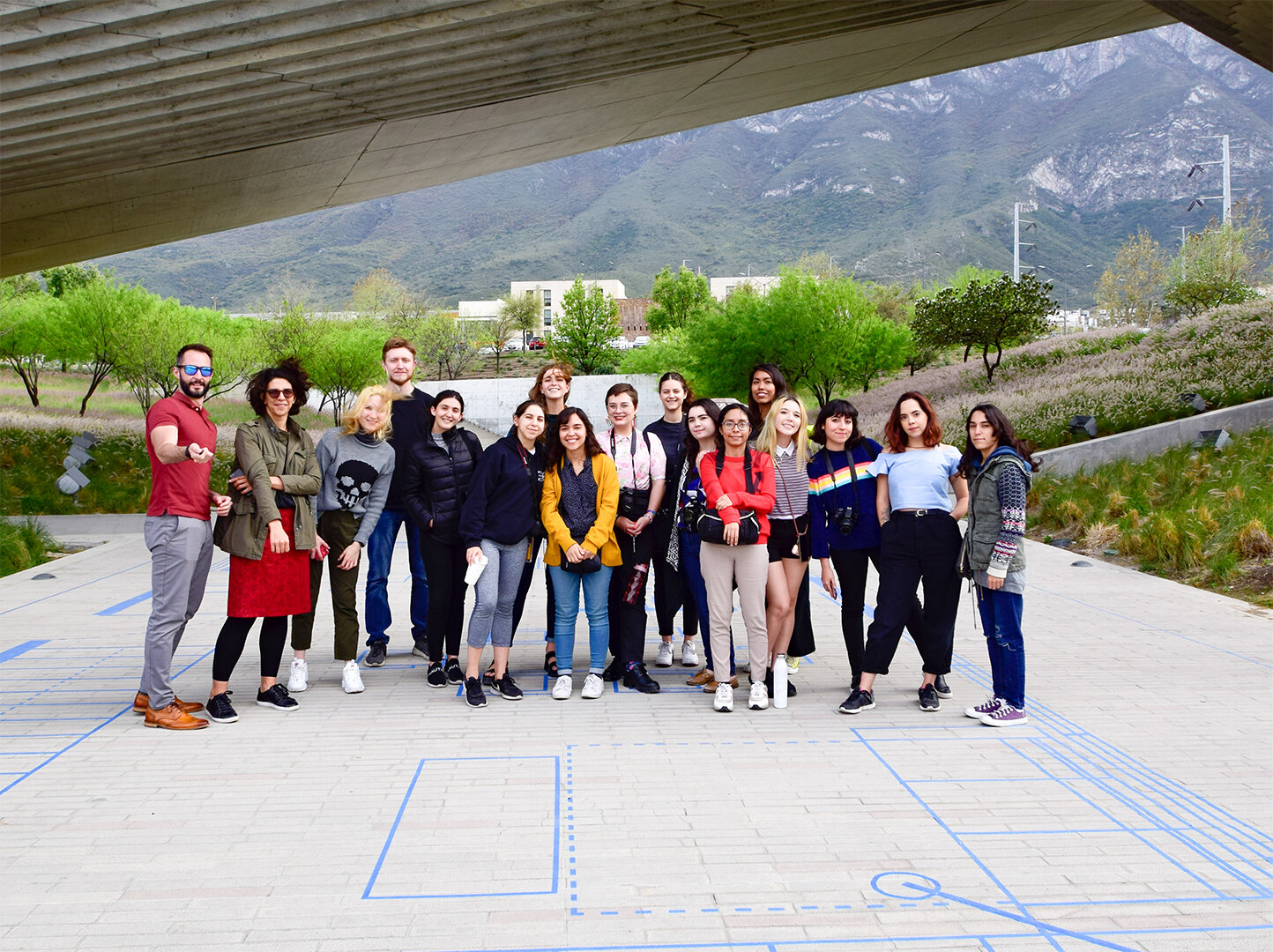
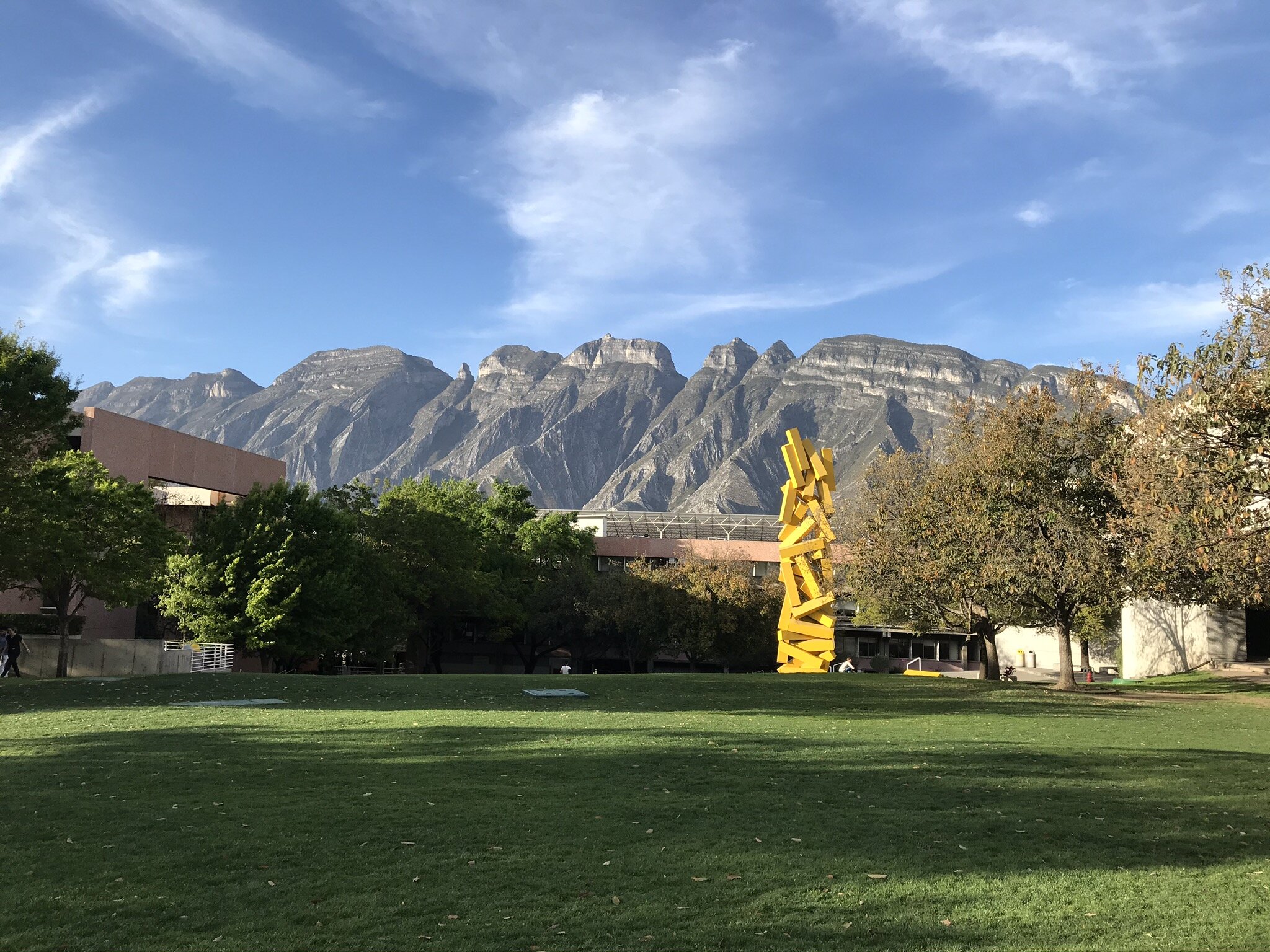
Universidad de Monterrey (UDEM) // Centro Roberto Garza Sada (CRGS) de Arte, Arquitectura y Diseño - UDEM // 3, 4 y 5 de marzo 2020

El taller transcurrió en tres sesiones en las que trabajamos diferentes técnicas fotogramétricas con los estudiantes, para capturar exteriores e interiores de unos de los edificios más emblemáticos del Campus de la UDEM: El CRGS. Construido y diseñado por el arquitecto Tadao Ando.

Fotogrametría aérea con Dron

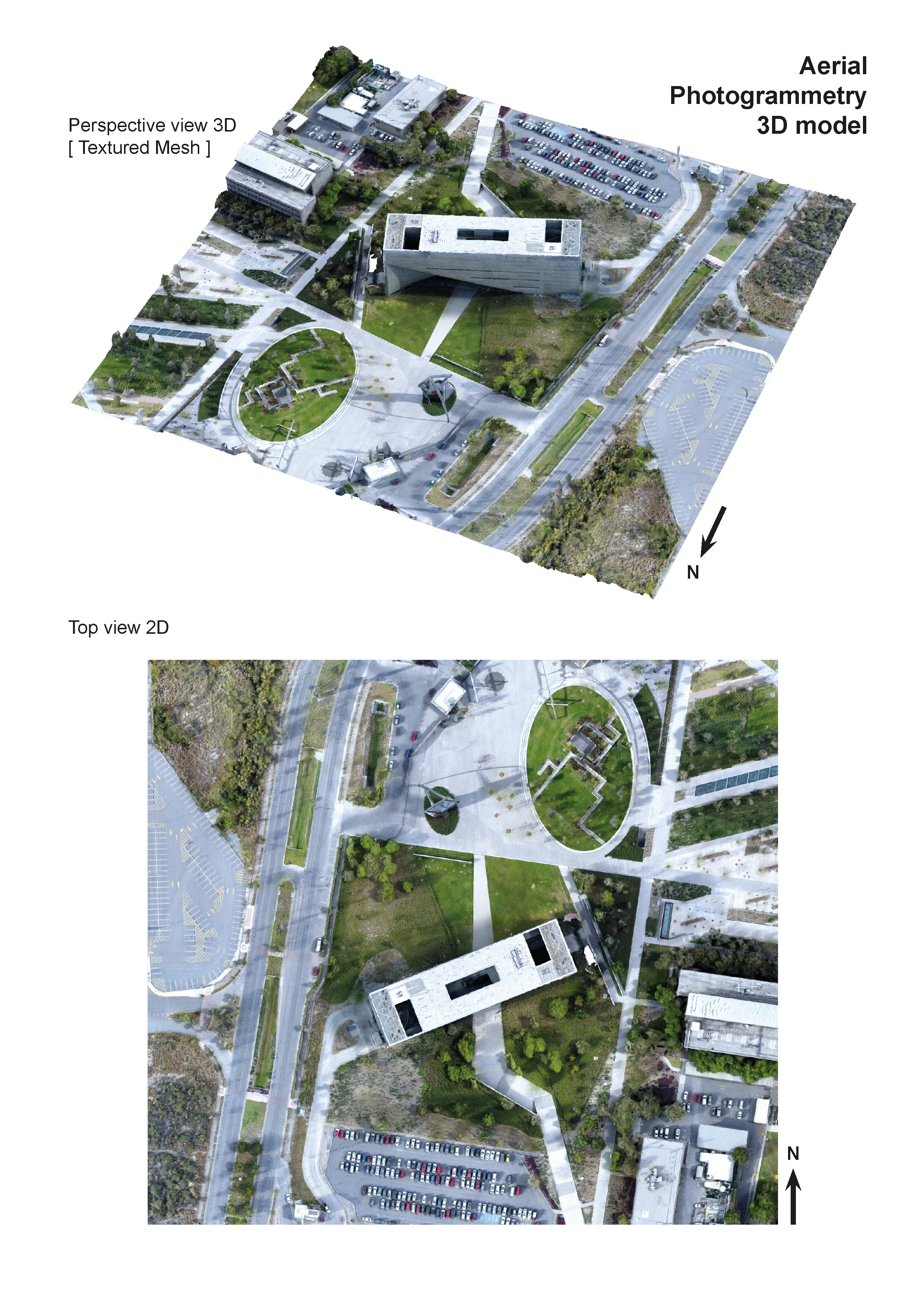
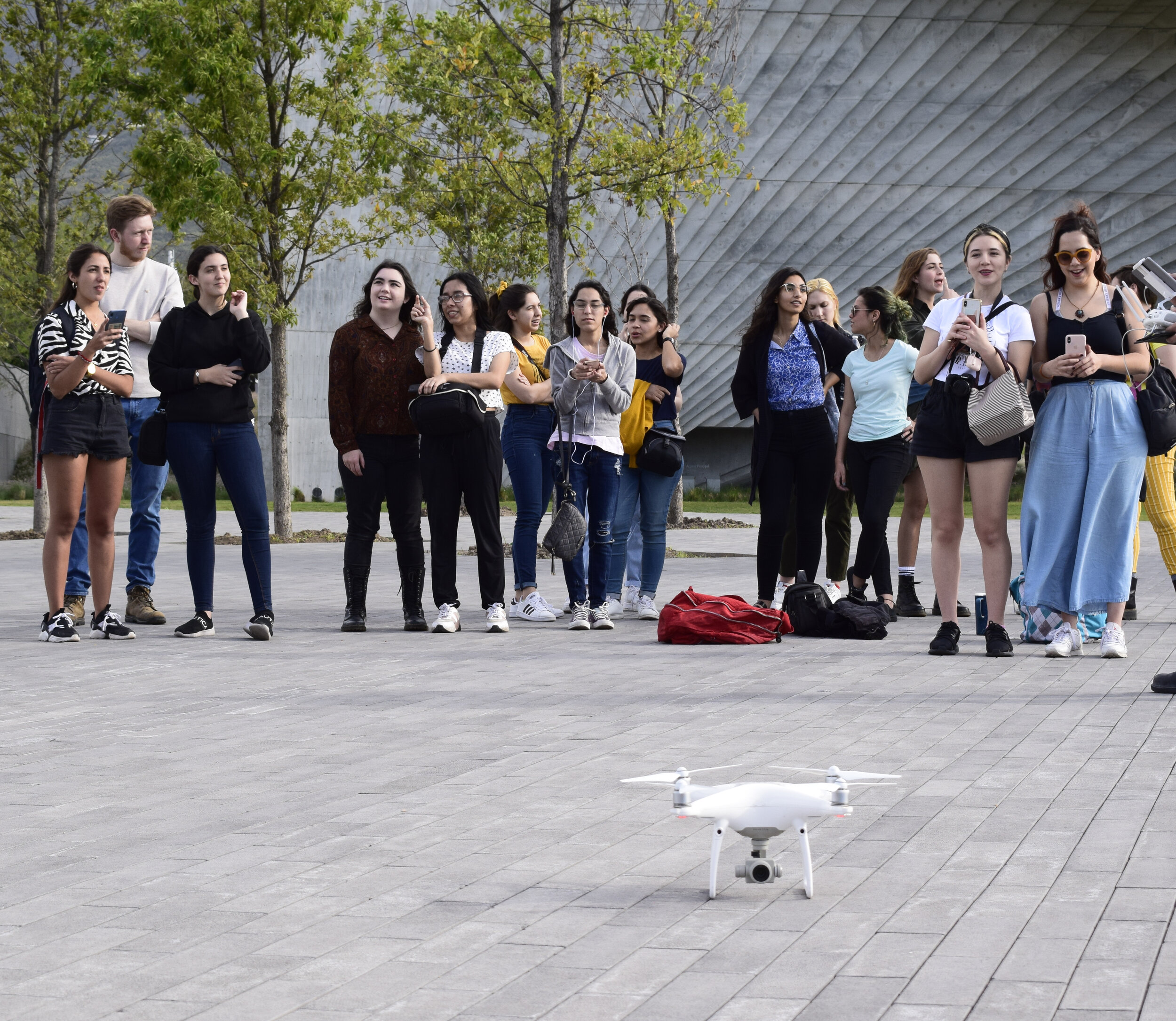
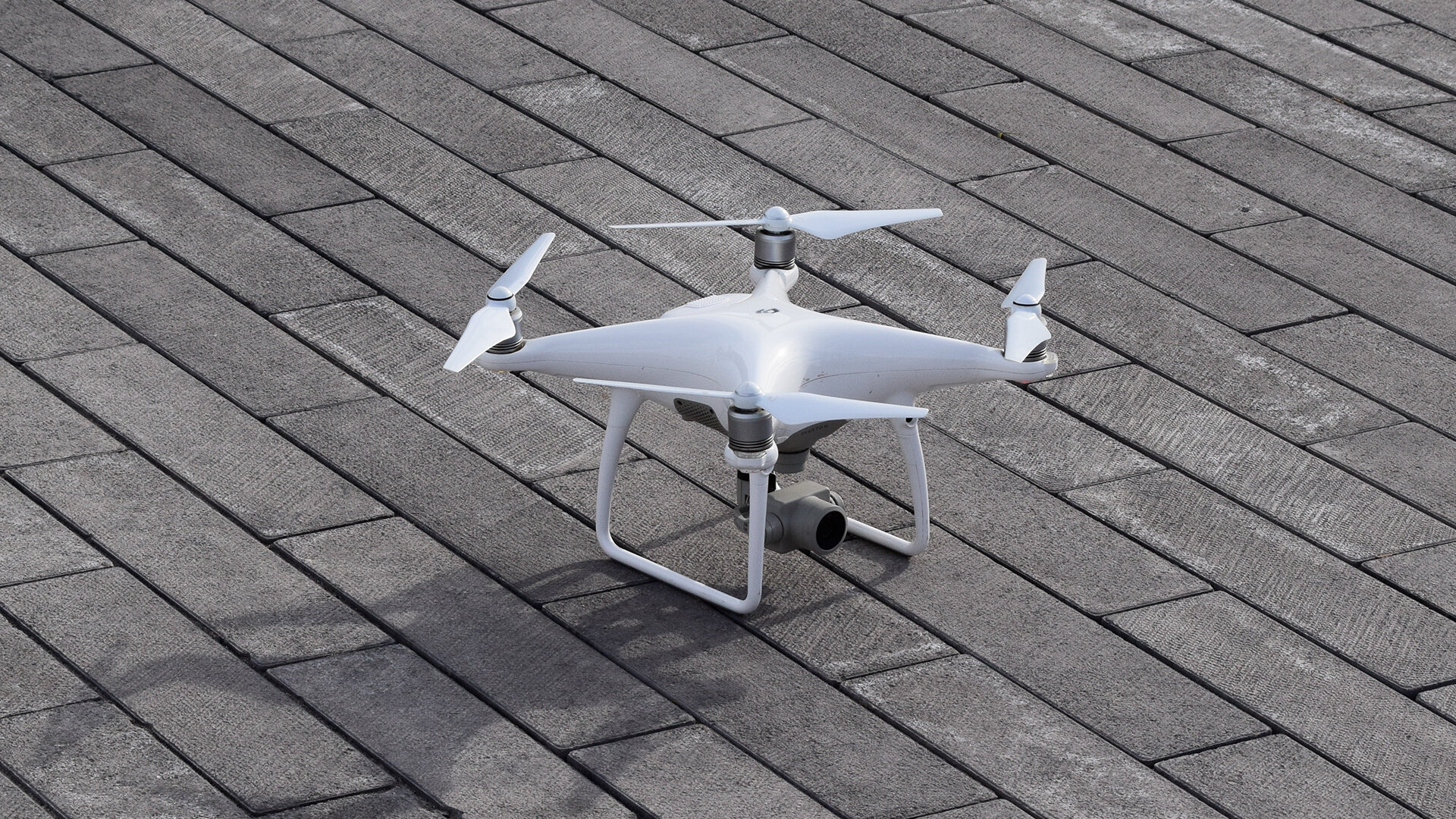
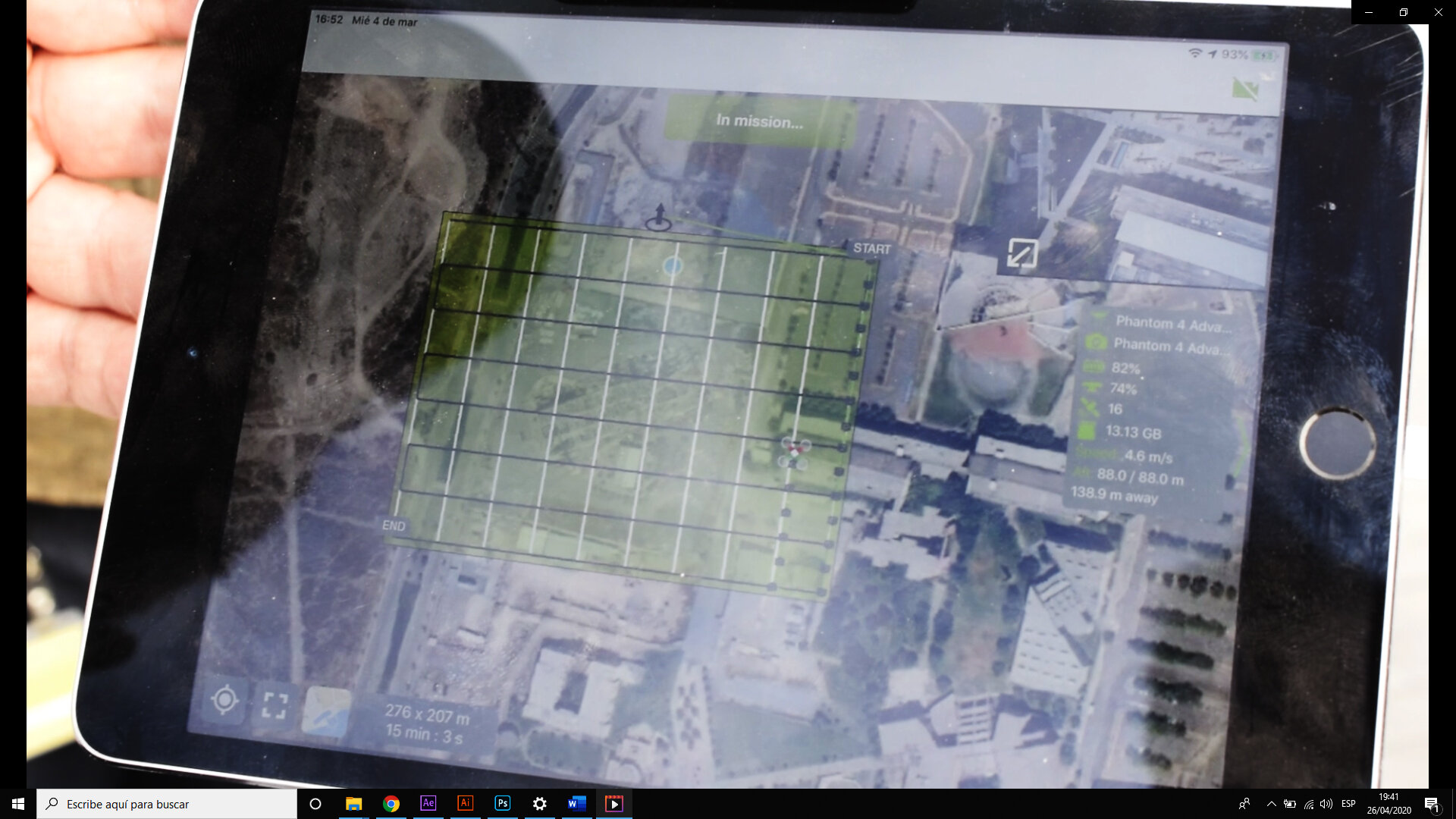
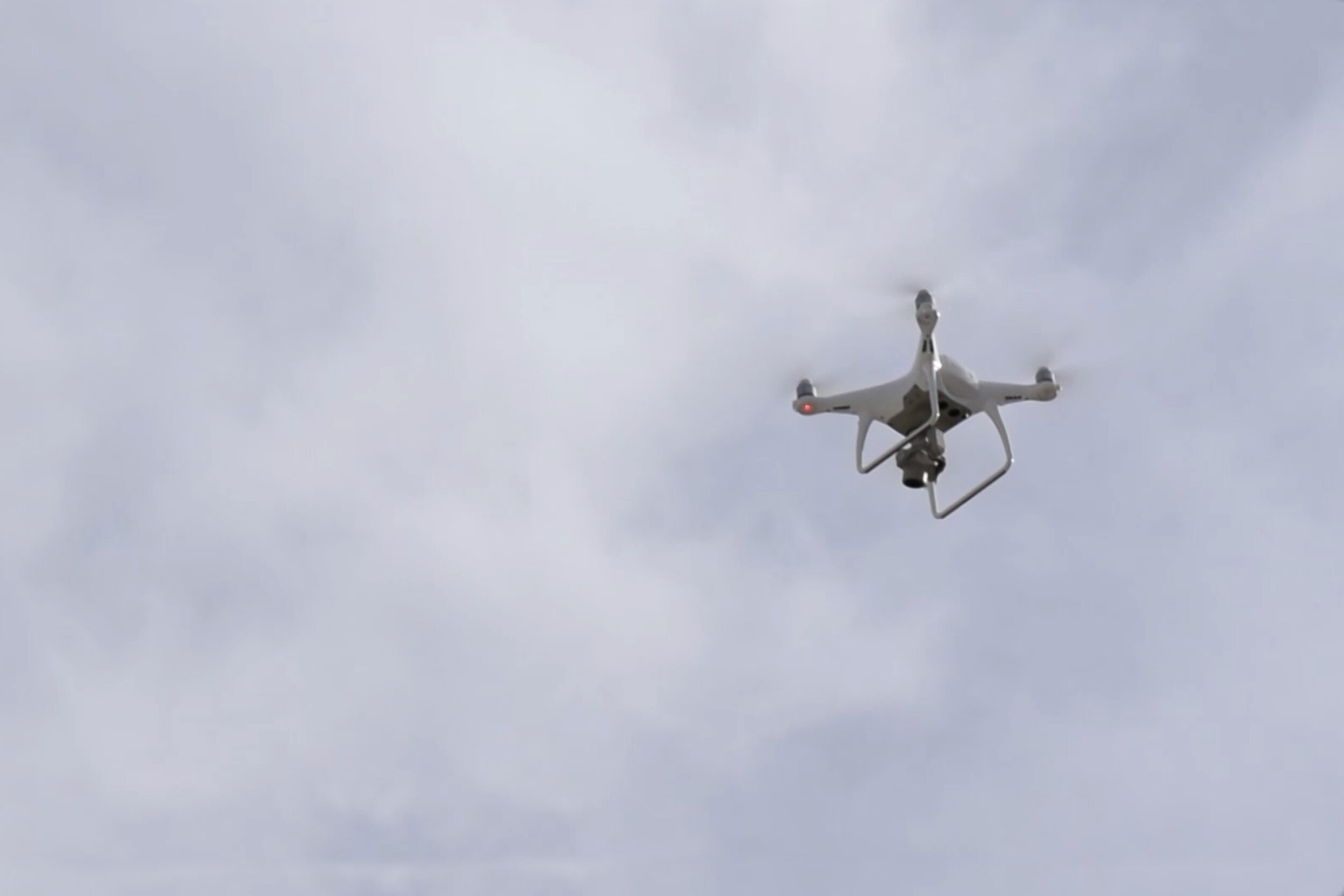
Para esta sesión inicial contamos con un dron manejado de forma autónoma con el que tomamos alrededor de 500 imágenes con las que posteriormente ensamblaríamos el modelo 3D. El dron se concreta a una aplicación que lo controla desde el despegue hasta el aterrizaje y realiza la toma de imágenes en una secuencia organizada, El vuelo sigue trayectoria en zig-zag sobre el entorno a escanear, a una altura de 80 metros para salvar todos los posibles obstáculos con los que pudiese colisionar.

Capturas de contexto real

Hicimos una salida de campo de donde trabajamos con los estudiantes en las capturas de elementos que pudieran ser encontrados en espacios exteriores, e interiores. por las inmediaciones del campus observando y fotografiando entornos y elementos que encontramos a nuestro paso y más tarde trabajamos los materiales en el PC.

Caputras aéreas con Dron

Para esta sesión contamos con un dron manejado de forma autónoma a través de una aplicación para la Tablet, con el que tomamos alrededor de 200 imágenes para posteriormente ensamblar un modelo 3D a partir de ellas. La aplicación programa el vuelo del dron y lo controla desde el despegue hasta el aterrizaje realizando la toma de imágenes en una manera secuencial organizada, El vuelo sigue una trayectoria en zig-zag sobre el entorno a escanear, a una altura de 80 metros para salvar todos los posibles obstáculos con los que pudiera colisionar.

Imágenes panorámicas 360

Durante el tercer día de workshop trabajamos con los estudiantes el tema de la composición de imágenes para generar esferas fotográficas 360, ensamblando múltiples tomas desde diferentes ángulos. Este tipo de técnica fotografía es ampliamente utilizado para capturar contextos y generar Tours virtuales, navegando de una imagen a otra, visualizándolas cómo si estuviéramos dentro del entorno fotografiado. Desde la industria inmobiliaria a la museográfica, pasando por el cine y los estudios de visualización arquitectónica, todas ellos utilizan estas técnicas para crear experiencias envolventes e inversivas. Para ejecutar imágenes de alta resolución y calidad es necesario un equipamiento fotográfico especiales. Con el podemos conseguir modelos de alta alta calidad que pueden ser compartidos de manera online, para navegar por ellos y promocionar lugares, eventos especiales o proyectos culturales creativos. Las posibilidades de aplicación son infinitas y están abiertas a las características de cada proyecto.

Para ver un ejemplo haz clic en el link bajo estas líneas.